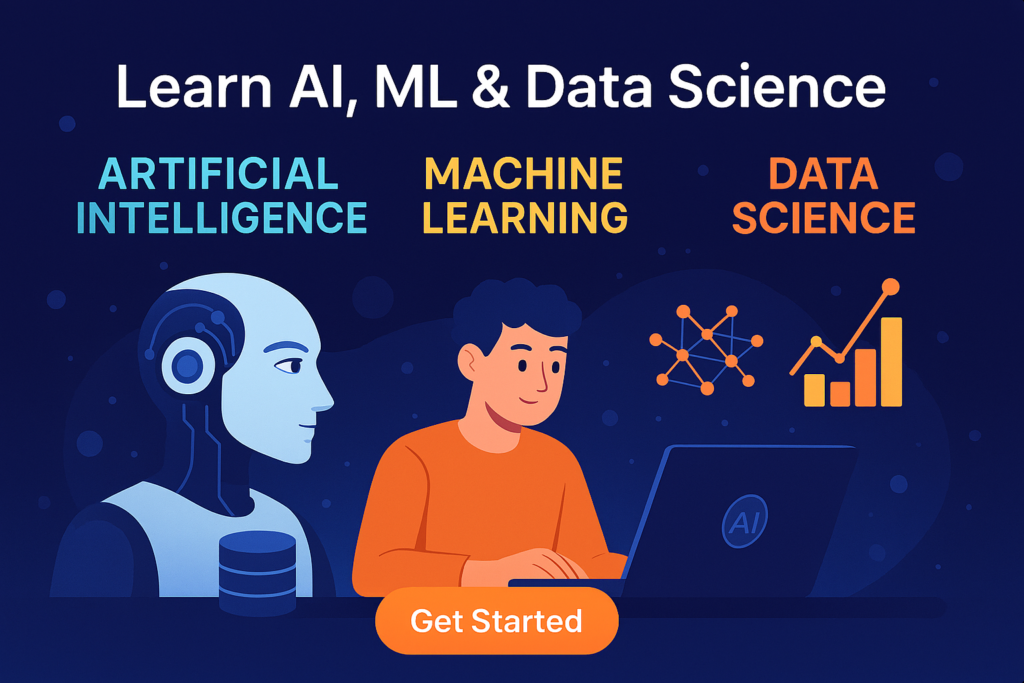
🌟 The Power Trio: Artificial Intelligence, Machine Learning & Data Science
A Young Learner’s Guide to the Technologies Shaping Tomorrow
We live in a world where technology doesn’t just support our lives—it defines them. From the apps we use to the way we learn, shop, travel, and even receive healthcare, intelligent systems are quietly working behind the scenes. At the heart of this transformation are three interconnected fields: Artificial Intelligence (AI), Machine Learning (ML), and Data Science.
For young learners, these aren’t just buzzwords—they’re the building blocks of the future. Whether you’re in high school, college, or just starting your tech journey, understanding these domains will open doors to innovation, creativity, and career opportunities that didn’t exist a decade ago.
🤖 What Is Artificial Intelligence?
Artificial Intelligence is the science of making machines think and act like humans. It’s about building systems that can understand, reason, learn, and make decisions.
Key Concepts:
- Intelligent Agents
- Natural Language Processing (NLP)
- Computer Vision
- Expert Systems
Real-World Examples:
- Voice assistants like Siri and Alexa
- AI-powered recommendation engines on Netflix
- Autonomous vehicles and drones
- Smart home devices that learn your habits
📈 What Is Machine Learning?
Machine Learning is a subset of AI that focuses on teaching machines to learn from data. Instead of being explicitly programmed, ML models improve themselves through experience.
Types of ML:
- Supervised Learning
- Unsupervised Learning
- Reinforcement Learning
Tools & Languages:
- Python (scikit-learn, TensorFlow, PyTorch)
- Jupyter Notebooks
- Google Colab
📊 What Is Data Science?
Data Science is the art of extracting insights from data. It combines statistics, programming, and domain knowledge to solve complex problems.
Core Skills:
- Data Cleaning & Wrangling
- Visualization
- Statistical Analysis
- Machine Learning Integration
Popular Tools:
- Pandas, NumPy, Matplotlib
- SQL
- Tableau and Power BI
🎓 Why Young Learners Should Care
- Early Exposure = Future Readiness
- Creative Problem Solving
- Career Opportunities
- Cross-Disciplinary Impact
🧠 How These Fields Are Shaping Education
- Personalized Learning
- Intelligent Tutoring Systems
- Gamification & Engagement
- Data-Driven Insights for Teachers
🌍 The Future of Technology: What’s Coming Next?
- AI + Robotics
- ML in Climate Science
- Data Science in Social Good
- AI in Creativity
🛠️ Getting Started: A Roadmap for Young Learners
- Learn the Basics: Start with Python and explore free platforms like Kaggle, Coursera, and edX.
- Build Projects: Chatbots, movie recommenders, sports analytics.
- Join Communities: Hackathons, forums, social media groups.
- Stay Curious: Ask questions, explore, and experiment.
💬 Voices of Young Innovators
“I built my first ML model in high school—it predicted student grades based on study hours. Now I’m working on an AI app to help kids learn math.” — Riya, 17
“Data Science helped me understand how social media trends work. I used it to analyze meme popularity and built a dashboard for it!” — Arjun, 19
🔮 Final Thoughts: You Are the Future
Artificial Intelligence, Machine Learning, and Data Science aren’t just for tech giants—they’re for you. The next breakthrough could come from a teenager in Delhi, a college student in Bengaluru, or a self-taught coder in a small town.
If you’re curious, creative, and ready to learn, these fields will empower you to shape the world—not just adapt to it.