
🎯 Ultimate AI Learning Guide 2025: Top YouTube Resources & Career Roadmap
🎬 TOP 10 YOUTUBE CHANNELS FOR AI LEARNING IN 2025
1. DeepLearning.AI (Andrew Ng)
Subscribers: ~850K+ | Level: Beginner to Advanced
Andrew Ng’s platform provides comprehensive AI education through courses ported from Coursera, featuring 40+ video playlists covering Machine Learning Specialization, Machine Learning Engineering for Production, and regular livestreams on topics like reading AI research papers effectively DecodingdatascienceTech.co.
Best For: Structured learning paths, university-quality education for free
2. Two Minute Papers
Level: All Levels | Focus: Research Updates
This channel excels at condensing complex AI research into digestible two-minute summaries, making cutting-edge topics accessible Decodingdatascience. Perfect for staying current with breakthrough developments in AI, computer graphics, and machine learning.
Best For: Quick AI research updates, understanding latest breakthroughs
3. Sentdex (Harrison Kinsley)
Subscribers: ~1.2M+ | Level: Beginner to Intermediate
Harrison Kinsley, a software developer and data scientist, provides hands-on coding lessons with real projects, making it ideal for beginners wanting practical AI implementation experience DecodingdatascienceAnalytics Vidhya.
Best For: Python programming, hands-on machine learning tutorials, practical projects
4. 3Blue1Brown
Level: Intermediate to Advanced
This channel breaks down the mathematics behind AI with clear, engaging visuals, essential for grasping machine learning concepts Decodingdatascience. Focuses on the algebra and calculus foundations of neural networks.
Best For: Understanding mathematical foundations, neural network mechanics
5. Lex Fridman Podcast
Subscribers: ~3M+ | Level: All Levels
Lex’s podcast-style videos feature top AI minds, offering insights into the field’s future and applications Decodingdatascience. Includes interviews with researchers, CEOs, and thought leaders in AI.
Best For: Industry insights, AI philosophy, future trends, networking perspectives
6. Yannic Kilcher
Level: Advanced
Yannic provides deep dives into research papers with detailed critiques and explanations, ideal for intermediate to advanced learners seeking technical depth Decodingdatascience.
Best For: Research paper analysis, advanced ML concepts, technical critiques
7. Andrej Karpathy
Subscribers: ~220K+ | Level: Intermediate to Advanced
Known for his work at OpenAI and Tesla, his channel dives into Large Language Models with detailed analysis, including a comprehensive 3.5-hour ChatGPT breakdown Decodingdatascience.
Best For: LLM architecture, deep technical understanding, AI from industry experts
8. Krish Naik
Subscribers: ~1M+ | Level: Intermediate to Advanced
Krish’s warm demeanor and mentoring background make complex topics accessible, with countless tutorials on machine learning, deep learning, and data science, including building LLM pipelines and fine-tuning generative AI models HyperWrite.
Best For: ML/DL tutorials, GenAI applications, project-based learning
9. Siraj Raval
Subscribers: ~750K+ | Level: Beginner to Intermediate
Known for energetic, project-based tutorials that simplify AI and ML coding in Python, with infectious enthusiasm that makes learning AI accessible for those with little technical background DigitalOceanHyperWrite.
Best For: Beginner-friendly AI projects, motivational learning, creative AI applications
10. The AI Advantage
Level: Beginner to Intermediate
Provides step-by-step tutorials focused on real-world applications, teaching how to leverage AI for competitive business advantage and productivity workflows DigitalOceanKDnuggets.
Best For: Practical AI tools, no-code solutions, business applications
🎯 COMPLETE AI CAREER ROADMAP FOR 2026
📊 MARKET OUTLOOK
In the United States, approximately 50% of technology job postings now demand AI-related skills, representing a 98% increase year-over-year, while India’s demand for AI professionals is projected to reach 1 million by 2026 Scaler.
Job growth for AI Engineer roles increased by 143%, and Prompt Engineer roles by 135% year-on-year Scaler.
PHASE 1: FOUNDATIONS (Months 1-2)
Mathematics & Statistics
- Linear Algebra (matrices, vectors, eigenvalues)
- Calculus (derivatives, gradients, optimization)
- Probability & Statistics (distributions, hypothesis testing)
- Resources: 3Blue1Brown, Khan Academy
Programming Fundamentals
- Python mastery (NumPy, Pandas, Matplotlib)
- Data structures and algorithms
- Version control (Git/GitHub)
- Practice: LeetCode, HackerRank (50+ problems)
Data Skills
- SQL for data manipulation
- Data cleaning and preprocessing
- Exploratory Data Analysis (EDA)
- Data visualization techniques
PHASE 2: MACHINE LEARNING (Months 3-4)
Core ML Concepts
- Supervised Learning (regression, classification)
- Unsupervised Learning (clustering, dimensionality reduction)
- Model evaluation and validation
- Feature engineering
Key Algorithms
- Linear/Logistic Regression
- Decision Trees & Random Forests
- Support Vector Machines
- K-Means, PCA
Tools & Frameworks
- Scikit-learn (primary ML library)
- Jupyter Notebooks
- MLflow for experiment tracking
Projects to Build
- House price prediction
- Customer segmentation
- Fraud detection system
- Recommendation engine
PHASE 3: DEEP LEARNING (Months 4-5)
Choose one deep learning framework to begin with, either TensorFlow (famous for scalability) or PyTorch (well-liked for flexibility and experimentation) Medium.
Neural Networks
- Feedforward neural networks
- Backpropagation and optimization
- Activation functions and regularization
- CNNs for Computer Vision
- RNNs/LSTMs for sequences
- Transformers architecture
Specialized Areas
- Computer Vision: Image classification, object detection (YOLO, R-CNN)
- NLP: Text classification, sentiment analysis, language models
- Generative AI: GANs, VAEs, Diffusion Models
Advanced Projects
- Image classifier with PyTorch/TensorFlow
- Object detection system
- Chatbot using transformers
- Style transfer application
PHASE 4: GENERATIVE AI & LLMs (Month 5)
Master Large Language Models including how they generate human-like text, understand Transformers and Attention Mechanisms behind models like BERT, GPT, and T5, and learn RLHF (Reinforcement Learning with Human Feedback) to help models respond as humans expect IABAC®.
Key Technologies
- OpenAI API, Anthropic Claude API
- Hugging Face Transformers
- LangChain for LLM applications
- Vector databases (Pinecone, Weaviate)
- RAG (Retrieval Augmented Generation)
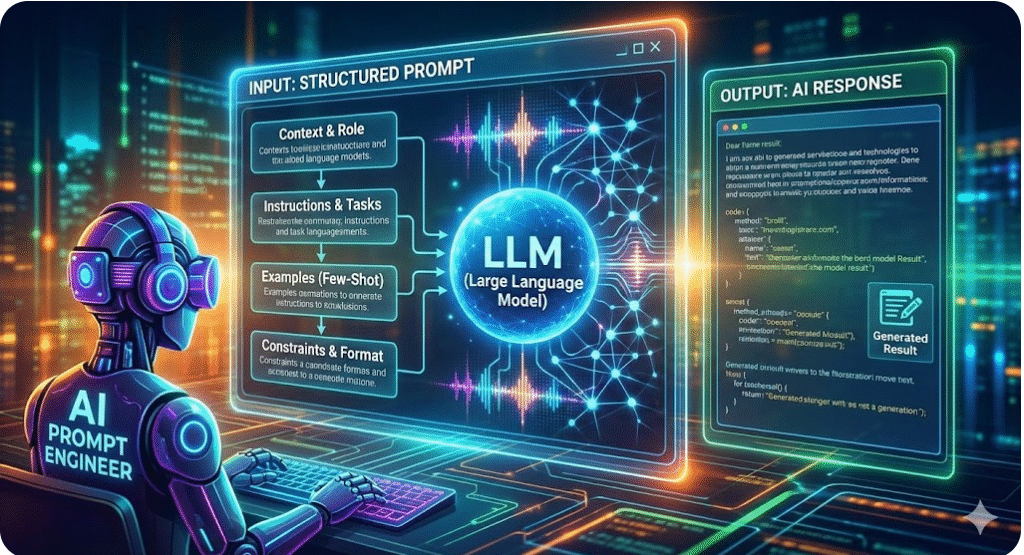
Prompt Engineering
- Prompt design patterns
- Few-shot learning
- Chain-of-thought prompting
Projects
- Custom chatbot with RAG
- Document Q&A system
- AI content generation tool
- Personal AI assistant
PHASE 5: MLOps & DEPLOYMENT (Month 6)
Companies now seek professionals who can both train and deploy models efficiently, requiring skills in MLOps tools like MLflow and Docker Scaler.
Production Skills
- Docker containerization
- API development (FastAPI, Flask)
- Cloud platforms (AWS, GCP, Azure)
- Model serving (TensorFlow Serving, TorchServe)
- CI/CD pipelines
- Model monitoring and maintenance
Essential Tools
- Docker & Kubernetes
- MLflow or Weights & Biases
- GitHub Actions
- Cloud services (EC2, S3, Lambda)
🎓 ESSENTIAL SKILL STACK FOR 2026
The hybrid specialist who can straddle ML, Deep Learning, GenAI, MLOps, and API integration represents what’s currently needed in the market Scaler.
Core Technologies:
- Languages: Python, SQL
- ML/DL: PyTorch/TensorFlow, Scikit-learn
- GenAI: LangChain, Hugging Face, OpenAI/Anthropic APIs
- MLOps: Docker, MLflow, Kubernetes
- Cloud: AWS/GCP/Azure
- Tools: Git, Jupyter, VS Code
💼 TOP AI CAREER PATHS FOR 2026
The AI job market encompasses 13 major career paths set to explode by 2026, ranging from deep technical roles to creative and ethical positions The Cloud Girl:
- Data Engineer – Build data pipelines ($100K-$140K)
- Data Scientist – Extract insights ($110K-$150K)
- Machine Learning Engineer – Deploy ML models ($120K-$180K)
- AI Research Scientist – Advance AI research ($130K-$200K+)
- NLP Engineer – Language AI systems ($110K-$160K)
- Computer Vision Engineer – Visual AI ($115K-$170K)
- MLOps Engineer – Production AI systems ($120K-$165K)
- AI Product Manager – AI strategy ($130K-$180K)
- Prompt Engineer – LLM optimization ($90K-$150K)
- AI Ethics Specialist – Responsible AI ($100K-$145K)
🚀 ACTION STEPS TO START TODAY
Week 1-2:
- Choose your primary YouTube channels (start with DeepLearning.AI + Two Minute Papers)
- Set up Python environment and GitHub account
- Complete a Python basics course
- Start daily coding practice (30 minutes minimum)
Month 1:
- Mathematics refresher (Khan Academy + 3Blue1Brown)
- Build 3 simple Python projects
- Learn Pandas and NumPy
- Join AI communities (Reddit r/MachineLearning, Discord servers)
Ongoing:
- Build portfolio on GitHub (minimum 10 projects)
- Write technical blog posts
- Participate in Kaggle competitions
- Network on LinkedIn with AI professionals
- Attend AI meetups and webinars
📚 SUPPLEMENTARY RESOURCES
Free Courses:
- Fast.ai – Practical Deep Learning
- Google’s Machine Learning Crash Course
- Stanford CS229 (YouTube)
Practice Platforms:
- Kaggle (competitions + datasets)
- Google Colab (free GPU)
- Hugging Face Spaces
Communities:
- AI Discord servers
- Twitter/X AI community
- LinkedIn AI groups
Top 10 AI YouTube Channels – Direct Links
- DeepLearning.AI – youtube.com/@Deeplearningai
- Two Minute Papers – youtube.com/@TwoMinutePapers
- Sentdex – youtube.com/@sentdex
- 3Blue1Brown – youtube.com/@3blue1brown
- Lex Fridman Podcast – youtube.com/@lexfridman
- Yannic Kilcher – youtube.com/@YannicKilcher
- Andrej Karpathy – youtube.com/@AndrejKarpathy
- Krish Naik – youtube.com/@krishnaik06
- Siraj Raval – youtube.com/@SirajRaval
- The AI Advantage – youtube.com/@aiadvantage
Bonus Channels Worth Following:
- StatQuest – youtube.com/@statquest
- freeCodeCamp.org – youtube.com/@freecodecamp
- Google DeepMind – youtube.com/@Google_DeepMind
- Stanford Online – youtube.com/@stanfordonline
- IBM Technology – youtube.com/@IBMTechnology
⚡ FINAL TIPS FOR SUCCESS
- Consistency Over Intensity: 2 hours daily beats 14 hours on weekends
- Build in Public: Share your learning journey on social media
- Project-First Approach: Learn by building, not just watching
- Stay Current: AI changes rapidly—follow latest research
- Network Actively: Attend virtual conferences and meetups
- Ethical Foundation: Learn transparency, fairness, sustainability, and lifecycle governance as these principles will be critical by 2026 IABAC®
The AI revolution is happening NOW. Start today, stay consistent, and you’ll be ready for the incredible opportunities in 2026! 🚀