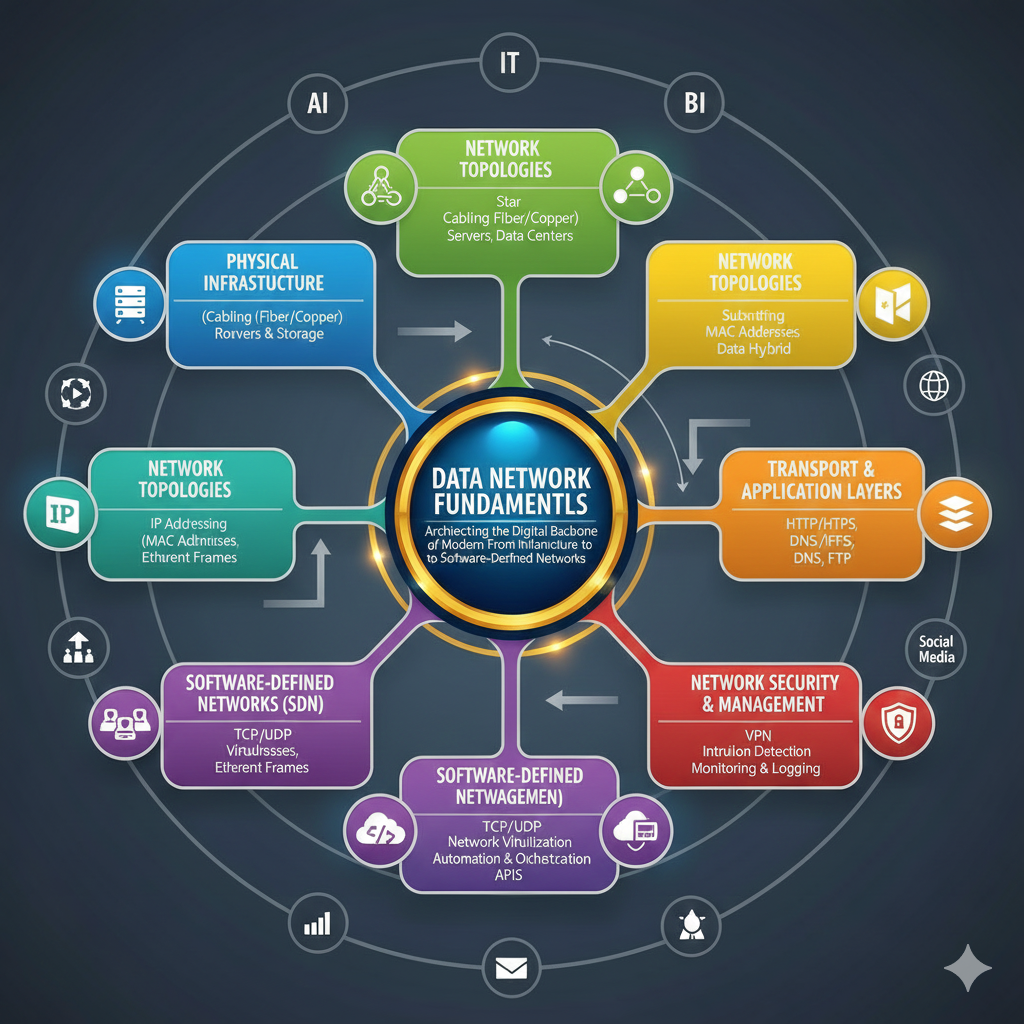

DATA NETWORK FUNDAMENTALS Architecting the Digital Backbone of Modern Enterprise From Physical Infrastructure to Software-Defined Networks
🌐 DATA NETWORK FUNDAMENTALS
Architecting the Digital Backbone of Modern Enterprise
From Physical Infrastructure to Software-Defined Networks
1. Executive Overview: The Foundation of Digital Transformation
Data networks form the circulatory system of our digital civilization, carrying petabytes of information across global infrastructure connecting billions of devices. From submarine fiber optic cables spanning oceans to millimeter-wave 5G signals connecting smartphones, from massive data center fabrics to edge computing nodes, networking technology enables every aspect of modern computing, communication, and commerce. Understanding network fundamentals has never been more critical as we transition from traditional hardware-centric architectures to software-defined, cloud-native, AI-optimized network infrastructures.
1. Routers: Inter-Network Intelligence
Hardware Architecture
- Control Plane: CPU, memory, routing protocol processing, management interfaces running network operating system (IOS-XR, Junos, SR Linux). Makes routing decisions and builds forwarding tables
- Data Plane (Forwarding Plane): ASICs, NPUs, TCAM hardware performing high-speed packet forwarding based on routing table lookups. Operates at line rate without CPU involvement
- Modular Chassis: Enterprise routers (Cisco ASR, Juniper MX) feature hot-swappable line cards, route processors, fabric modules supporting terabit-scale forwarding capacity
- Interfaces: Diverse port types including Ethernet (1G, 10G, 25G, 40G, 100G, 400G), serial, optical transceivers (SFP, QSFP), supporting various media and distance requirements
- Memory Hierarchy: DRAM for routing tables, TCAM for fast lookups, flash for OS storage, NVRAM for configuration persistence
Router Software Components
- Network Operating Systems: Cisco IOS/IOS-XE/IOS-XR, Juniper Junos, Nokia SR OS, Arista EOS providing CLI, routing protocols, management capabilities
- Routing Protocol Daemons: Separate processes for OSPF, BGP, IS-IS, EIGRP, RIP implementing protocol logic and maintaining neighbor relationships
- Routing Information Base (RIB): Master routing table containing all routes learned from various protocols, with best path selection based on administrative distance
- Forwarding Information Base (FIB): Optimized subset of RIB programmed into hardware for fast packet forwarding decisions
- Management Plane: SSH, SNMP, NETCONF, RESTCONF, gRPC interfaces for configuration, monitoring, and automation
Enterprise Router Categories
- Edge Routers: Border devices connecting enterprise to internet/WAN (Cisco ASR 1000, Juniper MX series) supporting BGP, MPLS, encryption, DDoS mitigation
- Core Routers: High-capacity backbone devices (Cisco CRS, Juniper PTX, Nokia FP) providing terabit switching fabrics for carrier and large enterprise networks
- Branch Routers: Integrated services routers (Cisco ISR, Juniper SRX) combining routing, switching, security, wireless for remote offices
- Virtual Routers: Software implementations (Cisco CSR 1000v, Juniper vMX, VyOS) running in virtualized or cloud environments
2. Switches: Local Network Fabric
Switching Technologies
- Layer 2 Switches: MAC address-based forwarding within VLANs using content addressable memory (CAM) tables, operating at wire speed with microsecond latencies
- Layer 3 Switches: Combined switching and routing capabilities performing inter-VLAN routing in hardware using ternary CAM (TCAM) for IP lookups
- Multilayer Switches: Advanced platforms (Cisco Catalyst 9000, Juniper EX, Arista 7000) integrating routing protocols, ACLs, QoS, and application awareness
- Data Center Switches: High-density leaf-spine architectures (Arista 7500, Cisco Nexus 9000, Juniper QFX) supporting VXLAN overlays, EVPN, 400GbE optics
Switch Hardware Features
- Port Density: Enterprise switches supporting 24-48 ports per unit with stacking capabilities aggregating multiple switches into single logical device
- Power over Ethernet (PoE): IEEE 802.3af/at/bt standards delivering power to IP phones, wireless access points, cameras through Ethernet cables
- Stacking Technology: High-speed backplane (Cisco StackWise, Juniper Virtual Chassis) creating unified management and forwarding plane across multiple physical switches
- Redundancy: Dual power supplies, hot-swappable fans, modular components ensuring continuous operation during component failures
Key Switch Protocols
- Spanning Tree Protocol (STP/RSTP/MSTP): Loop prevention in redundant Layer 2 topologies, blocking redundant paths while maintaining backup connectivity
- Link Aggregation (LACP): IEEE 802.3ad bundling multiple physical links into single logical connection for bandwidth aggregation and redundancy
- Virtual Trunking Protocol (VTP): Cisco proprietary VLAN management protocol synchronizing VLAN configurations across switches (use with caution in production)
- VLAN Trunking (802.1Q): Standard protocol carrying multiple VLANs over single physical link using VLAN tags in Ethernet frames
3. MPLS: Multi-Protocol Label Switching
MPLS Fundamentals
- Label-Based Forwarding: Layer 2.5 technology using short fixed-length labels instead of lengthy IP address lookups, enabling fast packet forwarding and traffic engineering
- Label Distribution Protocol (LDP): Automatic label distribution mechanism creating label-switched paths (LSPs) across MPLS networks without manual configuration
- Label Stack: Multiple labels pushed onto packets enabling hierarchical VPNs, traffic engineering tunnels, and QoS classifications in single packet
- Provider Edge (PE) Routers: Customer-facing MPLS routers handling VPN attachment, label imposition/disposition, and inter-AS routing
- Provider (P) Routers: Core MPLS devices performing label swapping at high speed without examining IP headers or VPN contexts
MPLS Applications
- Layer 3 VPNs (MPLS VPN/BGP MPLS VPN): Scalable multi-tenant IP VPN service using VRF instances and MP-BGP for route distribution across provider backbone
- Layer 2 VPNs (VPLS, VPWS): Virtual private LAN service and virtual private wire service providing Layer 2 connectivity across MPLS networks
- Traffic Engineering (MPLS-TE): Explicit path routing using RSVP-TE or PCEP creating constrained shortest path first (CSPF) tunnels for bandwidth optimization
- Fast Reroute (FRR): Sub-50ms failover protection using pre-computed backup paths activated immediately upon link or node failure detection
- Quality of Service: EXP bits in MPLS header enabling differentiated services and per-hop behaviors for voice, video, and data traffic classes
4. Gateways: Protocol Translation and Interconnection
Gateway Functions
- Default Gateway: Router interface serving as exit point from local subnet, typically first or last usable IP address in subnet range
- Protocol Gateways: Converting between different protocol stacks (IPv4/IPv6 translation, SIP/H.323 gateways, API gateways) enabling communication across incompatible systems
- Application Gateways: Layer 7 proxies providing protocol-specific intelligence, security inspection, content filtering, and load balancing for HTTP, FTP, SMTP
- VoIP Gateways: Connecting traditional PSTN telephony to IP networks, performing voice encoding, signaling translation (SIP, H.323, MGCP), and media processing
- IoT Gateways: Edge devices aggregating sensor data, protocol translation (Zigbee, LoRaWAN to IP), local processing, and cloud connectivity for industrial IoT deployments
5. Network Operating Systems and Software
Major Network OS Platforms
- Cisco IOS Family: IOS (legacy monolithic), IOS-XE (Linux-based with modularity), IOS-XR (carrier-grade high availability), NX-OS (data center fabric)
- Juniper Junos: FreeBSD-based unified OS across routing, switching, security platforms featuring consistent CLI and modular architecture
- Nokia SR OS: Service Router Operating System optimized for carrier networks with advanced MPLS, segment routing, and virtualization capabilities
- Arista EOS: Extensible Operating System built on Linux providing state-driven programmability, automation APIs, and cloud-native architecture
- Open Source Alternatives: VyOS, FRRouting, SONiC (Software for Open Networking in the Cloud), providing vendor-neutral network operating systems
Network Management Software
- Configuration Management: Ansible, Puppet, Chef, SaltStack enabling infrastructure-as-code practices with version control and automated deployment
- Monitoring Systems: Nagios, Zabbix, Prometheus, PRTG providing real-time visibility into network performance, availability, and capacity metrics
- Network Controllers: Cisco DNA Center, Juniper Contrail, VMware NSX orchestrating network policies, automation, and analytics across infrastructure
- Flow Analytics: NetFlow/sFlow/IPFIX collectors and analyzers (SolarWinds, Plixer, Kentik) providing traffic visibility for capacity planning and security
- Cisco: Market leader with extensive product portfolio, large talent pool, established ecosystem, but premium pricing and vendor lock-in concerns
- Juniper: Strong in service provider and enterprise core, excellent automation capabilities, Junos consistency across platforms
- Nokia: Carrier-grade reliability, deep MPLS/segment routing expertise, strong in mobile networks and IP/optical convergence
- Arista: Data center and cloud networking leader, programmable architecture, modern APIs, competitive cloud-scale economics
- Open Networking: Disaggregated hardware/software, community-driven innovation, but requires deeper expertise and ecosystem maturity
Multicast
Efficient one-to-many communication method delivering single stream to multiple receivers simultaneously. Uses IGMP, PIM protocols and special addressing (224.0.0.0/4) for video distribution and financial data feeds.
🔧 OSI Model Layers – Network Context
- Layer 1 – Physical: Bits, cables, fiber, wireless signals – Cisco SFP modules, fiber optics, Ethernet standards
- Layer 2 – Data Link: Frames, MAC addresses, switching – VLANs, spanning tree, Ethernet, MPLS labels
- Layer 3 – Network: Packets, IP addressing, routing – Routers, IP, OSPF, BGP, EIGRP protocols
- Layer 4 – Transport: Segments, ports, reliability – TCP/UDP, port numbers, flow control
- Layer 5-7 – Upper Layers: Sessions, presentation, applications – HTTP, DNS, SMTP, APIs