
AI AUTOMATION From Bricks to Building Architecting Intelligent Autonomous Systems Revolution
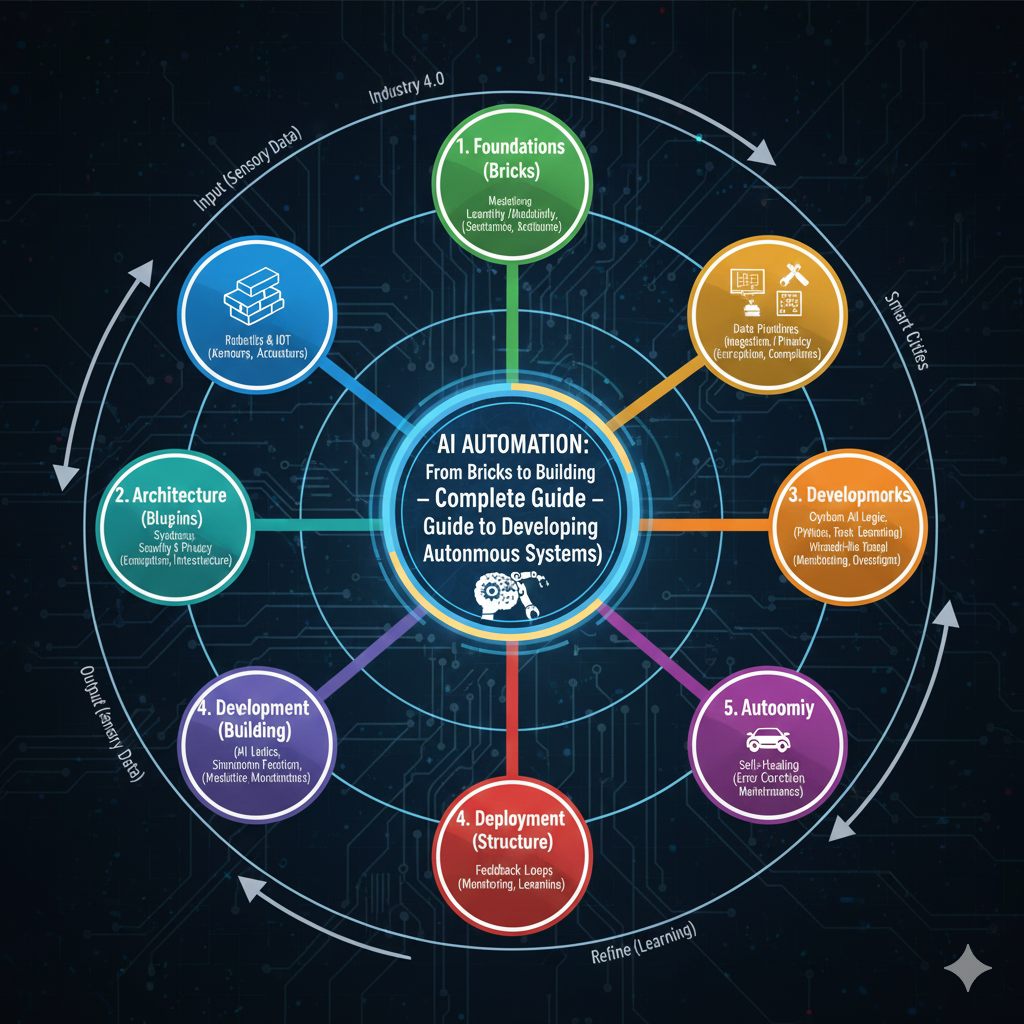
Discover how to architect fully autonomous systems using Claude AI and n8n! This comprehensive guide covers everything from core concepts to 5 real-world examples of intelligent automation.
✨ What’s Inside:
Core AI automation principles & terminology
System architecture & components
Step-by-step autonomous system development
Live examples: Customer support, content creation, financial analysis, HR recruitment & supply chain
Evolution from 1950s to 2025+
Future trends & implementation roadmap
Perfect for AI researchers, tech entrepreneurs, developers, and business leaders looking to leverage automation for competitive advantage.
🔗 Dive into the future of intelligent systems!
#AIAutomation #ArtificialIntelligence #MachineLearning #TechInnovation
AI AUTOMATION
EDUNXT TECH LEARNING | Global Tech Innovation 2025
The AI Automation Revolution
We stand at the precipice of a transformative era where artificial intelligence has evolved from isolated experimental tools into the fundamental building blocks of autonomous systems that reshape industries, redefine productivity, and reimagine what’s possible in human-machine collaboration. AI automation represents not merely the mechanization of tasks, but the orchestration of intelligent, adaptive, and context-aware systems that learn, evolve, and execute complex workflows with minimal human intervention.
Core Concepts of AI Automation
AI automation transcends traditional rule-based automation by integrating cognitive capabilities, enabling systems to understand context, make decisions, adapt to changing conditions, and continuously improve performance through learning mechanisms.
Foundational Principles
- Autonomous Decision-Making: Systems that evaluate multiple data points, assess situational context, apply learned patterns, and execute decisions without requiring human intervention at every step, while maintaining alignment with predefined objectives and ethical guidelines.
- Adaptive Learning: The capability to continuously ingest new information, identify emerging patterns, refine existing models, and improve performance over time through reinforcement learning, transfer learning, and meta-learning approaches.
- Contextual Understanding: Moving beyond simple pattern recognition to comprehend the broader context, including temporal relationships, causal connections, semantic meaning, and situational nuances.
- Multi-Modal Integration: The seamless fusion of diverse data types including text, images, audio, video, sensor data, and structured databases to create comprehensive understanding.
- Intelligent Orchestration: Coordinating multiple AI agents, services, and workflows in a harmonious ecosystem where specialized components collaborate and collectively accomplish complex objectives.
Essential Terminology & Lexicon
Understanding the language of AI automation is crucial for effective implementation and communication across technical and business stakeholders. These terms form the foundation of discussions around autonomous system design and deployment.
| Term | Definition | Practical Significance |
|---|---|---|
| Agent | An autonomous entity that perceives its environment through sensors and acts upon it to achieve specific goals | Foundation of autonomous systems that operate independently within defined parameters |
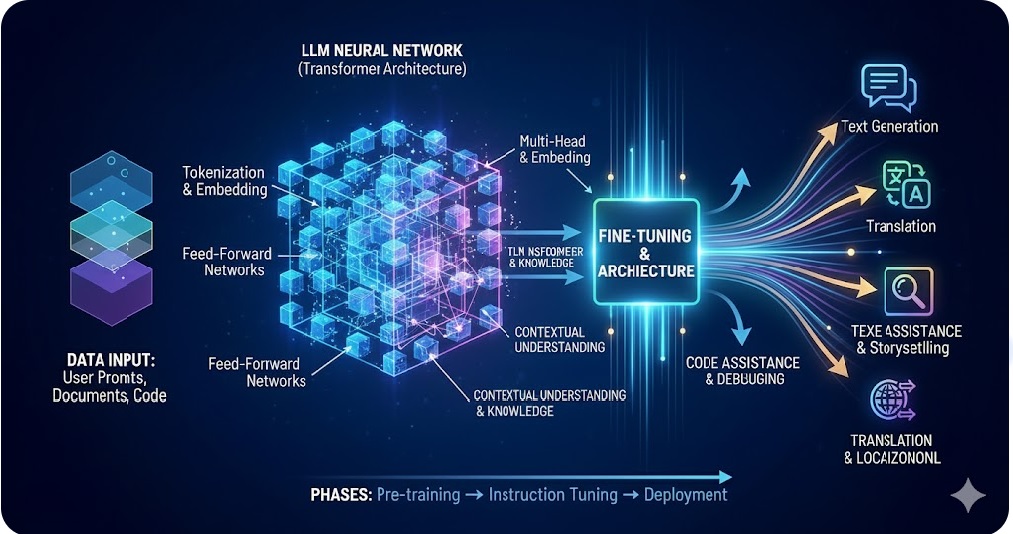
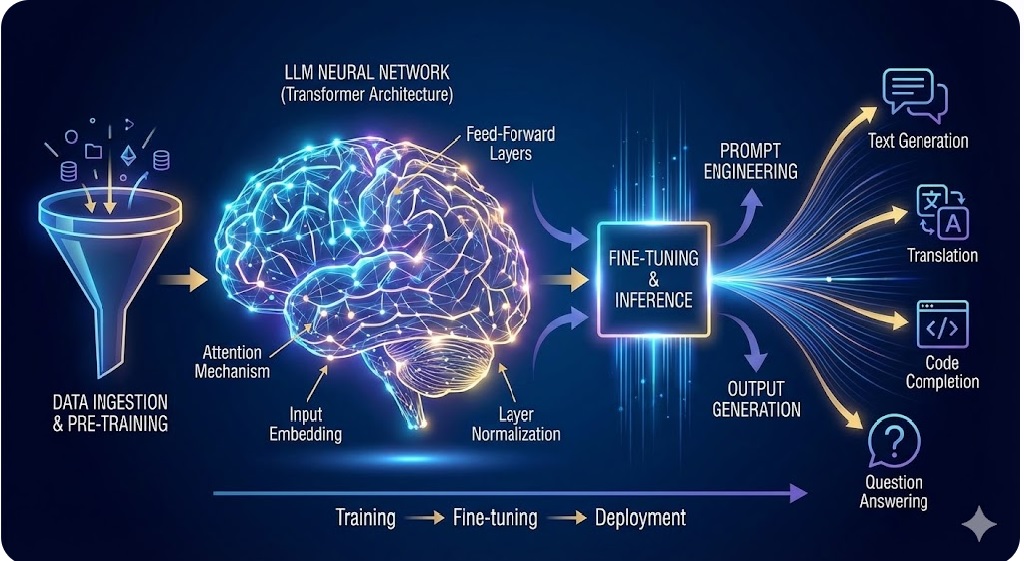
| LLM | Large Language Model – Neural networks trained on vast text corpora to understand and generate human-like text | Powers natural language interfaces, content generation, and semantic understanding |
| RAG | Retrieval-Augmented Generation combining information retrieval with generative AI | Enables AI to provide accurate, up-to-date information from specific knowledge bases |
| Workflow Orchestration | Coordination of multiple automated tasks, services, and processes into coherent sequences | Enables complex business processes to execute automatically with proper sequencing |
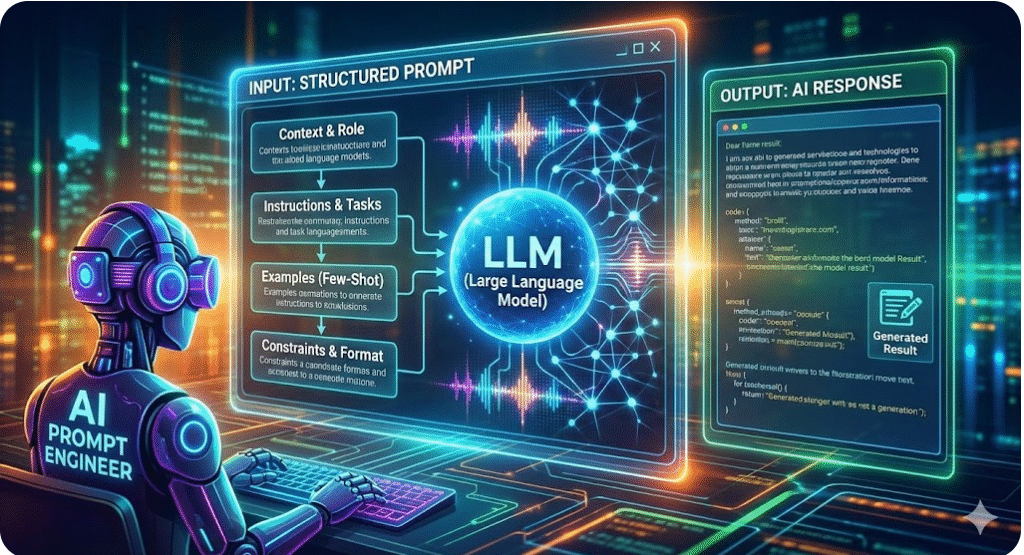
| Prompt Engineering | The art and science of crafting effective instructions to guide AI model outputs | Determines quality, accuracy, and relevance of AI-generated responses |
| API Integration | Programmatic interfaces that allow different software systems to communicate seamlessly | Critical for connecting AI systems with existing enterprise tools and external services |
Key Insight
The terminology of AI automation is rapidly evolving as the field matures. Staying current with these concepts is essential for effectively designing, implementing, and communicating about autonomous systems. Each term represents not just a technical concept but a capability that can be leveraged to build more sophisticated automation solutions.
Core Components of AI Automation Systems
Modern AI automation systems are composed of interconnected components that work in concert to create intelligent, autonomous capabilities. Understanding these building blocks is essential for architecting robust solutions.
1. Intelligence Layer: AI Models & Engines
- Large Language Models (LLMs): Advanced neural networks like Claude, GPT-4, and PaLM that provide natural language understanding, generation, reasoning, and task execution capabilities.
- Specialized Models: Purpose-built models for specific domains including computer vision, speech recognition, time-series forecasting, and recommendation engines.
- Embedding Models: Transform text and images into dense vector representations that capture semantic meaning for similarity search and retrieval operations.
2. Integration Layer: Connectivity & Orchestration
- API Gateways: Standardized interfaces enabling AI systems to communicate with external services, databases, and applications.
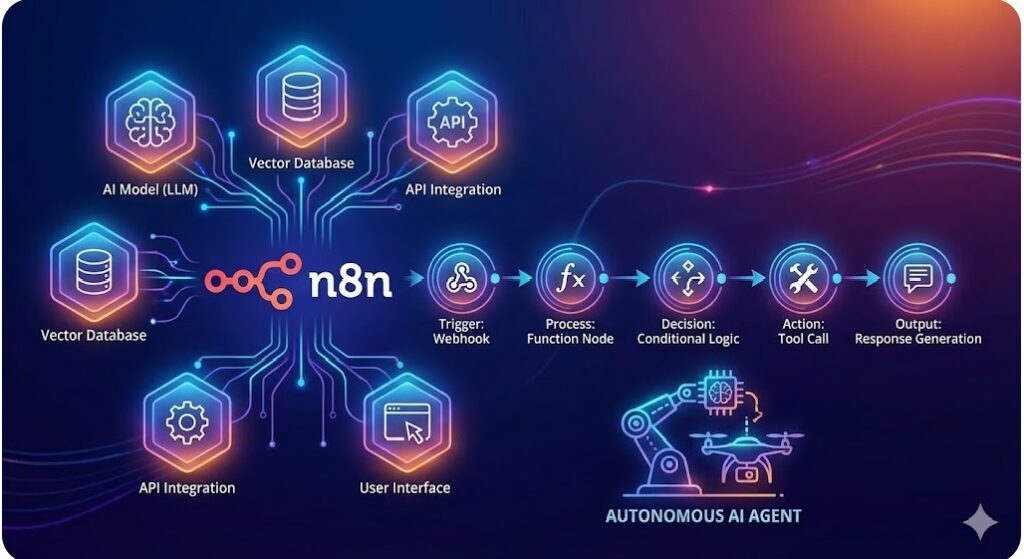
- Workflow Engines: Platforms like n8n, Zapier, and Apache Airflow that design, schedule, and execute complex multi-step automation workflows.
- Message Queues: Asynchronous communication systems that decouple components, enable reliable delivery, and ensure system resilience.
3. Data Layer: Knowledge & Memory
- Vector Databases: Specialized storage systems optimized for storing and retrieving high-dimensional embeddings for semantic search.
- Knowledge Graphs: Structured representations of entities and relationships that enable reasoning and discovery of hidden connections.
- Caching Layers: In-memory data stores that reduce latency and improve system responsiveness.
Real-World Examples: Building with Claude & n8n
Example 1: Intelligent Customer Support Automation
System Overview
This autonomous system handles customer inquiries across multiple channels, providing instant, accurate responses while seamlessly escalating complex issues to human agents. The system learns from each interaction, continuously improving its knowledge base and response quality.
Key Architecture Components
- Multi-Channel Intake: n8n webhooks capture incoming messages from Slack, email, web chat, and support ticket systems with normalized formatting.
- Intelligent Classification: Claude analyzes queries to categorize by topic, determine complexity level, assess urgency, and identify customer sentiment.
- Knowledge Retrieval: Semantic search across vector database containing documentation, past resolutions, and best practices.
- Response Generation: Claude generates personalized responses incorporating retrieved knowledge, customer history, and brand voice guidelines.
- Automated Actions: System executes actions like updating ticket status, creating follow-up tasks, and triggering refund processes through n8n workflows.
n8n Workflow Sequence:
1. Webhook Trigger (Slack/Email/Chat)
2. Data Extraction & Normalization
3. Customer Context Lookup (CRM API)
4. Vector DB Semantic Search
5. Claude API Call (with context)
6. Response Validation
7. Confidence Check Decision
- High Confidence → Auto-Respond
- Low Confidence → Human Review Queue
8. Action Execution (Update Ticket/Send Email)
9. Log to Analytics Database
10. Update Knowledge Base if New Pattern
Impact Metrics
Example 2: Automated Content Creation Pipeline
System Overview
An end-to-end content automation system that monitors industry trends, generates original articles, creates social media variations, schedules publications, and tracks performance metrics. The system maintains consistent brand voice while adapting content for different platforms and audiences.
Workflow Architecture
- Trend Monitoring: n8n scheduled workflows continuously monitor RSS feeds, Google Trends API, social media trending topics, and competitor content.
- Topic Selection: Claude analyzes detected trends against content calendar priorities, audience interests, SEO opportunities, and publication frequency targets.
- Content Generation: Claude creates long-form articles incorporating researched information, brand voice guidelines, SEO keywords, and target audience preferences.
- Multi-Platform Adaptation: Claude reformats approved articles into platform-specific variations including Twitter threads, LinkedIn posts, and Instagram captions.
- Performance Tracking: System monitors engagement metrics, tracks content performance, and feeds insights back into topic selection algorithms.
Results Achieved
Example 3: Intelligent Financial Analysis System
Autonomous financial intelligence system that ingests earnings reports, market data, and news sentiment to generate comprehensive investment analysis, risk assessments, and portfolio recommendations.
Example 4: HR Recruitment Automation
End-to-end recruitment automation that sources candidates, screens resumes, conducts initial assessments, schedules interviews, and maintains candidate communication throughout the hiring process.
Example 5: Supply Chain Optimization Engine
Autonomous supply chain management system that monitors inventory levels, predicts demand, optimizes procurement timing, selects optimal shipping routes, and manages vendor relationships to minimize costs while ensuring product availability.
Evolution of AI Automation
The journey from simple rule-based automation to intelligent autonomous systems represents decades of technological advancement, shifting paradigms, and expanding capabilities that have fundamentally transformed how we approach problem-solving and productivity.
1950s-1970s: Rule-Based Automation
The earliest automation relied on explicit programming where every possible scenario required manual coding. Systems like assembly line robots followed predetermined sequences without adaptation or learning.
1980s-1990s: Expert Systems Era
Introduction of expert systems that encoded human expertise into if-then rule structures. Systems like MYCIN for medical diagnosis demonstrated the potential of knowledge-based approaches.
2000s-2010s: Machine Learning Revolution
Shift from rule-based to data-driven approaches where systems learn patterns from examples. Automation became more adaptive and could handle previously unseen scenarios.
2020-2023: Foundation Model Era
Emergence of large language models demonstrating unprecedented versatility. Models like GPT-3, BERT, and Claude showed strong performance across diverse tasks without task-specific training.
2024-Present: Agentic AI Systems
Current frontier focuses on AI agents that can break down complex goals into subtasks, use tools and APIs, maintain context across interactions, and collaborate with other agents and humans to accomplish open-ended objectives autonomously.
Importance of AI Automation in the Present Era
AI automation has transcended from a competitive advantage to a fundamental necessity for organizations seeking to thrive in the modern digital economy. Its importance spans multiple dimensions of business, society, and technological progress.
Business Transformation
- Operational Efficiency at Scale: AI automation enables organizations to handle exponentially growing data volumes and transaction counts without proportional increases in headcount.
- Decision Quality Enhancement: Automated systems process vastly more information than humans can analyze, identifying subtle patterns and correlations that inform better decisions.
- Speed to Market: AI automation dramatically compresses development cycles, accelerates testing and validation, and enables rapid iteration.
- Personalization at Scale: AI automation makes it economically feasible to deliver individualized content, recommendations, pricing, and support to millions of customers simultaneously.
Societal Impact
- Accessibility & Inclusion: AI automation democratizes access to sophisticated services previously available only to large enterprises or wealthy individuals.
- Healthcare Advancement: Automated diagnostic systems extend specialist expertise to rural areas and accelerate drug discovery through computational modeling.
- Environmental Sustainability: AI optimization reduces energy consumption in buildings and industrial processes, improving transportation efficiency.
- Scientific Discovery: AI automation accelerates research by analyzing vast scientific literature and discovering patterns in complex datasets.
Conclusion: Building the Future Together
AI automation represents far more than incremental technological improvement—it is a fundamental transformation in how we organize work, create value, and solve problems. We have progressed from simple rule-based systems to sophisticated autonomous agents capable of understanding context, making decisions, learning from experience, and collaborating with humans to achieve complex objectives.
Key Takeaways
- From Bricks to Buildings: Individual AI components—models, APIs, workflows, and data systems—integrate into comprehensive automation architectures that accomplish objectives far beyond their individual capabilities.
- Democratization of Capability: Tools like Claude and n8n have made sophisticated AI automation accessible to organizations of all sizes, enabling innovation without massive infrastructure investments.
- Continuous Evolution: AI automation is not a destination but a journey. Systems must be designed for continuous learning, adaptation, and improvement.
- Human-Centric Design: The most successful automation augments human capabilities rather than replacing them, creating partnerships where machines handle routine cognitive work while humans provide judgment and creativity.
- Responsible Innovation: Organizations must balance enthusiasm for automation with thoughtful consideration of ethical implications, privacy protection, and societal impact.
The Path Forward
We stand at an inflection point where AI automation transitions from experimental technology to essential infrastructure. The organizations, industries, and societies that successfully navigate this transition will be those that approach automation strategically, invest in both technology and people, maintain ethical principles, and remain adaptable as capabilities continue to advance at an accelerating pace.
The future belongs not to those who fear automation or blindly embrace it, but to those who thoughtfully architect systems that amplify human potential, create sustainable value, and contribute to flourishing societies. As we continue building from bricks to buildings, let us ensure we construct structures that stand the test of time and serve the greater good.
Thank You
Let’s build the future of AI automation together
EDUNXT TECH LEARNING | Global Tech Innovation