
Telecom Engineering Design Concepts for Entrepreneurs
A CTO-level field guide to the architecture, acronyms, and design decisions behind every mobile network — built for founders launching MVNOs, IoT platforms, and connectivity startups.
By EDUNXT TECH LEARNING — Telecom & Network Engineering Desk
Why Entrepreneurs Need Telecom Engineering Literacy
Telecom is one of the few industries where a founder without engineering fluency is at a genuine competitive disadvantage — not because the business model is unusually technical, but because nearly every meaningful decision (spectrum strategy, network partnerships, coverage commitments, SLA negotiations, device certification) depends on understanding concepts that are invisible to a non-technical observer. Whether you’re launching a Mobile Virtual Network Operator (MVNO), building an IoT connectivity platform, deploying a private 5G network for an industrial site, or building network monitoring software for carriers, the same underlying vocabulary and architecture govern what’s possible and what it will cost.
This guide is designed to give you that vocabulary — not at the depth a network engineer would need to configure equipment, but at the depth a CTO or technical founder needs to negotiate intelligently and confidently with vendors, evaluate carrier partnerships, and ask the right questions in a board meeting or investor pitch. We’ll move from the physical layer (radio waves themselves) through network architecture, identity systems, performance measurement, network management, and finally into the 5G concepts reshaping the industry today — before landing on a concrete roadmap for taking a telecom-adjacent product from concept to production.
Telecom also differs from most software verticals in a structural way worth naming directly: the physical layer is real. A software product can iterate its architecture overnight in response to user feedback; a telecom product is constrained by physics, licensed spectrum, regulatory approval, and multi-year infrastructure investment cycles on the part of carrier partners. This means the cost of a wrong technical assumption compounds differently than it does in a typical SaaS business — a mistaken belief about latency, coverage, or SLA enforceability can surface months after a partnership is signed, once real customers are depending on it. Building genuine literacy in these concepts up front is one of the highest-leverage investments a telecom-adjacent founder can make, precisely because so many of these decisions are difficult and expensive to reverse once committed to, unlike a software feature that can simply be shipped again differently next sprint.
This guide is organized to build that literacy progressively: starting with the physics of radio waves themselves, moving through the architecture that turns those waves into a functioning network, the identity systems that connect a signal to a specific subscriber and device, the performance metrics that determine whether a network is actually any good, the management systems that keep it running, and finally the 5G-era concepts that are actively reshaping what’s commercially possible today. By the end, you should be able to sit in a technical review with a carrier partner or infrastructure vendor and follow — and meaningfully question — nearly everything being discussed. Treat this presentation as a living reference document, one you can return to before every major infrastructure decision your company makes, rather than a single one-time read.
The Physical Layer: RF, Electromagnetic Waves, and Signal Basics
Every mobile network, at its foundation, is built on Radio Frequency (RF) — electromagnetic waves used for wireless communication, characterized by their wavelength and frequency. Electromagnetic (EM) waves themselves are composed of oscillating electric and magnetic fields propagating together, and understanding their basic properties is the entry point to nearly every other concept in this guide.
Why this matters commercially
Spectrum — the range of frequencies a carrier is licensed to use — is one of the most expensive and tightly regulated assets in the entire telecom industry. Lower frequencies travel farther and penetrate buildings better but carry less data; higher frequencies (like 5G mmWave) carry far more data but travel shorter distances and are more easily blocked. Nearly every network coverage-versus-capacity tradeoff a founder will negotiate with a carrier partner traces back to this basic physical relationship between frequency, wavelength, and propagation behavior.
This tradeoff shows up concretely in almost every carrier conversation a founder will have. A rural IoT deployment monitoring agricultural sensors across a large, sparsely populated area needs a low-frequency band optimized for range, even at lower data rates. A dense urban deployment supporting high-bandwidth video applications may prioritize higher-frequency spectrum despite its shorter range, compensating with a denser grid of smaller cells. Neither choice is universally correct — the right answer depends entirely on your specific use case’s balance of coverage area, data rate requirements, and device density, and a carrier partner who doesn’t ask about these tradeoffs before recommending a spectrum strategy is worth questioning further, since it suggests they’re proposing a generic solution rather than one genuinely fitted to your product.
Mobile Network Architecture: BTS, BSC, MSC, and Beyond
A mobile network is built from a hierarchy of network elements, each responsible for a specific function, connected in a chain from the handset all the way to the public telephone network.
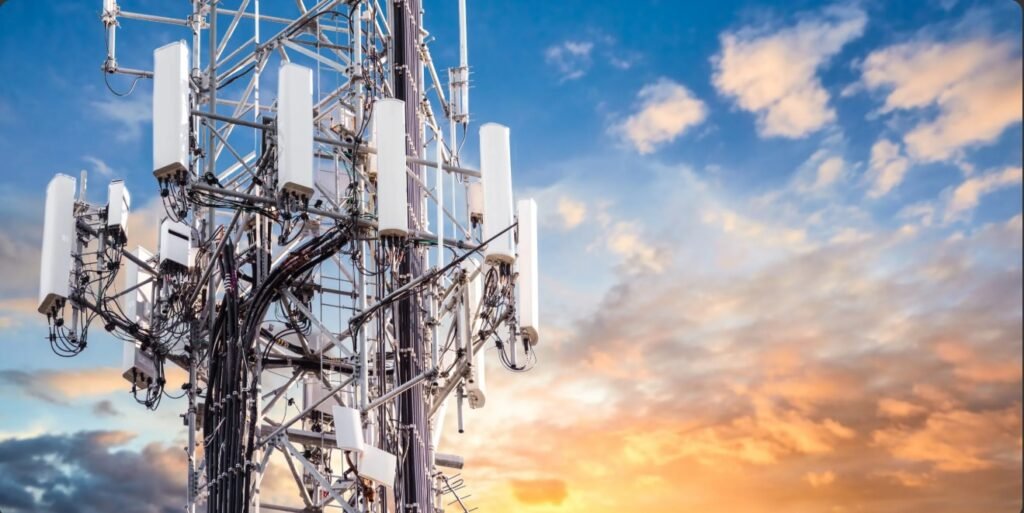
- BTS (Base Transceiver Station): The mobile station’s radio equipment that handles transmission and reception directly with mobile devices — the physical tower and radio hardware most people picture when they think of “cell towers.”
- BSC (Base Station Controller): Controls multiple BTS units and manages radio resources, including handover between towers as a user moves.
- MSC (Mobile Switching Center): The central switching node managing call setup, routing, and mobility management across the network.
- PSTN (Public Switched Telephone Network): The worldwide circuit-switched network of telephone lines that mobile calls ultimately interconnect with for voice communication.
GSM and CDMA: two founding approaches
GSM (Global System for Mobile Communications) is a digital standard using TDMA for voice and data, historically dominant in 2G networks worldwide. CDMA (Code Division Multiple Access) is a different multiplexing technique where multiple users share the same frequency band simultaneously, distinguished by unique codes rather than time slots. Understanding that these represent fundamentally different philosophies for sharing limited spectrum among many users is foundational to understanding everything that came after them in 3G, 4G, and 5G.
Why architecture history still matters today
It might seem like these older network elements — BTS, BSC, MSC — are purely historical, relevant only to legacy 2G networks. In practice, the underlying functional roles they represent persist in modern LTE and 5G architectures, simply renamed and reorganized: what a BTS did for radio transmission is now largely handled by an eNodeB (4G) or gNodeB (5G); what an MSC did for call switching has evolved into modern packet-core functions. Recognizing this continuity helps a founder read a modern 5G architecture diagram without feeling like they’re learning an entirely new vocabulary from scratch — the functional building blocks (radio access, resource control, core switching, external interconnection) are consistent across every generation, even as the specific names and underlying technology evolve.
Multiple Access and Duplexing: How Networks Share Spectrum
Because radio spectrum is a scarce, shared resource, every generation of mobile technology has relied on a specific technique for allowing many users to share the same frequency band without interfering with each other.
| Technique | How It Works | Typically Used In |
|---|---|---|
| TDMA (Time Division Multiple Access) | Users share a frequency channel by transmitting in different time slots | 2G (GSM), satellite communication |
| FDMA (Frequency Division Multiple Access) | Users share spectrum using different frequency bands simultaneously | 1G analog systems, radio broadcasting |
| CDMA (Code Division Multiple Access) | Users share the same frequency band using unique spreading codes | 3G/4G/5G networks, spread spectrum systems |
Duplexing: FDD versus TDD
Separately from multiple access, every network must also decide how uplink (device to network) and downlink (network to device) traffic share resources. Frequency Division Duplex (FDD) uses two separate frequency bands for uplink and downlink, transmitting simultaneously. Time Division Duplex (TDD) uses the same frequency band for both directions, but at different time intervals. FDD tends to offer more predictable latency for voice, while TDD offers more flexibility to dynamically allocate more capacity to whichever direction (upload or download) has heavier demand at a given moment — a flexibility increasingly valuable for data-heavy 5G use cases.
For founders: If you’re negotiating spectrum access or evaluating a network partner’s technical claims, knowing whether their deployment is FDD or TDD tells you a great deal about their latency characteristics and flexibility for asymmetric data loads — a genuinely useful due-diligence question in any carrier partnership conversation.
Subscriber and Device Identity: SIM, IMSI, IMEI, MSISDN
Every mobile connection depends on a layered identity system that separates the subscriber, the device, and the phone number — a distinction that matters enormously for any founder building products involving SIM provisioning, IoT device fleets, or subscriber management.
- UE (User Equipment): Any device used to access a mobile network — phones, tablets, IoT sensors, laptops with cellular modems.
- SIM (Subscriber Identity Module): The smart card storing subscriber information and authenticating the user to the network.
- IMSI (International Mobile Subscriber Identity): A unique number identifying the subscriber worldwide, composed of a Mobile Country Code (MCC), Mobile Network Code (MNC), and Mobile Subscriber Identification Number (MSIN).
- IMEI (International Mobile Equipment Identity): A unique number identifying the physical device itself, hardcoded by the manufacturer — used for theft tracking and network registration, independent of which SIM is inserted.
- MSISDN (Mobile Station International Subscriber Directory Number): The actual phone number used for calling and billing — distinct from, though linked to, the IMSI.
Why the distinction matters for IoT founders specifically: An IoT device typically has an IMEI (identifying the hardware) and an embedded SIM with its own IMSI (identifying the network subscription) — and these can, in many modern eSIM deployments, be reprovisioned to different carrier profiles without physically swapping hardware. Understanding this separation is essential for any founder building a connected-device product that needs to work across multiple countries or carrier networks.
This becomes especially important at scale. A founder shipping a few hundred connected devices can often manage SIM logistics manually — physically inserting SIMs, tracking assignments in a spreadsheet. A founder shipping tens of thousands of devices across multiple countries cannot realistically operate this way, and needs a deliberate strategy from the outset: centralized eSIM provisioning platforms, automated carrier-profile switching based on device location, and a clear ownership model for the relationship between a device’s IMEI, its currently assigned IMSI, and the billing account associated with that subscription. Retrofitting this kind of identity management architecture after a product has already shipped at scale is considerably more expensive than designing for it from the first hardware revision.
The Network Identification Hierarchy: PLMN to Cell Identity
Beyond identifying subscribers and devices, mobile networks rely on a nested hierarchy of codes to identify countries, operators, and individual cells — essential for roaming, billing, and network planning.
| Identifier | What It Identifies | Example |
|---|---|---|
| MCC (Mobile Country Code) | A specific country | 310 = USA, 404 = India |
| MNC (Mobile Network Code) | A specific operator within a country | 150 = Airtel (India) |
| PLMN (Public Land Mobile Network) | A network operator, identified by MCC + MNC | Combines the two codes above |
| LAC (Location Area Code) | A group of cells under a single MSC (GSM) | Used for call routing and location management |
| TAC (Tracking Area Code) | A group of cells in LTE/5G networks | Used for mobility management and paging |
| CI / CGI (Cell Identity / Cell Global Identity) | An individual cell, globally unique when combined with MCC/MNC/LAC | Used for handover and location tracking |
| PCI (Physical Cell Identity) | A cell identity used specifically in LTE for handover and interference management | Assists devices in distinguishing neighboring cells |
This hierarchy — country, then operator, then location area, then individual cell — is what allows a phone to roam seamlessly from one country to another, be billed correctly, and hand over between cell towers without dropping a call. For a founder evaluating international expansion or roaming agreements, this hierarchy is precisely what a carrier partner’s roaming contract is built around.
Measuring What Matters: KPI, QoS, and SLA
KPIs: the vital signs of a network
A Key Performance Indicator (KPI) is a measurable value showing how effectively a network or service is performing against defined objectives — used for monitoring, troubleshooting, and capacity planning. Common telecom KPIs include Reference Signal Received Power (signal strength), throughput (data rate achieved), latency (end-to-end delay), and call drop rate (percentage of dropped calls).
Quality of Service (QoS)
QoS refers to a network’s ability to provide better, prioritized service to selected traffic, ensuring critical services like voice and video receive guaranteed performance even when the network is under load. QoS is typically managed across four parameters — bandwidth, delay, jitter, and packet loss — and organized into classes such as conversational (voice, video calls; low delay and loss required), streaming (medium delay tolerance), interactive (web, gaming), and background (email, downloads — best-effort, lowest priority).
SLAs: where engineering meets contract law
A Service Level Agreement (SLA) is a contract between a service provider and customer defining expected performance levels — including specific KPI targets, responsibilities, and penalties if targets are missed. For any founder negotiating a carrier partnership, an SLA is where the technical concepts in this guide become directly enforceable business commitments: uptime guarantees, latency ceilings, and remediation credits if the network underperforms.
For founders negotiating carrier SLAs: Always ask which specific KPIs the SLA’s performance targets are measured against, over what time window, and what the penalty structure looks like for a missed target. A vague SLA that doesn’t reference concrete KPIs like latency, packet loss, or availability percentage offers far less real protection than it appears to on paper.
Running the Network: OSS, BSS, and the FCAPS Framework
Behind every functioning mobile network sits a layer of software systems responsible for keeping it running, billing customers correctly, and detecting problems before they become outages.
- OSS (Operations Support System): Software applications used to monitor, control, analyze, and manage network operations — fault management, performance management, configuration management, and security.
- BSS (Business Support System): Applications handling business-related activities — customer data, billing, subscriptions, and accounts.
- NMS (Network Management System) / NOC (Network Operations Center): The software and the physical team, respectively, responsible for 24/7 monitoring, incident management, and service assurance across the network.
- EMS (Element Management System) / NE (Network Element) / EMSP: An EMS manages a specific network element (a base station, router, or switch); an EMSP acts as an intermediary layer providing unified management across multiple EMS systems from different vendors.
FCAPS: the universal network management framework
FCAPS — Fault, Configuration, Accounting, Performance, and Security management — is the standard framework used to monitor, manage, and optimize telecom networks. Fault management detects, isolates, and resolves network faults; configuration management manages network changes and settings; accounting management tracks usage for billing; performance management monitors and optimizes KPIs; and security management protects the network from threats.
How FCAPS scales down to a startup
Large carriers implement FCAPS through dedicated, enterprise-grade OSS platforms staffed by round-the-clock NOC teams. A connectivity startup obviously doesn’t need that scale of investment, but the five underlying disciplines still apply in a leaner form: fault management might mean automated alerting when your service’s error rate crosses a threshold; configuration management might mean version-controlled infrastructure-as-code rather than a formal change advisory board; accounting management might mean usage-based billing instrumentation; performance management might mean a simple KPI dashboard; and security management might mean basic access controls and encryption rather than a dedicated security operations center. The discipline matters far more than the scale at which it’s implemented — skipping any one of these five categories entirely, even informally, tends to surface as an operational blind spot exactly when the business can least afford it.
Transmission Integrity: Errors, Alarms, and Signal Health
Even a well-designed network experiences transmission errors, and a shared vocabulary exists across the industry for detecting, quantifying, and alerting on them.
- LOS (Loss of Signal): The received signal power drops below a detectable threshold — the transmission equivalent of a dead line.
- LOF (Loss of Frame): A received frame or multi-frame isn’t detected properly, resulting in loss of synchronization.
- AIS (Alarm Indication Signal): A special signal generated by network equipment to indicate a failure or out-of-service condition to the remote end of a link.
- RDI (Remote Defect Indication): An alarm generated by far-end equipment indicating a defect back to the local end, allowing both sides of a link to be aware of a failure.
Quantifying error rates
BER (Bit Error Rate), BLER (Block Error Rate), and FER (Frame Error Rate) all measure the same underlying concept — the ratio of erroneous units received to total units transmitted — at different levels of granularity (individual bits, blocks, or frames). CRC (Cyclic Redundancy Check) is the error-detecting technique used to verify data integrity, generating a checksum that the receiver recalculates to confirm the received data matches what was sent.
For founders: These metrics matter beyond pure engineering interest — a carrier or vendor’s willingness to share BER, BLER, and FER data transparently is often a useful signal of technical maturity and honesty during due diligence, since these numbers are directly tied to the actual reliability your customers will experience.
Signal Quality Metrics Every Founder Should Recognize
| Metric | What It Measures | Why It Matters |
|---|---|---|
| RSSI (Received Signal Strength Indicator) | Total received signal power, including interference | General signal strength indicator |
| RSRP (Reference Signal Received Power) | Average power of reference signals from the serving cell | Coverage measurement in 4G/5G |
| RSRQ (Reference Signal Received Quality) | Signal quality accounting for interference and noise | Cell selection and handover decisions |
| SINR / SNR (Signal to Interference-plus-Noise / Signal to Noise Ratio) | Desired signal power relative to interference and noise | Directly impacts achievable throughput |
| EIRP / ERP (Effective Isotropic / Effective Radiated Power) | Total effective power radiated by an antenna | Link budget calculations, regulatory compliance |
| VSWR (Voltage Standing Wave Ratio) | Impedance mismatch on a transmission line | Antenna and feeder system health |
None of these metrics need to be memorized in formula form by a non-engineering founder — but recognizing them by name, and understanding broadly that “higher is generally better” for most (RSRP, SINR, SNR) while “lower is generally better” for others (VSWR, error rates), is enough to follow a technical briefing from your own network team or a vendor without feeling lost.
Advanced RF and 5G Concepts: MIMO, Carrier Aggregation, and NSA vs SA
MIMO (Multiple Input Multiple Output)
MIMO uses multiple transmit and receive antennas to send and receive multiple data streams simultaneously over the same frequency band, substantially improving both capacity and reliability — a foundational technology behind the throughput gains marketed in 4G LTE-Advanced and 5G NR.
Carrier Aggregation (CA)
Carrier Aggregation allows a device to combine multiple component carriers (separate frequency blocks) to increase overall bandwidth and achieve higher data rates — effectively letting a network stitch together several smaller spectrum bands into one larger effective pipe.
Dynamic Spectrum Sharing (DSS)
DSS allows 4G LTE and 5G NR to dynamically share the same frequency spectrum, with the network allocating resources between the two generations based on real-time traffic demand — a key tool operators use to roll out 5G faster by reusing existing 4G spectrum rather than requiring entirely new frequency allocations.
NSA versus SA: the two paths to 5G
| Deployment | NSA (Non-Standalone) | SA (Standalone) |
|---|---|---|
| Core network used | Existing 4G LTE core (EPC) | Dedicated 5G core network (5GC) |
| Deployment speed | Faster, reuses existing infrastructure | Slower, requires full new core buildout |
| Capabilities | Enhanced mobile broadband primarily | Full 5G capabilities, including network slicing and ultra-low latency |
| Typical use case | Early, faster-to-market 5G rollouts | True 5G use cases: industrial IoT, mission-critical communications |
For founders building on 5G: If your product depends on genuinely low-latency, mission-critical connectivity — industrial automation, remote surgery-adjacent applications, autonomous systems — verify explicitly whether your carrier partner’s 5G deployment is NSA or SA. Marketing materials frequently say “5G” without distinguishing between the two, and the difference in actual achievable latency and reliability can be substantial.
Network slicing: 5G’s most consequential capability for founders
Standalone 5G’s core network introduces network slicing — the ability to carve a single physical network into multiple logically isolated virtual networks, each with its own guaranteed performance characteristics tailored to a specific use case. A single 5G SA deployment could theoretically support one slice guaranteeing ultra-low latency for an industrial robotics application, another slice optimized for massive device density for a smart-agriculture sensor network, and a third slice handling ordinary consumer mobile broadband — all on the same underlying physical infrastructure. For founders building specialized connectivity products, network slicing is arguably the single most commercially significant capability standalone 5G introduces, because it means a carrier can offer genuinely differentiated service tiers without building entirely separate physical networks for each use case.
From Concepts to Production: A Founder’s Telecom Roadmap
- Define your connectivity model precisely. Are you building an MVNO (reselling a carrier’s network under your own brand), an MVNE (providing back-end infrastructure to other MVNOs), an IoT connectivity platform, or a private network deployment? Each implies a completely different set of vendor relationships and technical dependencies.
- Choose carrier and infrastructure partners based on measurable KPIs, not marketing claims. Request real coverage maps, historical KPI data, and clear SLA terms before committing to a long-term agreement.
- Design your device and subscriber identity strategy early. Decide how SIM provisioning, IMEI management, and (if relevant) eSIM reprovisioning will work across your target markets, especially if you plan to operate internationally.
- Build observability into your own product from day one. Whether you’re a carrier partner or a connectivity platform, monitoring your own service’s KPIs — latency, packet loss, availability — is essential both for your own operations and for holding upstream vendors accountable to their SLAs.
- Match your QoS requirements to your actual use case. A voice-heavy consumer product has fundamentally different QoS needs than a background IoT telemetry service — don’t over-provision for latency sensitivity you don’t actually need, and don’t under-provision for use cases that genuinely require it.
- Clarify NSA versus SA 5G requirements explicitly with every infrastructure partner. If your roadmap depends on capabilities unique to standalone 5G, confirm your partner’s actual deployment timeline for SA, not just their general “5G” marketing.
- Build FCAPS-equivalent thinking into your own operations, even at small scale. Fault detection, configuration control, usage tracking, performance monitoring, and security aren’t just carrier-scale concerns — a lean version of each is valuable even for an early-stage connectivity startup.
- Negotiate SLAs around concrete KPIs, not vague language. Insist on specific, measurable targets for availability, latency, and packet loss, along with clearly defined remediation if those targets are missed.
As with the general system design principles that apply across any technology venture, none of these steps require the founder personally to configure a base station or write RF link-budget calculations. What they require is a standing habit of informed questioning — asking a carrier partner which KPIs their SLA actually measures, asking an infrastructure vendor whether their 5G deployment is NSA or SA, asking your own technical team how subscriber identity will be managed as the device fleet scales. That habit of informed, specific questioning, built on the vocabulary this guide provides, is what telecom engineering literacy actually looks like in practice for a non-engineering founder.
Common Mistakes Telecom Entrepreneurs Make
Beyond the roadmap above, a handful of mistakes recur often enough across telecom-adjacent startups that they’re worth naming explicitly, since recognizing the pattern in advance is far cheaper than discovering it after a partnership is already signed.
Mistake 1 — Treating “5G” as a single, uniform technology
Assuming every 5G deployment offers the same latency and capability profile, without distinguishing NSA from SA or checking actual spectrum bands in use, leads to roadmap commitments the underlying network can’t actually support.
Mistake 2 — Signing carrier SLAs without concrete KPI targets
An SLA that promises “reliable service” without specifying measurable availability percentages, latency ceilings, or packet loss thresholds offers little real recourse when performance falls short.
Mistake 3 — Underestimating the complexity of international SIM and identity management
Expanding into new countries without a clear plan for IMSI, roaming agreements, and local regulatory requirements around subscriber identity often causes costly delays late in a product launch.
Mistake 4 — No independent visibility into network performance
Relying entirely on a carrier partner’s self-reported KPIs, without any independent monitoring of your own product’s actual latency, throughput, or error rates, leaves you unable to verify SLA compliance or diagnose customer complaints effectively.
Mistake 5 — Over-engineering QoS for use cases that don’t need it
Provisioning premium, low-latency QoS tiers for background data services that could easily tolerate best-effort delivery wastes budget that could be better spent on the specific use cases that genuinely require guaranteed performance.
Mistake 6 — Ignoring the regulatory dimension until launch is imminent
Telecom is one of the most heavily regulated industries in the world, and requirements around spectrum licensing, lawful intercept, data localization, and subscriber identity verification vary meaningfully by country. Founders who treat regulatory compliance as a late-stage checklist item, rather than a factor shaping architecture decisions from the outset, frequently discover expensive rework requirements just as they’re preparing to launch in a new market.
Your Telecom Launch Readiness Checklist
| Area | Readiness Signal |
|---|---|
| Connectivity model | Clearly defined (MVNO, MVNE, IoT platform, private network) |
| Carrier partnerships | SLA includes concrete, measurable KPI targets |
| Subscriber identity strategy | SIM/eSIM and IMEI management plan defined, including international roaming |
| Network observability | Independent monitoring of latency, throughput, and error rates in place |
| QoS design | Matched deliberately to actual use case requirements, not over- or under-provisioned |
| 5G deployment clarity | NSA vs SA status confirmed with every infrastructure partner |
| Network management practices | Lean fault, configuration, accounting, performance, and security practices in place |
Ready to build your telecom or connectivity product on solid technical footing?
Start by defining your connectivity model precisely — every other decision in this roadmap follows from that one.
Revisit the Founder’s Telecom RoadmapFrequently Asked Questions
Do I need an engineering background to launch a telecom or connectivity startup?
No, but you need enough fluency in core concepts — network architecture, identity systems, KPIs, and SLA terms — to evaluate vendor claims critically and negotiate effectively, even if your technical team handles implementation details.
What’s the difference between an MVNO and an MVNE?
An MVNO (Mobile Virtual Network Operator) resells a host carrier’s network under its own brand directly to consumers. An MVNE (Mobile Virtual Network Enabler) provides the back-end technical infrastructure that allows MVNOs to operate, without necessarily having its own consumer-facing brand.
Is 5G always faster and lower-latency than 4G?
Not automatically. Non-Standalone (NSA) 5G deployments, which still rely on a 4G core network, offer meaningfully less latency improvement than Standalone (SA) 5G, which uses a dedicated 5G core. The specific deployment type matters more than the “5G” label itself.
What should I look for in a carrier SLA?
Concrete, measurable KPI targets — specific availability percentages, latency ceilings, and packet loss thresholds — along with a clearly defined remediation or penalty structure if those targets aren’t met, rather than vague language about “reliable service.”
Why does QoS matter for a connectivity startup specifically?
QoS determines whether your product’s traffic receives guaranteed performance or best-effort delivery. Matching QoS tier to actual use case — guaranteed low latency for real-time applications, best-effort for background data — directly affects both user experience and infrastructure cost.
What is FCAPS and why should a non-engineer founder know about it?
FCAPS (Fault, Configuration, Accounting, Performance, Security) is the standard framework for network management. Even a lean version of FCAPS thinking — basic fault detection, change tracking, usage monitoring, performance review, and security practices — is valuable for any connectivity-dependent startup, not just large carriers.
What is network slicing and why does it matter for my startup?
Network slicing, available with Standalone (SA) 5G, allows a single physical network to be divided into multiple logically isolated virtual networks, each tuned to different performance requirements. It matters because it allows a carrier to offer genuinely differentiated, guaranteed service tiers for specialized use cases without building separate physical infrastructure — potentially unlocking commercial arrangements that weren’t previously possible.
How do IMSI and IMEI differ, and why should I care as a founder?
IMSI identifies the subscriber and their network subscription; IMEI identifies the physical device itself, independent of which SIM is inserted. This distinction matters directly for any founder building IoT fleets, eSIM-based products, or services that need to work across multiple carriers or countries, since managing these two identities correctly is central to provisioning, billing, and device lifecycle management.