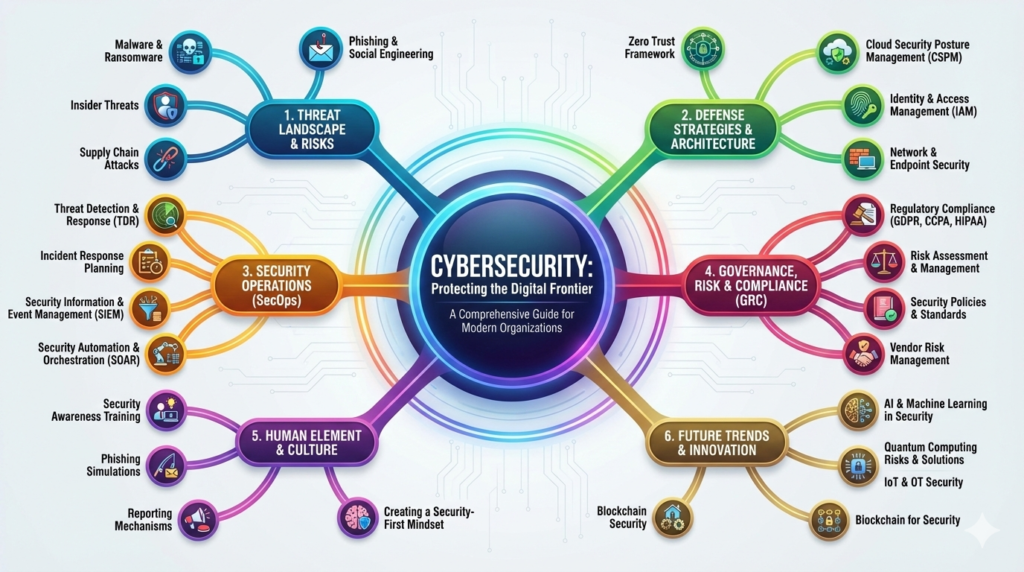

🛡️ CYBERSECURITY
Protecting the Digital Frontier in the AI Era
A Comprehensive Guide for Modern Organizations
1. Executive Summary: The Critical Importance of Cybersecurity
In today’s hyper-connected digital ecosystem, cybersecurity represents the cornerstone of business continuity, customer trust, and competitive advantage. Organizations face an unprecedented landscape of sophisticated threats that evolve faster than ever before. The integration of artificial intelligence, machine learning, and automation has created both incredible opportunities and significant vulnerabilities that demand our immediate attention and strategic response.
Why This Presentation Matters
- Business Imperative: Cybersecurity is no longer just an IT concern but a fundamental business requirement that impacts revenue, reputation, regulatory compliance, and organizational resilience
- Evolving Threat Landscape: Modern threats leverage artificial intelligence, quantum computing preparations, supply chain vulnerabilities, and sophisticated social engineering techniques
- Digital Transformation: As organizations migrate to cloud infrastructure, embrace remote work, and integrate IoT devices, the attack surface expands exponentially
- Regulatory Environment: Compliance requirements such as GDPR, CCPA, HIPAA, SOX, and industry-specific regulations demand robust security frameworks
- Competitive Advantage: Organizations with mature cybersecurity postures gain customer trust, reduce operational risks, and create sustainable competitive advantages
2. Cybersecurity Terminology: Building a Common Language
Understanding cybersecurity requires fluency in specialized terminology. This section provides comprehensive definitions of essential concepts that form the foundation of security discussions, strategy development, and incident response coordination.
Core Security Concepts
| Term | Definition | Business Impact |
|---|---|---|
| Confidentiality | Ensuring information is accessible only to authorized individuals, systems, or processes | Protects trade secrets, customer data, and competitive intelligence |
| Integrity | Maintaining accuracy and completeness of data throughout its lifecycle | Ensures data reliability for decision-making and regulatory compliance |
| Availability | Ensuring authorized users have reliable and timely access to information and resources | Prevents business disruption and revenue loss |
| Authentication | Verifying the identity of users, devices, or systems before granting access | Prevents unauthorized access and insider threats |
| Authorization | Determining what authenticated users are permitted to access or perform | Implements least privilege principle and reduces risk exposure |
| Encryption | Converting data into coded format that requires a key for decryption | Protects data in transit and at rest from unauthorized access |
| Vulnerability | Weakness in system, application, or process that can be exploited | Creates entry points for attacks and compliance violations |
| Threat | Potential danger that could exploit vulnerabilities to cause harm | Represents potential business risks requiring mitigation strategies |
| Risk | Likelihood and impact of threats exploiting vulnerabilities | Guides security investment priorities and resource allocation |
| Exploit | Method or tool used to take advantage of vulnerabilities | Represents active attack vectors requiring immediate patching |
Advanced Security Terminology
Zero-Day Vulnerability
Security flaw unknown to software vendor that attackers discover and exploit before patches are available. Represents highest risk category requiring immediate response protocols.
Attack Surface
Total sum of vulnerabilities and entry points that attackers can exploit. Increases with digital transformation, cloud adoption, and IoT integration.
Penetration Testing
Authorized simulated attack on systems to identify vulnerabilities before malicious actors exploit them. Critical for proactive security validation.
Social Engineering
Psychological manipulation techniques to trick individuals into divulging confidential information or performing actions that compromise security.
Defense in Depth
Layered security approach using multiple defensive mechanisms so if one fails, others continue providing protection. Core principle of enterprise security architecture.
Incident Response
Organized approach to addressing and managing security breaches or attacks. Minimizes damage, reduces recovery time, and preserves evidence.
- Myth: “Antivirus software provides complete protection” → Reality: Antivirus is one layer; comprehensive security requires multiple controls
- Myth: “Cybersecurity is solely IT’s responsibility” → Reality: Security is everyone’s responsibility requiring organization-wide culture
- Myth: “Small organizations aren’t targets” → Reality: 43% of cyber attacks target small businesses with weaker defenses
- Myth: “Compliance equals security” → Reality: Compliance is minimum baseline; true security requires continuous improvement
3. Core Components of Cybersecurity Infrastructure
Modern cybersecurity architecture comprises sophisticated hardware and software components working in concert to detect, prevent, and respond to threats. This section explores the essential technologies and systems that form a comprehensive security infrastructure.
Perimeter Defense & Traffic Control
Device-Level Security
Software Vulnerability Management
Information Protection & Privacy
Access Control & Authentication
Distributed Infrastructure Protection
Hardware Security Components
1. Firewall Appliances
- Next-Generation Firewalls (NGFW): Advanced packet inspection, application awareness, integrated intrusion prevention, and threat intelligence integration. Vendors include Palo Alto Networks, Cisco Firepower, and Fortinet
- Web Application Firewalls (WAF): Specialized protection for web applications against SQL injection, cross-site scripting, and other OWASP Top 10 vulnerabilities
- Hardware Security Modules (HSM): Dedicated cryptographic processors for key generation, storage, and management with tamper-resistant physical security
- Unified Threat Management (UTM): Integrated security appliances combining firewall, IPS/IDS, antivirus, content filtering, and VPN capabilities
2. Network Security Devices
- Intrusion Detection Systems (IDS): Passive monitoring solutions that analyze network traffic patterns to identify suspicious activities and generate alerts for security teams
- Intrusion Prevention Systems (IPS): Active defense systems that not only detect but automatically block malicious traffic based on signature and behavioral analysis
- Network Access Control (NAC): Hardware and software solutions enforcing security policies for devices attempting network connection, ensuring compliance before access
- Load Balancers: Distribute network traffic across servers while providing SSL/TLS termination, DDoS protection, and application delivery optimization
3. Authentication Hardware
- Hardware Security Tokens: Physical devices generating one-time passwords (OTP) for multi-factor authentication, including YubiKey, RSA SecurID, and smart cards
- Biometric Scanners: Fingerprint readers, facial recognition systems, iris scanners, and behavioral biometrics for strong authentication
- Smart Card Readers: Devices reading encrypted credentials from chip-based cards for physical and logical access control
4. Physical Security Integration
- Secure Access Points: Controlled entry systems with badge readers, biometric verification, and mantrap configurations
- Video Surveillance Systems: IP-based camera systems with AI-powered analytics for threat detection and forensic investigation
- Environmental Monitoring: Sensors tracking temperature, humidity, water detection, and power anomalies in data centers
Software Security Components
1. Endpoint Protection Platforms (EPP)
- Antivirus/Anti-Malware: Signature-based and heuristic detection engines identifying known and unknown threats. Modern solutions include behavioral analysis and machine learning
- Endpoint Detection and Response (EDR): Continuous monitoring and analysis of endpoint activities with automated response capabilities for threat containment
- Extended Detection and Response (XDR): Unified security platform correlating data across endpoints, networks, servers, cloud, and applications for comprehensive threat visibility
- Mobile Device Management (MDM): Centralized control over mobile devices, enforcing security policies, encryption, and remote wipe capabilities
2. Identity and Access Management (IAM)
- Single Sign-On (SSO): Centralized authentication allowing users to access multiple applications with one set of credentials, reducing password fatigue
- Multi-Factor Authentication (MFA): Requiring two or more verification factors (knowledge, possession, inherence) for access, dramatically reducing credential compromise
- Privileged Access Management (PAM): Specialized controls for administrative accounts including session recording, password vaulting, and just-in-time access
- Identity Governance and Administration (IGA): Automated provisioning, access certification, and compliance reporting for user identities and permissions
3. Security Information and Event Management (SIEM)
- Log Aggregation: Centralized collection of security events from diverse sources including firewalls, servers, applications, and cloud services
- Correlation Engine: Real-time analysis of events using rules, machine learning, and threat intelligence to identify security incidents
- Threat Intelligence Integration: Incorporating global threat data from multiple sources to enhance detection and prioritize response
- Compliance Reporting: Automated generation of audit reports for regulatory requirements including PCI-DSS, HIPAA, SOX, and GDPR
4. Data Loss Prevention (DLP)
- Content Inspection: Scanning data in motion, at rest, and in use to identify sensitive information based on patterns, keywords, and fingerprinting
- Policy Enforcement: Automated actions including blocking transfers, encrypting data, or alerting security teams when violations occur
- Endpoint DLP: Agent-based protection on workstations and servers monitoring file operations, clipboard usage, and external device connections
- Cloud DLP: Native and third-party solutions protecting data in cloud applications like Microsoft 365, Google Workspace, and Salesforce
5. Vulnerability Management
- Vulnerability Scanners: Automated tools identifying security weaknesses in networks, applications, and configurations. Leading solutions include Nessus, Qualys, and Rapid7
- Patch Management: Centralized deployment of security updates across operating systems and applications, with testing and rollback capabilities
- Configuration Management: Automated enforcement of security baselines and hardening standards across infrastructure
- Asset Discovery: Continuous identification of devices, applications, and cloud resources to maintain accurate inventory
6. Security Orchestration, Automation, and Response (SOAR)
- Playbook Automation: Predefined workflows automating repetitive security tasks and incident response procedures
- Case Management: Centralized tracking of security incidents from detection through resolution with full audit trails
- Threat Intelligence Platform (TIP): Aggregating and analyzing threat data from internal and external sources for actionable insights
- Integration Hub: Connecting security tools through APIs for unified operations and data sharing
- Deploy security controls in layers (Defense in Depth) rather than relying on single solutions
- Integrate hardware and software components for comprehensive visibility and coordinated response
- Automate routine security operations to free analysts for complex threat hunting and investigation
- Regularly update and patch all security infrastructure to protect against emerging threats
- Implement zero-trust architecture assuming breach and verifying every access request
4. Comprehensive Threat Landscape: Types and Characteristics
The modern threat landscape is characterized by increasing sophistication, automation, and commoditization of attack tools. Understanding threat categories, attack vectors, and indicators of compromise is essential for developing effective defense strategies.
Malicious Software
Human Manipulation
Infrastructure Exploitation
Application Vulnerabilities
Sophisticated Campaigns
Internal Actors
Malware: Malicious Software Categories
1. Viruses
- Definition: Self-replicating code that attaches to legitimate programs or files, spreading when the infected host is executed or shared
- Attack Mechanism: Requires user action to propagate, such as opening infected attachments or executing compromised files
- Common Types: File infectors, boot sector viruses, macro viruses embedded in documents, multipartite viruses attacking multiple targets
- Business Impact: Data corruption, system crashes, productivity loss, and potential data theft or espionage
- Real-World Example: ILOVEYOU virus (2000) caused $10 billion in damages by overwriting files and stealing passwords
2. Worms
- Definition: Standalone malicious programs that self-replicate and spread across networks without requiring host files or user intervention
- Attack Mechanism: Exploit network vulnerabilities, email systems, or removable media to propagate automatically
- Propagation Methods: Network scanning, email attachments, instant messaging, file sharing, and USB drives
- Business Impact: Network congestion, service disruption, resource exhaustion, and rapid widespread infection
- Real-World Example: WannaCry ransomware worm (2017) infected 200,000+ computers across 150 countries, exploiting EternalBlue vulnerability
3. Trojans (Trojan Horses)
- Definition: Malicious software disguised as legitimate applications to deceive users into installation and execution
- Attack Mechanism: Social engineering tactics presenting malware as useful tools, games, or software updates
- Capabilities: Remote access, data theft, keylogging, cryptocurrency mining, botnet enrollment, and backdoor installation
- Distribution Methods: Phishing emails, malicious advertisements, compromised websites, fake software downloads
- Real-World Example: Emotet trojan serves as malware distribution network for ransomware and banking trojans
4. Ransomware
- Definition: Malware that encrypts victim’s files or locks systems, demanding payment for restoration of access
- Attack Mechanism: Strong encryption algorithms render data inaccessible; attackers threaten permanent data loss or public exposure
- Evolution: Modern ransomware uses double extortion (encryption plus data theft), targets backups, and implements time-pressure tactics
- Business Impact: Operational paralysis, revenue loss, ransom payments, recovery costs, reputational damage, regulatory fines
- Statistics: Average ransomware demand exceeded $200,000 in 2024; total cost including downtime averages $4.54 million per incident
5. Spyware
- Definition: Covert software monitoring user activities, collecting sensitive information without knowledge or consent
- Data Collection: Browsing habits, keystrokes, passwords, financial information, personal communications, and system configurations
- Types: Keyloggers, screen recorders, password stealers, banking trojans, and mobile surveillance applications
- Distribution: Bundled with legitimate software, drive-by downloads, phishing campaigns, and physical device access
- Business Impact: Intellectual property theft, competitive intelligence loss, regulatory violations, and privacy breaches
6. Adware
- Definition: Software automatically displaying or downloading advertising material when user is online
- Characteristics: Often borderline legitimate, bundled with free software, tracks browsing behavior for targeted advertising
- Security Concerns: Privacy violations, system performance degradation, potential malware delivery, and unauthorized data collection
- Business Impact: Reduced productivity, bandwidth consumption, privacy compliance violations, and security policy breaches
7. Rootkits
- Definition: Sophisticated malware providing persistent privileged access while hiding presence from detection systems
- Stealth Mechanisms: Kernel-level integration, bootkit variants loading before operating system, firmware implants
- Capabilities: Hide files, processes, registry entries; disable security software; maintain persistent backdoors
- Detection Challenges: Operates at system core level, evades traditional antivirus, requires specialized detection tools
- Business Impact: Prolonged undetected compromise, complete system control, difficult remediation requiring full rebuilds
8. Botnets
- Definition: Networks of compromised computers (bots/zombies) controlled remotely by attackers for coordinated malicious activities
- Command Structure: Centralized (single server), decentralized (peer-to-peer), or hybrid control architectures
- Malicious Uses: Distributed denial-of-service (DDoS) attacks, spam distribution, cryptocurrency mining, credential stuffing, click fraud
- Scale: Major botnets comprise millions of infected devices including computers, servers, IoT devices, and mobile phones
- Business Impact: Service disruption, resource hijacking, legal liability, and participation in attacks against others
Social Engineering Attacks
1. Phishing
- Definition: Fraudulent communications appearing from reputable sources to steal sensitive information or deploy malware
- Attack Vectors: Email, SMS (smishing), voice calls (vishing), social media messages, and instant messaging
- Techniques: Urgency creation, authority impersonation, fear tactics, curiosity exploitation, and trust abuse
- Success Factors: Realistic appearance, personalization, emotional manipulation, and timing during busy periods
- Statistics: Over 90% of successful breaches begin with phishing; average cost per incident exceeds $4.65 million
2. Spear Phishing
- Definition: Highly targeted phishing attacks customized for specific individuals or organizations using researched personal information
- Research Phase: Attackers gather intelligence from social media, company websites, public records, and data breaches
- Customization: References to colleagues, projects, industry events, and personal interests increase credibility
- Target Selection: High-value individuals including executives, finance personnel, system administrators, and privileged users
- Business Impact: Successful rate significantly higher than mass phishing; average compromise cost over $1.6 million
3. Whaling
- Definition: Sophisticated phishing attacks targeting senior executives, board members, and high-profile individuals (the “big fish”)
- Attack Sophistication: Professional language, legal terminology, board-level concerns, and executive communication patterns
- Common Scenarios: Fake legal subpoenas, board communications, M&A documents, regulatory compliance requests
- Access Targets: Strategic information, financial controls, M&A details, intellectual property, and executive credentials
- Business Impact: Catastrophic potential including fraudulent wire transfers, strategic information theft, stock manipulation
4. Pretexting
- Definition: Creating fabricated scenarios (pretexts) to manipulate targets into divulging information or performing actions
- Identity Deception: Impersonating IT support, vendors, executives, law enforcement, or trusted business partners
- Scenario Examples: Fake IT audits, vendor verifications, emergency situations, compliance checks, system upgrades
- Information Gathering: Credentials, financial data, employee information, security procedures, and system access
- Business Impact: Unauthorized access, data breaches, financial fraud, and security control circumvention
5. Baiting
- Definition: Offering something enticing to lure victims into traps that compromise security
- Physical Baiting: Infected USB drives labeled “Confidential” or “Salary Information” left in parking lots, elevators, or public areas
- Digital Baiting: Free software downloads, pirated content, fake job offers, or prizes requiring credential submission
- Human Psychology: Exploits curiosity, greed, desire for free items, and fear of missing opportunities
- Business Impact: Malware infection, credential theft, network compromise, and bypassing of physical security controls
Network-Based Attacks
1. Distributed Denial of Service (DDoS)
- Definition: Overwhelming target systems with massive traffic volume from multiple sources, causing service disruption
- Attack Types: Volumetric (bandwidth exhaustion), protocol (state table saturation), application layer (resource depletion)
- Amplification Techniques: DNS, NTP, SSDP, and Memcached reflection attacks multiplying traffic volume
- Motivations: Extortion, competitive sabotage, ideological activism, distraction during other attacks
- Business Impact: Service unavailability, revenue loss, SLA violations, customer dissatisfaction, ransom demands
2. Man-in-the-Middle (MITM)
- Definition: Intercepting communications between two parties to eavesdrop, steal data, or inject malicious content
- Attack Methods: ARP spoofing, DNS hijacking, rogue WiFi access points, SSL stripping, session hijacking
- Target Environments: Public WiFi networks, compromised routers, corporate networks, cloud communications
- Data at Risk: Credentials, financial transactions, personal communications, business negotiations, API keys
- Business Impact: Data breaches, financial fraud, competitive intelligence loss, regulatory violations
3. SQL Injection
- Definition: Inserting malicious SQL code into application inputs to manipulate database queries and operations
- Attack Vectors: Web forms, URL parameters, cookies, HTTP headers, and any user-controllable input
- Capabilities: Data extraction, authentication bypass, data modification, database deletion, command execution
- Prevalence: Consistently ranks in OWASP Top 10; affects countless web applications and APIs worldwide
- Business Impact: Massive data breaches, database destruction, reputation damage, regulatory penalties
4. Cross-Site Scripting (XSS)
- Definition: Injecting malicious scripts into trusted websites that execute in victims’ browsers
- Types: Stored (persistent), reflected (non-persistent), DOM-based (client-side)
- Attack Capabilities: Session hijacking, credential theft, malware distribution, website defacement, keylogging
- Target Vulnerability: Insufficient input validation and output encoding in web applications
- Business Impact: User account compromise, data theft, reputation damage, legal liability
Advanced Persistent Threats (APTs)
- Definition: Sophisticated, prolonged cyber campaigns by well-funded adversaries targeting specific organizations for strategic objectives
- Characteristics: Multi-stage attacks, custom malware, zero-day exploits, living-off-the-land techniques, long-term presence
- Attack Phases: Reconnaissance, initial compromise, establishing foothold, privilege escalation, lateral movement, data exfiltration
- Threat Actors: Nation-states, organized crime, industrial espionage groups, hacktivist collectives
- Business Impact: Intellectual property theft, strategic information loss, prolonged compromise, extensive remediation costs
- AI-Powered Attacks: Machine learning enhancing phishing, deepfake social engineering, automated vulnerability discovery
- Adversarial ML: Attacks poisoning training data or evading AI-based security systems
- Quantum Computing Threats: Future capability to break current encryption standards requiring crypto-agility
- Supply Chain Attacks: Compromising software development pipelines, hardware manufacturers, and third-party services
- Cloud-Native Attacks: Container escapes, misconfigured storage, compromised APIs, and serverless vulnerabilities
5. Cybersecurity Hygiene: Best Practices and Preventive Measures
Effective cybersecurity requires consistent implementation of best practices across people, processes, and technology. This comprehensive approach to security hygiene significantly reduces risk exposure and improves organizational resilience.
Identity & Authorization
Encryption & Privacy
Segmentation & Monitoring
Device Hardening
Training & Culture
Preparation & Recovery
1. Strong Authentication and Access Control
Multi-Factor Authentication (MFA)
- Implementation Priority: Mandatory for all remote access, administrative accounts, email, financial systems, and cloud applications
- Factor Types: Knowledge (passwords), possession (tokens, smartphones), inherence (biometrics), location (geofencing)
- Best Practices: Use authenticator apps over SMS, implement passwordless authentication where possible, require MFA for password resets
- Risk Reduction: MFA blocks 99.9% of automated attacks even if passwords are compromised
Password Management
- Password Requirements: Minimum 12 characters, complexity requirements, no dictionary words, unique per service
- Password Managers: Enterprise solutions like 1Password, LastPass, Bitwarden generate and securely store complex passwords
- Policy Enforcement: Regular password changes for privileged accounts, immediate reset after suspected compromise
- Passphrase Strategy: Four random words (diceware) creating memorable yet strong passwords: “correct-horse-battery-staple”
Least Privilege Principle
- Access Control: Grant minimum permissions necessary for job functions; regularly review and revoke unnecessary access
- Privileged Account Management: Separate administrator accounts from daily-use accounts, require elevation justification
- Just-in-Time Access: Time-limited permissions for administrative tasks, automatically expiring after completion
- Regular Audits: Quarterly access reviews, automated alerts for privilege creep, immediate deprovisioning upon role changes
2. System and Software Management
Patch Management
- Automated Patching: Enable automatic updates for operating systems, applications, and firmware where appropriate
- Vulnerability Assessment: Weekly scans identifying missing patches, prioritizing critical vulnerabilities
- Testing Protocol: Validate patches in development environments before production deployment
- Emergency Patching: Accelerated procedures for zero-day vulnerabilities and actively exploited flaws
- Statistics: 60% of breaches involve unpatched known vulnerabilities with available fixes
Configuration Management
- Security Baselines: Implement CIS Benchmarks, NIST guidelines, or vendor-specific hardening standards
- Default Settings: Change default passwords, disable unnecessary services, remove sample files and accounts
- Configuration Monitoring: Automated detection of configuration drift from approved baselines
- Infrastructure as Code: Version-controlled configurations enabling rapid deployment and rollback
Asset Inventory
- Comprehensive Discovery: Maintain accurate inventory of all hardware, software, cloud resources, and data assets
- Asset Classification: Categorize by criticality, data sensitivity, and business impact
- Lifecycle Management: Track from procurement through disposal, ensuring secure decommissioning
- Shadow IT Detection: Identify unauthorized devices, applications, and cloud services
3. Data Protection Strategies
Encryption
- Data at Rest: Full disk encryption (BitLocker, FileVault), database encryption, encrypted backups
- Data in Transit: TLS 1.3 for web traffic, VPN for remote access, encrypted email (S/MIME, PGP)
- Key Management: Centralized key storage, regular rotation, separation of encryption and decryption keys
- Mobile Devices: Mandatory encryption for laptops, smartphones, tablets, and removable media
Backup and Recovery
- 3-2-1 Rule: Three backup copies, two different media types, one offsite/offline copy
- Backup Testing: Monthly restoration tests verifying data integrity and recovery procedures
- Ransomware Protection: Immutable backups, air-gapped storage, version retention preventing encryption
- Recovery Time Objectives: Define acceptable downtime, implement redundancy for critical systems
Data Classification
- Classification Levels: Public, internal, confidential, restricted based on sensitivity and impact
- Handling Requirements: Specific controls for storage, transmission, access, and disposal per classification
- Automated Classification: Tools scanning content for sensitive patterns (SSN, credit cards, health data)
- User Awareness: Training on appropriate handling, marking, and sharing of classified information
4. Network Security Practices
Network Segmentation
- Logical Separation: VLANs isolating departments, guest networks, IoT devices, and production environments
- Micro-Segmentation: Application-level segmentation limiting lateral movement after compromise
- DMZ Architecture: Isolated zones for public-facing services, enforcing strict access controls
- Zero Trust Network: Verify every access request regardless of location, never implicitly trust
Secure WiFi
- Encryption Standard: WPA3-Enterprise with certificate-based authentication, disable WPA2 and earlier
- Guest Network Isolation: Separate SSID with no access to corporate resources
- Rogue AP Detection: Continuous monitoring for unauthorized wireless access points
- Strong Passwords: Complex pre-shared keys for personal use, changing quarterly
Remote Access Security
- VPN Requirements: Mandatory encrypted tunnel for all remote connections, split-tunnel restrictions
- Zero Trust Access: Software-defined perimeters verifying user, device, and context before access
- Device Posture: Verify endpoint security (antivirus, patches, encryption) before network access
- Geographic Restrictions: Block access from high-risk countries unless business-justified
5. Email and Communication Security
Email Protection
- Anti-Phishing Controls: Advanced threat protection scanning attachments and links in sandboxed environments
- SPF, DKIM, DMARC: Email authentication preventing sender spoofing and domain impersonation
- External Email Warnings: Visual indicators for messages originating outside organization
- Attachment Filtering: Block executable files, macros, and high-risk file types
Secure Communication Channels
- Encrypted Messaging: End-to-end encryption for sensitive discussions (Signal, WhatsApp Business)
- Secure File Sharing: Approved platforms with encryption, access controls, and audit logs
- Video Conferencing Security: Password protection, waiting rooms, participant verification
- Data Loss Prevention: Automated scanning and blocking of sensitive information in communications
6. Security Awareness and Training
Employee Training Programs
- Onboarding Training: Security policies, acceptable use, data handling, incident reporting during first week
- Annual Refresher: Updated training covering new threats, policy changes, real-world examples
- Role-Specific Training: Specialized content for developers, administrators, executives, finance teams
- Measurement: Knowledge assessments, phishing simulation tests, behavior observation
Phishing Simulation
- Regular Testing: Monthly simulated phishing campaigns with varying difficulty and techniques
- Immediate Feedback: Educational messages when users click suspicious links or submit credentials
- Progressive Difficulty: Increasingly sophisticated scenarios based on organizational performance
- No Punishment: Focus on education and improvement rather than disciplinary action
Security Culture
- Leadership Commitment: Executive sponsorship, board-level security discussions, visible support
- Reporting Encouragement: Anonymous reporting channels, no-blame culture for suspected incidents
- Recognition Programs: Reward employees identifying threats or demonstrating security excellence
- Clear Policies: Accessible, understandable security policies with real-world examples
7. Incident Response Preparation
Incident Response Plan
- Team Structure: Defined roles including incident commander, technical leads, communications, legal counsel
- Response Procedures: Documented workflows for detection, containment, eradication, recovery, lessons learned
- Communication Templates: Pre-approved messaging for stakeholders, customers, regulators, media
- Regular Testing: Quarterly tabletop exercises, annual full-scale simulations
Security Monitoring
- 24/7 Monitoring: Security Operations Center (SOC) or managed detection and response (MDR) service
- Log Retention: Centralized logging with minimum 90-day retention, longer for compliance requirements
- Alerting Thresholds: Tuned detection rules minimizing false positives while catching true threats
- Threat Hunting: Proactive searches for indicators of compromise and suspicious patterns
- Enable MFA on all email accounts and critical systems this week
- Implement automated patching for operating systems and major applications
- Conduct organization-wide phishing awareness training within 30 days
- Review and remove unnecessary administrative privileges
- Deploy password manager and enforce unique passwords
- Enable full disk encryption on all laptops and mobile devices
- Implement network segmentation separating guest from corporate networks
- Configure automatic backups with offsite retention
6. Evolution of Cybersecurity: From Past to AI-Powered Future
Cybersecurity has evolved from basic password protection to sophisticated AI-driven defense ecosystems. Understanding this evolution provides context for current challenges and future strategic planning.
First computer viruses (Creeper, 1971), development of encryption standards (DES, 1977), emergence of antivirus software, and recognition of computer security as distinct discipline. Security focused on mainframe access control and physical security.
Rapid internet expansion, first widespread worms (Morris Worm, 1988), development of firewalls, SSL/TLS protocols, and web application security concerns. Hacktivism emerges as cybercrime becomes organized and profitable.
Large-scale data breaches, rise of organized cybercrime, development of compliance frameworks (SOX, PCI-DSS), intrusion detection/prevention systems, and security operations centers. Identity theft becomes major concern.
Nation-state attacks (Stuxnet, 2010), massive breaches (Target, Home Depot), mobile security challenges, cloud security emergence, and recognition of cyber warfare. Ransomware becomes widespread business threat.
WannaCry and NotPetya global incidents, GDPR implementation, zero trust architecture adoption, endpoint detection and response (EDR), security orchestration and automation (SOAR), and AI-powered threat detection becoming standard.
Sophisticated supply chain attacks (SolarWinds, Log4j), explosion of ransomware-as-a-service, AI-powered attacks and defenses, quantum-resistant cryptography development, extended detection and response (XDR), and cloud-native security platforms.
Autonomous threat response, quantum computing implications, deepfake and synthetic identity challenges, IoT and 5G security at scale, human-AI collaboration in security operations, and predictive threat intelligence becoming reality.
Cybersecurity in the AI and Internet Era
AI-Powered Defense Capabilities
- Behavioral Analytics: Machine learning models establishing baseline normal behavior, detecting anomalies indicating compromise
- Automated Threat Hunting: AI systems continuously searching for indicators of compromise across vast datasets
- Predictive Intelligence: Forecasting attack trends based on global threat data and historical patterns
- Natural Language Processing: Analyzing threat reports, dark web communications, and security research automatically
- Autonomous Response: AI-driven containment actions executing faster than human reaction time
AI-Enabled Attack Evolution
- Deepfake Attacks: AI-generated audio and video for CEO fraud, impersonation, and manipulation
- Adversarial Machine Learning: Attacks designed to fool AI-based security systems through crafted inputs
- Automated Reconnaissance: AI scanning for vulnerabilities at superhuman speed and scale
- Polymorphic Malware: Self-modifying code using AI to evade signature-based detection
- Intelligent Phishing: Personalized attacks at scale using AI analysis of social media and public data
Cloud Security Transformation
- Shared Responsibility: Clear delineation between cloud provider security (of the cloud) and customer security (in the cloud)
- Cloud-Native Tools: CASB, CSPM, CWPP providing visibility, compliance, and protection across multi-cloud environments
- Identity-Centric Security: Shift from network perimeter to identity as new security boundary
- API Security: Protecting microservices and API communications in cloud-native architectures
- Container Security: Image scanning, runtime protection, and Kubernetes security platforms
IoT Security Challenges
- Scale and Diversity: Billions of devices with varying capabilities, standards, and lifecycles
- Limited Resources: Constrained processing power and memory limiting security controls
- Default Configurations: Weak default credentials and insecure settings proliferating across deployments
- Patch Management: Difficulty updating firmware across distributed, long-lived devices
- Network Segmentation: Isolating IoT devices from critical systems preventing lateral movement
The Critical Importance of Cybersecurity Today
Why Cybersecurity Matters More Than Ever
- Digital Economy Foundation: Modern business operations depend entirely on digital infrastructure, making cybersecurity essential for continuity
- Data as Currency: Organizations hold vast quantities of valuable personal and business data requiring protection
- Regulatory Landscape: Increasing compliance requirements with significant penalties for breaches and violations
- Reputational Impact: Security incidents cause lasting damage to brand trust and customer relationships
- National Security: Critical infrastructure protection essential for societal function and safety
- Economic Impact: Cybercrime costs exceed $10 trillion annually, affecting global economic stability
- Innovation Enabler: Strong security enables safe adoption of transformative technologies
Board-Level Priorities
- Cyber Risk Quantification: Understanding security in business terms including financial exposure and risk appetite
- Executive Accountability: Board oversight of cybersecurity strategy, budget, and incident response
- Insurance and Risk Transfer: Cyber insurance as component of comprehensive risk management strategy
- Third-Party Risk: Vendor security requirements and supply chain risk management
- Incident Disclosure: Legal and regulatory obligations for breach notification and transparency
Competitive Advantage Through Security
- Customer Trust: Strong security posture differentiates organizations in privacy-conscious markets
- Contract Requirements: Security certifications enabling business opportunities with enterprise customers
- Operational Efficiency: Mature security enables faster, safer innovation and digital transformation
- Talent Attraction: Security-conscious professionals prefer organizations with strong security cultures
- Business Continuity: Resilient security ensuring consistent operations during attacks and incidents
7. Security Frameworks and Standards
Industry frameworks provide structured approaches to cybersecurity program development, maturity assessment, and compliance demonstration. Understanding key frameworks enables strategic planning and benchmarking.
| Framework | Focus Area | Best Use Case |
|---|---|---|
| NIST Cybersecurity Framework | Risk management across identify, protect, detect, respond, recover functions | Comprehensive enterprise security program development and communication |
| ISO 27001/27002 | Information security management system certification and controls | Formal certification demonstrating security commitment to customers |
| CIS Controls | Prioritized, prescriptive security actions across 18 control categories | Tactical implementation guidance with clear action items |
| COBIT | IT governance integrating security with business objectives | Aligning security investments with organizational strategy |
| PCI-DSS | Payment card data protection requirements | Mandatory compliance for organizations processing credit cards |
| HIPAA | Healthcare information privacy and security rules | Required for healthcare providers, insurers, and business associates |
| GDPR | EU data protection and privacy regulation | Organizations processing EU resident data regardless of location |
| SOC 2 | Service organization controls for security, availability, confidentiality | SaaS and cloud service providers demonstrating security to customers |
- Start with NIST Cybersecurity Framework for comprehensive risk-based approach
- Implement CIS Controls for tactical, actionable security improvements
- Pursue ISO 27001 certification for formal third-party validation
- Address industry-specific regulations (PCI-DSS, HIPAA) as mandatory requirements
- Align multiple frameworks avoiding duplicate efforts through mapping exercises
8. Strategic Implementation Roadmap
Building a Cybersecurity Program: Phased Approach
Phase 1: Foundation (Months 1-3)
- Conduct comprehensive risk assessment identifying critical assets and vulnerabilities
- Establish security governance structure with executive sponsorship
- Implement MFA across all systems and deploy password manager
- Enable automated patching and vulnerability scanning
- Deploy endpoint protection and basic network segmentation
- Develop and communicate security policies and procedures
- Launch initial security awareness training program
Phase 2: Enhancement (Months 4-6)
- Deploy SIEM for centralized logging and monitoring
- Implement data classification and DLP controls
- Establish incident response team and procedures
- Conduct penetration testing and remediate findings
- Deploy email security and anti-phishing controls
- Implement privileged access management
- Begin regular phishing simulations
Phase 3: Optimization (Months 7-12)
- Deploy EDR/XDR for advanced threat detection
- Implement SOAR for automated response workflows
- Establish 24/7 SOC or engage MDR service
- Conduct tabletop exercises and full incident simulations
- Achieve compliance certifications (ISO 27001, SOC 2)
- Implement threat intelligence program
- Develop security metrics and KPI dashboard
Phase 4: Maturity (Ongoing)
- Continuous improvement based on metrics and lessons learned
- Advanced threat hunting and proactive security operations
- Integration of AI and machine learning for enhanced detection
- Regular framework assessments and maturity evaluation
- Security architecture evolution supporting business transformation
Key Success Factors
- Executive Support: Visible leadership commitment with adequate budget and resources
- Culture Integration: Security embedded in organizational DNA rather than separate IT function
- Metrics-Driven: Quantifiable objectives measuring program effectiveness and improvement
- Risk-Based: Prioritizing investments based on actual threat landscape and business impact
- Continuous Adaptation: Regular reassessment and evolution responding to emerging threats
9. Conclusion: The Path Forward
Cybersecurity represents one of the defining challenges and opportunities of the digital age. As we navigate the convergence of artificial intelligence, quantum computing, and ubiquitous connectivity, the principles of strong security become increasingly critical to organizational success and societal wellbeing.
Key Takeaways
- Cybersecurity is Business-Critical: No longer optional or purely technical concern, but fundamental business requirement for survival and growth
- Threats Continue Evolving: Adversaries leverage cutting-edge technology requiring continuous adaptation and investment in defense capabilities
- People Remain Central: Technology alone insufficient; security culture, training, and awareness essential components of effective programs
- Layered Defense Works: Defense-in-depth approach with multiple controls provides resilience when individual controls fail
- Preparation Enables Response: Incident response planning, testing, and continuous monitoring minimize breach impact
- Frameworks Provide Structure: Industry standards and frameworks accelerate program development and maturity
- AI Transforms Security: Machine learning and automation enable detection and response at necessary speed and scale
- Security Enables Innovation: Strong security posture allows safe adoption of transformative technologies and business models
Call to Action
- Assess current security posture against industry frameworks and identify gaps
- Secure executive support and adequate budget for comprehensive security program
- Implement quick wins: MFA, patching, training, backups within 30 days
- Develop phased roadmap addressing people, process, and technology
- Establish metrics demonstrating value and driving continuous improvement
- Foster security culture where everyone understands their role in protection
- Stay informed about emerging threats and evolving best practices
- View security as competitive advantage and business enabler, not cost center
Cybersecurity is a journey, not a destination. Threats evolve daily, and yesterday’s adequate defense becomes tomorrow’s vulnerability. Commit to continuous learning, adaptation, and improvement. The question is not if your organization will face a cyber incident, but when—and whether you will be prepared to respond effectively.
Organizations embracing cybersecurity as core competency rather than necessary evil will thrive in the digital economy. By protecting data, systems, and customer trust, you create foundation for sustainable innovation, competitive advantage, and long-term success. The investment in security today determines your organizational resilience tomorrow.
10. Additional Resources and References
Recommended Reading
- NIST Cybersecurity Framework – framework.nist.gov
- CIS Critical Security Controls – cisecurity.org
- OWASP Top 10 Web Application Security Risks – owasp.org
- SANS Security Awareness – sans.org
- Verizon Data Breach Investigations Report (Annual) – verizon.com/dbir
Industry Certifications
- CISSP: Certified Information Systems Security Professional – comprehensive security knowledge
- CISM: Certified Information Security Manager – management-focused certification
- CEH: Certified Ethical Hacker – penetration testing and offensive security
- GCIH: GIAC Certified Incident Handler – incident response specialization
- Security+: CompTIA Security+ – foundational security certification
Security Tools and Platforms
- Endpoint Protection: CrowdStrike, Microsoft Defender, SentinelOne
- SIEM: Splunk, Microsoft Sentinel, IBM QRadar
- Vulnerability Management: Tenable, Qualys, Rapid7
- Identity Management: Okta, Microsoft Entra ID, Ping Identity
- Cloud Security: Palo Alto Prisma, Wiz, Orca Security