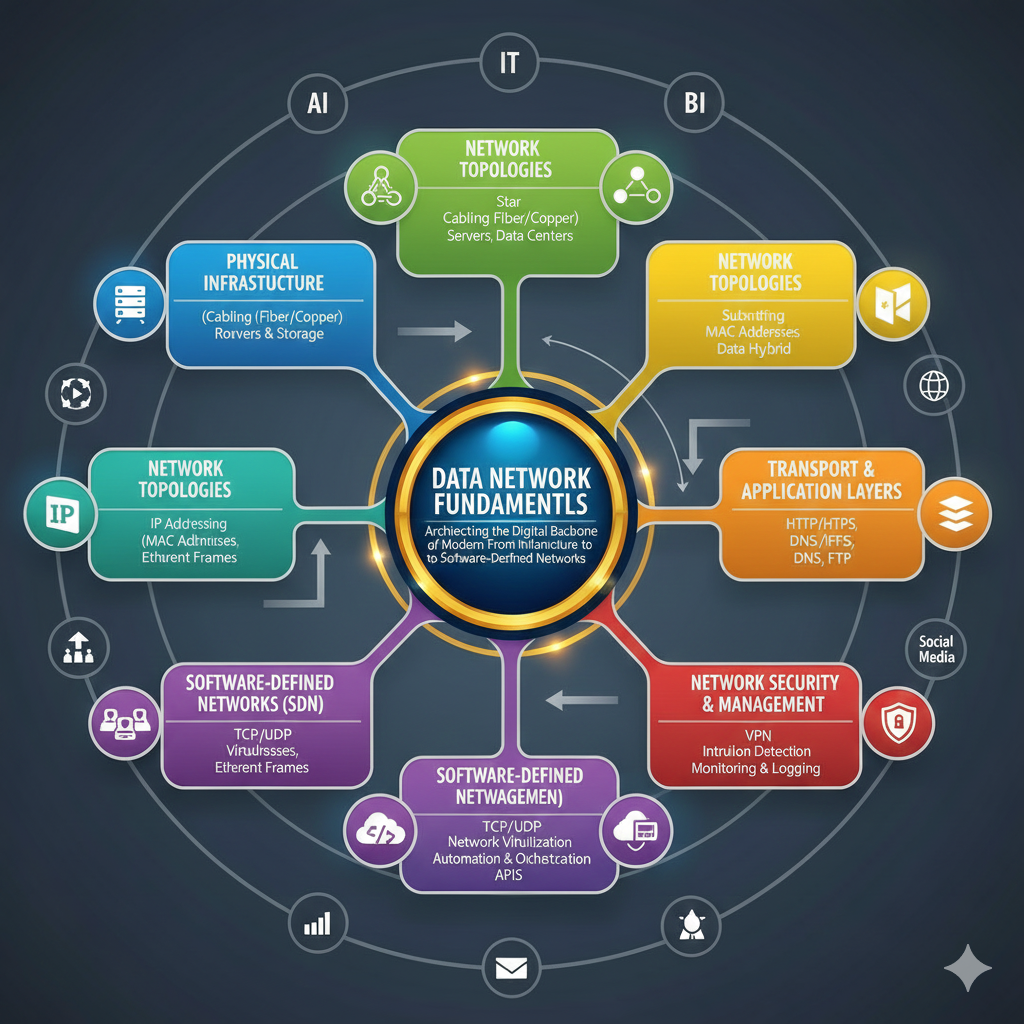
Professional mind map of Enterprise Data Network Fundamentals, showing branches for Physical Infrastructure, Software-Defined Networking (SDN), and Network Security.
🌐 Building the Digital Backbone: From Physical to Software-Defined. 🚀 In today’s enterprise, the network is more than just wires; it's the intelligent foundation for AI and autonomous systems. This mind map breaks down the core pillars of modern networking—bridging the gap between legacy hardware and the future of SD-WAN and automated infrastructure. #ITInfrastructure #Networking #SDN

DATA NETWORK FUNDAMENTALS

DATA NETWORK FUNDAMENTALS Architecting the Digital Backbone of Modern Enterprise From Physical Infrastructure to Software-Defined Networks
Data Network Fundamentals: Architecting the Digital Backbone

🌐 DATA NETWORK FUNDAMENTALS

Architecting the Digital Backbone of Modern Enterprise

From Physical Infrastructure to Software-Defined Networks

1. Executive Overview: The Foundation of Digital Transformation

🎯 Presentation Mission: This comprehensive presentation explores data networking fundamentals from first principles through cutting-edge innovations. We’ll examine physical and logical architectures, routing protocols, network topologies, and the revolutionary shift toward software-defined networking in the cloud and AI era. Whether you’re architecting enterprise networks for Cisco, Juniper, Nokia, or emerging vendors, this presentation provides the technical depth and strategic context essential for modern network engineering.

Data networks form the circulatory system of our digital civilization, carrying petabytes of information across global infrastructure connecting billions of devices. From submarine fiber optic cables spanning oceans to millimeter-wave 5G signals connecting smartphones, from massive data center fabrics to edge computing nodes, networking technology enables every aspect of modern computing, communication, and commerce. Understanding network fundamentals has never been more critical as we transition from traditional hardware-centric architectures to software-defined, cloud-native, AI-optimized network infrastructures.

400+
Tbps Global Internet Traffic
5.3B
Internet Users Worldwide
29B
IoT Connected Devices
$1.5T
Global Network Equipment Market

1. Routers: Inter-Network Intelligence

Hardware Architecture

  • Control Plane: CPU, memory, routing protocol processing, management interfaces running network operating system (IOS-XR, Junos, SR Linux). Makes routing decisions and builds forwarding tables
  • Data Plane (Forwarding Plane): ASICs, NPUs, TCAM hardware performing high-speed packet forwarding based on routing table lookups. Operates at line rate without CPU involvement
  • Modular Chassis: Enterprise routers (Cisco ASR, Juniper MX) feature hot-swappable line cards, route processors, fabric modules supporting terabit-scale forwarding capacity
  • Interfaces: Diverse port types including Ethernet (1G, 10G, 25G, 40G, 100G, 400G), serial, optical transceivers (SFP, QSFP), supporting various media and distance requirements
  • Memory Hierarchy: DRAM for routing tables, TCAM for fast lookups, flash for OS storage, NVRAM for configuration persistence

Router Software Components

  • Network Operating Systems: Cisco IOS/IOS-XE/IOS-XR, Juniper Junos, Nokia SR OS, Arista EOS providing CLI, routing protocols, management capabilities
  • Routing Protocol Daemons: Separate processes for OSPF, BGP, IS-IS, EIGRP, RIP implementing protocol logic and maintaining neighbor relationships
  • Routing Information Base (RIB): Master routing table containing all routes learned from various protocols, with best path selection based on administrative distance
  • Forwarding Information Base (FIB): Optimized subset of RIB programmed into hardware for fast packet forwarding decisions
  • Management Plane: SSH, SNMP, NETCONF, RESTCONF, gRPC interfaces for configuration, monitoring, and automation

Enterprise Router Categories

  • Edge Routers: Border devices connecting enterprise to internet/WAN (Cisco ASR 1000, Juniper MX series) supporting BGP, MPLS, encryption, DDoS mitigation
  • Core Routers: High-capacity backbone devices (Cisco CRS, Juniper PTX, Nokia FP) providing terabit switching fabrics for carrier and large enterprise networks
  • Branch Routers: Integrated services routers (Cisco ISR, Juniper SRX) combining routing, switching, security, wireless for remote offices
  • Virtual Routers: Software implementations (Cisco CSR 1000v, Juniper vMX, VyOS) running in virtualized or cloud environments

2. Switches: Local Network Fabric

Switching Technologies

  • Layer 2 Switches: MAC address-based forwarding within VLANs using content addressable memory (CAM) tables, operating at wire speed with microsecond latencies
  • Layer 3 Switches: Combined switching and routing capabilities performing inter-VLAN routing in hardware using ternary CAM (TCAM) for IP lookups
  • Multilayer Switches: Advanced platforms (Cisco Catalyst 9000, Juniper EX, Arista 7000) integrating routing protocols, ACLs, QoS, and application awareness
  • Data Center Switches: High-density leaf-spine architectures (Arista 7500, Cisco Nexus 9000, Juniper QFX) supporting VXLAN overlays, EVPN, 400GbE optics

Switch Hardware Features

  • Port Density: Enterprise switches supporting 24-48 ports per unit with stacking capabilities aggregating multiple switches into single logical device
  • Power over Ethernet (PoE): IEEE 802.3af/at/bt standards delivering power to IP phones, wireless access points, cameras through Ethernet cables
  • Stacking Technology: High-speed backplane (Cisco StackWise, Juniper Virtual Chassis) creating unified management and forwarding plane across multiple physical switches
  • Redundancy: Dual power supplies, hot-swappable fans, modular components ensuring continuous operation during component failures

Key Switch Protocols

  • Spanning Tree Protocol (STP/RSTP/MSTP): Loop prevention in redundant Layer 2 topologies, blocking redundant paths while maintaining backup connectivity
  • Link Aggregation (LACP): IEEE 802.3ad bundling multiple physical links into single logical connection for bandwidth aggregation and redundancy
  • Virtual Trunking Protocol (VTP): Cisco proprietary VLAN management protocol synchronizing VLAN configurations across switches (use with caution in production)
  • VLAN Trunking (802.1Q): Standard protocol carrying multiple VLANs over single physical link using VLAN tags in Ethernet frames

3. MPLS: Multi-Protocol Label Switching

MPLS Fundamentals

  • Label-Based Forwarding: Layer 2.5 technology using short fixed-length labels instead of lengthy IP address lookups, enabling fast packet forwarding and traffic engineering
  • Label Distribution Protocol (LDP): Automatic label distribution mechanism creating label-switched paths (LSPs) across MPLS networks without manual configuration
  • Label Stack: Multiple labels pushed onto packets enabling hierarchical VPNs, traffic engineering tunnels, and QoS classifications in single packet
  • Provider Edge (PE) Routers: Customer-facing MPLS routers handling VPN attachment, label imposition/disposition, and inter-AS routing
  • Provider (P) Routers: Core MPLS devices performing label swapping at high speed without examining IP headers or VPN contexts

MPLS Applications

  • Layer 3 VPNs (MPLS VPN/BGP MPLS VPN): Scalable multi-tenant IP VPN service using VRF instances and MP-BGP for route distribution across provider backbone
  • Layer 2 VPNs (VPLS, VPWS): Virtual private LAN service and virtual private wire service providing Layer 2 connectivity across MPLS networks
  • Traffic Engineering (MPLS-TE): Explicit path routing using RSVP-TE or PCEP creating constrained shortest path first (CSPF) tunnels for bandwidth optimization
  • Fast Reroute (FRR): Sub-50ms failover protection using pre-computed backup paths activated immediately upon link or node failure detection
  • Quality of Service: EXP bits in MPLS header enabling differentiated services and per-hop behaviors for voice, video, and data traffic classes

4. Gateways: Protocol Translation and Interconnection

Gateway Functions

  • Default Gateway: Router interface serving as exit point from local subnet, typically first or last usable IP address in subnet range
  • Protocol Gateways: Converting between different protocol stacks (IPv4/IPv6 translation, SIP/H.323 gateways, API gateways) enabling communication across incompatible systems
  • Application Gateways: Layer 7 proxies providing protocol-specific intelligence, security inspection, content filtering, and load balancing for HTTP, FTP, SMTP
  • VoIP Gateways: Connecting traditional PSTN telephony to IP networks, performing voice encoding, signaling translation (SIP, H.323, MGCP), and media processing
  • IoT Gateways: Edge devices aggregating sensor data, protocol translation (Zigbee, LoRaWAN to IP), local processing, and cloud connectivity for industrial IoT deployments

5. Network Operating Systems and Software

Major Network OS Platforms

  • Cisco IOS Family: IOS (legacy monolithic), IOS-XE (Linux-based with modularity), IOS-XR (carrier-grade high availability), NX-OS (data center fabric)
  • Juniper Junos: FreeBSD-based unified OS across routing, switching, security platforms featuring consistent CLI and modular architecture
  • Nokia SR OS: Service Router Operating System optimized for carrier networks with advanced MPLS, segment routing, and virtualization capabilities
  • Arista EOS: Extensible Operating System built on Linux providing state-driven programmability, automation APIs, and cloud-native architecture
  • Open Source Alternatives: VyOS, FRRouting, SONiC (Software for Open Networking in the Cloud), providing vendor-neutral network operating systems

Network Management Software

  • Configuration Management: Ansible, Puppet, Chef, SaltStack enabling infrastructure-as-code practices with version control and automated deployment
  • Monitoring Systems: Nagios, Zabbix, Prometheus, PRTG providing real-time visibility into network performance, availability, and capacity metrics
  • Network Controllers: Cisco DNA Center, Juniper Contrail, VMware NSX orchestrating network policies, automation, and analytics across infrastructure
  • Flow Analytics: NetFlow/sFlow/IPFIX collectors and analyzers (SolarWinds, Plixer, Kentik) providing traffic visibility for capacity planning and security
⚠️ Vendor Selection Considerations:
  • Cisco: Market leader with extensive product portfolio, large talent pool, established ecosystem, but premium pricing and vendor lock-in concerns
  • Juniper: Strong in service provider and enterprise core, excellent automation capabilities, Junos consistency across platforms
  • Nokia: Carrier-grade reliability, deep MPLS/segment routing expertise, strong in mobile networks and IP/optical convergence
  • Arista: Data center and cloud networking leader, programmable architecture, modern APIs, competitive cloud-scale economics
  • Open Networking: Disaggregated hardware/software, community-driven innovation, but requires deeper expertise and ecosystem maturity

Multicast

Efficient one-to-many communication method delivering single stream to multiple receivers simultaneously. Uses IGMP, PIM protocols and special addressing (224.0.0.0/4) for video distribution and financial data feeds.

🔧 OSI Model Layers – Network Context

  • Layer 1 – Physical: Bits, cables, fiber, wireless signals – Cisco SFP modules, fiber optics, Ethernet standards
  • Layer 2 – Data Link: Frames, MAC addresses, switching – VLANs, spanning tree, Ethernet, MPLS labels
  • Layer 3 – Network: Packets, IP addressing, routing – Routers, IP, OSPF, BGP, EIGRP protocols
  • Layer 4 – Transport: Segments, ports, reliability – TCP/UDP, port numbers, flow control
  • Layer 5-7 – Upper Layers: Sessions, presentation, applications – HTTP, DNS, SMTP, APIs

3. Core Network Components: Hardware and Software

Modern networks comprise sophisticated hardware platforms running complex software stacks enabling packet forwarding, protocol processing, traffic engineering, and network services. Understanding these components and their interactions is fundamental to network design and operations.

🏗️ Network Infrastructure Architecture
Routers
Layer 3 Packet Forwarding & Inter-Network Communication
Switches
Layer 2 Frame Switching & Local Network Fabric
Gateways
Protocol Translation & Network Interconnection
Firewalls
Security Policy Enforcement & Traffic Filtering
Load Balancers
Traffic Distribution & Application Delivery
Controllers
SDN Centralized Control Plane Management

4. Network Topologies: Physical and Logical Architectures

Network topology defines how devices are physically connected and logically organized, directly impacting performance, reliability, scalability, and operational complexity. Modern networks often combine multiple topologies at different layers creating hybrid architectures optimized for specific requirements.

🔷 Network Topology Patterns
Bus Topology
Linear Sequential Connection
Star Topology
Centralized Hub Architecture
Ring Topology
Circular Path Design
Mesh Topology
Full/Partial Interconnection
Tree Topology
Hierarchical Structure
Hybrid Topology
Combined Architectures

Classic Topology Patterns

Bus Topology

Architecture: All devices connected to single communication line (backbone cable) with terminators at both ends

Advantages: Simple implementation, minimal cabling, easy expansion for small networks

Disadvantages: Single point of failure, performance degrades with increased traffic, difficult troubleshooting, collision domains

Use Cases: Legacy Ethernet (10BASE2, 10BASE5), small office networks, now largely obsolete except specialized industrial applications

Star Topology

Architecture: All devices connect to central hub or switch creating centralized point for all communications

Advantages: Easy troubleshooting, device failure doesn’t affect network, simple addition/removal of devices, centralized management

Disadvantages: Central device represents single point of failure, requires more cabling than bus, hub device cost

Use Cases: Modern Ethernet LANs, office networks, access layer switches, most common topology in enterprise environments

Ring Topology

Architecture: Devices connected in closed loop with data traveling in one or both directions using token passing or similar mechanism

Advantages: Deterministic performance, equal access to network, no collision domain issues, predictable latency

Disadvantages: Single link failure breaks ring (without redundancy), difficult reconfiguration, troubleshooting complexity

Use Cases: Token Ring (legacy), FDDI, SONET/SDH rings, industrial control systems, metropolitan area networks with dual-ring protection

Mesh Topology

Architecture: Multiple direct point-to-point connections between devices (full mesh: all-to-all, partial mesh: selective connections)

Advantages: High redundancy and fault tolerance, multiple paths for load distribution, no single point of failure, excellent reliability

Disadvantages: Expensive with many links required (n(n-1)/2 for full mesh), complex configuration, difficult management at scale

Use Cases: Wireless mesh networks, data center spine-leaf fabrics, WAN interconnects, military and critical infrastructure networks

Tree (Hierarchical) Topology

Architecture: Hierarchical structure with root node branching to subordinate layers, combining characteristics of bus and star topologies

Advantages: Scalable design, hierarchical organization matches business structure, easy expansion, fault isolation by branch

Disadvantages: Root node failure affects entire network, complex cabling, backbone dependency

Use Cases: Campus networks, three-tier architecture (core/distribution/access), enterprise WAN designs, spanning tree protocol domains

Hybrid Topology

Architecture: Combination of two or more topologies creating complex but optimized network designs

Advantages: Flexibility to optimize different segments, leverages strengths of multiple designs, scalable architecture

Disadvantages: Design complexity, potential interoperability challenges, requires sophisticated planning

Use Cases: Large enterprise networks, data centers (spine-leaf mesh with star access), campus networks (hierarchical with mesh core)

Modern Data Center Topologies

Leaf-Spine Architecture

  • Design Principle: Two-tier Clos network with leaf switches connecting servers and spine switches providing full-mesh connectivity between leaves
  • Characteristics: Every leaf connects to every spine, consistent latency (two hops maximum), predictable performance, horizontal scalability
  • Benefits: Equal-cost multipath (ECMP) load distribution, easy capacity addition, no spanning tree complexity, optimal for east-west traffic
  • Protocols: BGP unnumbered, VXLAN overlays, EVPN control plane, segment routing providing L2/L3 fabric with SDN programmability
  • Use Cases: Cloud data centers, hyperscale environments, private clouds, containerized workloads requiring network agility

Fat-Tree Topology

  • Design Principle: Three-tier architecture with access, aggregation, and core layers providing multiple paths between endpoints
  • Oversubscription: Ratio of downlink to uplink bandwidth (1:1 non-blocking, 2:1, 4:1, 8:1) balancing cost and performance
  • Advantages: Proven design, vendor ecosystem support, familiar operational model, incremental migration path
  • Limitations: Complex spanning tree domains, challenging scalability, suboptimal for modern workload patterns

SD-WAN Topology Patterns

  • Hub-and-Spoke: Traditional WAN with branches connecting through central headquarters providing centralized security and services
  • Full Mesh: Direct any-to-any connectivity between sites using dynamic IPsec tunnels, optimal for voice/video collaboration
  • Hybrid: Combination of MPLS core with internet breakout, application-aware path selection, dynamic traffic steering based on performance
  • Cloud-First: Branch sites connecting directly to cloud providers with local internet breakout, minimal datacenter traversal
✅ Topology Selection Guidelines:
  • Star topology for office LANs providing simplicity and centralized management
  • Leaf-spine for data centers requiring predictable latency and horizontal scalability
  • Partial mesh for WAN balancing redundancy with connection costs
  • Ring with protection for metropolitan networks requiring carrier-grade reliability
  • Hybrid designs for large enterprises optimizing different network segments appropriately

5. Routing Protocols and Algorithms: The Intelligence Layer

Routing protocols represent the distributed intelligence enabling networks to automatically discover topologies, calculate optimal paths, and dynamically adapt to failures or changes. Understanding protocol characteristics, operational behaviors, and appropriate deployment scenarios is essential for network design and troubleshooting.

🛣️ Routing Protocol Classification
Distance Vector
RIP, EIGRP – Direction & Distance
Link State
OSPF, IS-IS – Complete Topology
Path Vector
BGP – Path Attributes
Interior Gateway
IGP – Within AS
Exterior Gateway
EGP – Between AS
Hybrid Protocols
EIGRP – Combined Features

Interior Gateway Protocols (IGP)

OSPF (Open Shortest Path First)

  • Protocol Type: Link-state IGP using Dijkstra’s Shortest Path First (SPF) algorithm for best path calculation
  • Operation: Routers flood link-state advertisements (LSAs) describing their connections, each router builds identical topology database (LSDB) and computes shortest path tree
  • Metric: Cost based on interface bandwidth (reference bandwidth / interface bandwidth), lower cost preferred, default reference 100 Mbps
  • Areas: Hierarchical design with backbone area (Area 0) and subordinate areas reducing LSDB size, controlling LSA flooding, improving scalability
  • Area Types: Standard areas, stub areas (no external routes), totally stubby areas (single default route), NSSA (allowing limited external injection)
  • Router Roles: Internal routers (single area), Area Border Routers (ABR connecting areas), Autonomous System Boundary Routers (ASBR importing external routes), Backbone routers
  • Neighbor Formation: Hello protocol discovering neighbors on broadcast/point-to-point segments, DR/BDR election on multi-access networks reducing adjacencies
  • Convergence: Fast convergence (sub-second with proper tuning) due to event-driven updates, SPF calculation upon topology change
  • Authentication: MD5 or SHA authentication preventing routing table pollution from unauthorized sources
  • Versions: OSPFv2 for IPv4, OSPFv3 for IPv6 with address-family extensions supporting both protocols
  • Use Cases: Enterprise networks, data centers, campus environments requiring fast convergence and hierarchical design

IS-IS (Intermediate System to Intermediate System)

  • Protocol Type: Link-state IGP originally for ISO CLNS, adapted for IP routing in large service provider and data center networks
  • Advantages: Protocol-agnostic design supporting IPv4, IPv6, MPLS simultaneously, flat address space, no IP dependency for protocol operation
  • Level Structure: Level-1 (intra-area), Level-2 (inter-area backbone), Level-1-2 (both) providing hierarchical routing with less overhead than OSPF
  • Network Types: Point-to-point and broadcast networks with DIS (Designated Intermediate System) election similar to OSPF DR
  • Metric: Originally narrow metric (6-bit), extended metrics (24-bit or 32-bit) for modern high-bandwidth interfaces
  • Use Cases: Large service provider networks, internet backbone, data center fabrics, segment routing deployments

EIGRP (Enhanced Interior Gateway Routing Protocol)

  • Protocol Type: Cisco proprietary (later opened) advanced distance-vector protocol with link-state characteristics
  • DUAL Algorithm: Diffusing Update Algorithm ensuring loop-free operation and providing instant convergence to backup paths (feasible successors)
  • Composite Metric: K-values weighting bandwidth, delay, reliability, load, MTU (typically only bandwidth and delay used)
  • Features: Partial updates (only changes), bounded updates (only affected routers), rapid convergence, unequal-cost load balancing
  • Neighbor Discovery: Hello protocol with holdtime, reliable transport for updates using RTP (Reliable Transport Protocol)
  • Use Cases: Cisco-centric enterprise networks, environments requiring fast convergence and unequal-cost load balancing

Exterior Gateway Protocol (EGP)

BGP (Border Gateway Protocol)

  • Protocol Type: Path-vector EGP using TCP (port 179) for reliable communication between autonomous systems
  • Function: Internet routing protocol connecting 70,000+ autonomous systems, exchanging hundreds of thousands of network prefixes
  • Path Attributes: AS_PATH (loop prevention), NEXT_HOP (next router), LOCAL_PREF (inbound preference), MED (outbound suggestion), COMMUNITY tags
  • Path Selection: Complex decision process considering: highest weight, highest LOCAL_PREF, locally originated, shortest AS_PATH, lowest origin type, lowest MED, eBGP over iBGP, lowest IGP metric, oldest path, lowest router ID
  • BGP Types: eBGP (external, between different AS), iBGP (internal, within AS requiring full mesh or route reflectors)
  • Route Reflectors: Scaling mechanism avoiding iBGP full mesh by allowing designated routers to re-advertise routes to clients
  • Confederation: Dividing single AS into sub-ASs reducing iBGP complexity while appearing as single AS externally
  • Prefix Filtering: Extensive policy control using prefix-lists, AS-path filters, community matching enabling granular traffic engineering
  • BGP Security: MD5 authentication, GTSM (Generalized TTL Security), prefix limit protection, RPKI (Resource Public Key Infrastructure) for route origin validation
  • Timers: Keepalive (60s default), holdtime (180s), slower convergence than IGPs but providing stability through dampening
  • Use Cases: Internet routing, multi-homing, large enterprise WAN, data center fabric (BGP unnumbered), MPLS VPN (MP-BGP)

MP-BGP (Multi-Protocol BGP)

  • Extensions: Address family support for IPv4 unicast, IPv6 unicast, VPNv4, VPNv6, EVPN, multicast, MPLS labels
  • VPN Applications: MPLS L3VPN using route distinguishers (RD) and route targets (RT) for multi-tenant isolation
  • EVPN: Ethernet VPN control plane for VXLAN overlays in data centers providing MAC/IP learning, multihoming, optimal forwarding

Advanced Routing Concepts

VRF (Virtual Routing and Forwarding)

  • Definition: Multiple separate routing table instances on single router creating virtualized routers with isolated routing domains
  • Components: Separate RIB, FIB, interface assignment per VRF enabling complete traffic isolation
  • VRF-Lite: VRF without MPLS for local segregation in enterprises (customer separation, management network isolation)
  • MPLS VPN: VRF combined with MP-BGP and MPLS for scalable service provider VPN offerings
  • Use Cases: Multi-tenancy, network segmentation, managed services, testing/development environment isolation

Route Redistribution and Filtering

  • Redistribution: Importing routes between routing protocols (OSPF↔BGP, EIGRP↔OSPF) requiring careful metric translation and loop prevention
  • Route Maps: Powerful policy tools matching traffic based on prefixes, AS paths, communities and modifying attributes like metric, preference, tags
  • Prefix Lists: Efficient filtering based on IP prefix and prefix-length ranges (permit/deny specific networks)
  • Route Tags: Marking routes during redistribution for filtering at redistribution boundaries preventing loops
  • Administrative Distance Manipulation: Adjusting route preference when multiple protocols provide routes to same destination

Policy-Based Routing (PBR)

  • Purpose: Overriding routing table decisions based on source address, application, or other criteria for traffic engineering
  • Match Criteria: Source/destination IP, packet length, TOS/DSCP, application protocols
  • Actions: Set next-hop, set interface, set IP precedence/DSCP, set VRF
  • Use Cases: Multi-ISP traffic distribution, application-specific path selection, guest network routing through internet without corporate access

🔧 Protocol Selection Decision Matrix

Scenario Recommended Protocol Rationale
Enterprise Campus OSPF Industry standard, vendor neutral, fast convergence, hierarchical design
Service Provider Core IS-IS + MP-BGP Scalability, protocol independence, segment routing support
Data Center Fabric BGP (eBGP or iBGP) Simple configuration, ECMP support, proven at scale
Internet Edge BGP Only option for inter-AS routing, policy control, multi-homing
Small Branch Static Routes or EIGRP Simplicity, minimal overhead, easy troubleshooting
MPLS VPN Provider MP-BGP + IGP (OSPF/IS-IS) Standard VPN implementation, scalable multi-tenancy

6. Software-Defined Networking: The Paradigm Shift

Software-Defined Networking represents fundamental architectural transformation separating network control intelligence from forwarding hardware, enabling programmatic network management, dynamic policy enforcement, and infrastructure automation at unprecedented scale.

🚀 SDN Architecture Components
Application Layer
Business Applications & Orchestration
Control Plane
Centralized Network Intelligence
Data Plane
Hardware Packet Forwarding
Northbound APIs
Application Integration
Southbound APIs
Device Communication
Management Plane
Operations & Analytics

SDN Fundamentals

Core Principles

  • Control/Data Plane Separation: Network intelligence moved from individual devices to centralized controller providing global network view and coordinated decision-making
  • Programmability: Network behavior defined through software using high-level languages and APIs rather than device-specific CLI configurations
  • Centralized Control: Single logical controller (physically distributed) maintaining network state and computing forwarding decisions
  • Open Interfaces: Standard protocols (OpenFlow, NETCONF, RESTCONF) enabling multi-vendor environments and innovation
  • Network Abstraction: Applications interact with logical network view without concerning physical infrastructure details

OpenFlow Protocol

  • Definition: Standard southbound protocol enabling controller to program flow tables in switches, defining match-action rules for packet forwarding
  • Flow Tables: Match fields (MAC, IP, ports, VLAN, MPLS), priority, counters, instructions (forward, drop, modify, goto-table)
  • Controller Communication: Secure channel (TLS) between switch and controller for flow installation, packet-in events, statistics collection
  • Pipeline Processing: Multiple tables enabling complex forwarding logic with sequential processing and table transitions
  • Versions: OpenFlow 1.0 (basic forwarding), 1.3 (multiple tables, groups), 1.4-1.5 (enhanced features, extensibility)
  • Limitations: State synchronization complexity, controller scalability, single point of failure without proper redundancy

SDN Controllers

  • OpenDaylight: Linux Foundation project, Java-based, modular architecture, extensive protocol support (OpenFlow, NETCONF, BGP-LS)
  • ONOS (Open Network Operating System): Carrier-grade SDN controller designed for high availability, scalability, performance in service provider networks
  • Cisco ACI (Application Centric Infrastructure): Data center SDN solution using declarative policy model, hardware VXLAN fabric, centralized APIC controller
  • VMware NSX: Network virtualization platform providing overlay networking, micro-segmentation, distributed firewall for virtualized environments
  • Juniper Contrail: Cloud networking controller supporting OpenStack, Kubernetes, providing multi-cloud connectivity and security

Modern Network Protocols

NETCONF (Network Configuration Protocol)

  • Purpose: IETF standard protocol for network device configuration management using XML encoding over secure transport (SSH, TLS)
  • Operations: get, get-config, edit-config, copy-config, delete-config, lock, unlock enabling transactional configuration changes
  • YANG Models: Data modeling language defining configuration and operational state structure for vendor-neutral automation
  • Capabilities: Candidate configuration, confirmed commit, rollback-on-error providing safe configuration deployment
  • Advantages: Structured data (vs. CLI parsing), transaction support, standardized error handling, vendor interoperability

RESTCONF

  • Definition: HTTP-based protocol providing RESTful API access to YANG-modeled data using JSON or XML encoding
  • HTTP Methods: GET (retrieve), POST (create), PUT (replace), PATCH (modify), DELETE (remove) mapping to CRUD operations
  • Advantages: Web-friendly, easy integration with modern applications, stateless operation, widespread tooling support
  • Use Cases: Microservices integration, cloud automation, application-driven networking, DevOps workflows

gRPC and gNMI

  • gRPC: Google’s high-performance RPC framework using HTTP/2 and Protocol Buffers for efficient network automation
  • gNMI (gRPC Network Management Interface): Streaming telemetry and configuration protocol providing real-time operational data
  • Benefits: High performance, bidirectional streaming, strong typing, language-agnostic, sub-second telemetry collection
  • Telemetry: Model-driven telemetry streaming structured operational data at scale replacing polling-based SNMP

Segment Routing (SR)

  • Concept: Source-based routing encoding explicit path as stack of segments (instructions) in packet header
  • SR-MPLS: Segment routing using MPLS data plane with simplified label distribution (no LDP required)
  • SRv6: Segment routing using IPv6 with segments encoded in IPv6 address providing network programming capabilities
  • Segment Types: Node segments (routing to specific node), adjacency segments (forwarding over specific link), service segments (service function chaining)
  • Benefits: Simplified control plane, optimal traffic engineering, seamless SDN integration, service function chaining
  • Use Cases: 5G transport networks, cloud interconnection, traffic engineering, low-latency applications

EVPN (Ethernet VPN)

  • Definition: MP-BGP-based control plane for Layer 2 and Layer 3 VPN services in data centers and service provider networks
  • VXLAN Integration: EVPN provides control plane for VXLAN overlays enabling automated MAC/IP learning and optimal forwarding
  • Features: Multi-homing with active-active forwarding, MAC mobility, ARP suppression, integrated routing and bridging (IRB)
  • Route Types: Ethernet auto-discovery, MAC/IP advertisement, inclusive multicast, Ethernet segment, IP prefix routes
  • Use Cases: Data center interconnect (DCI), multi-tenant cloud, campus fabric, replacing traditional spanning tree designs

Network Automation and Orchestration

Infrastructure as Code (IaC)

  • Ansible: Agentless automation using YAML playbooks, extensive network module library (Cisco, Juniper, Arista), idempotent operations
  • Terraform: Infrastructure provisioning tool using declarative configuration, state management, cloud and on-premises resource creation
  • Python Automation: Netmiko, NAPALM, Nornir libraries providing programmatic device interaction and configuration management
  • Version Control: Git-based workflows enabling configuration versioning, peer review, automated testing, rollback capabilities

Intent-Based Networking (IBN)

  • Concept: Defining desired business outcomes (intent) rather than device configurations, with system automatically implementing and verifying
  • Components: Translation (intent to configuration), activation (deploying changes), assurance (continuous verification)
  • Examples: Cisco DNA Center, Juniper Apstra, Aruba NetEdit providing intent-based automation with closed-loop verification
  • Benefits: Reduced complexity, faster deployment, proactive issue detection, consistent policy enforcement
✅ SDN Adoption Strategy:
  • Start Small: Begin with network automation (Ansible, Python) before full SDN controller deployment
  • Overlay Approach: Deploy SDN overlays (VXLAN, SD-WAN) over existing underlay minimizing disruption
  • Use Case Focus: Target specific problems (data center automation, WAN optimization) rather than complete replacement
  • Skills Development: Invest in staff training on programming, APIs, automation tools alongside traditional networking
  • Hybrid Model: Combine traditional routing protocols with SDN controllers for gradual transition

7. Network Evolution: From Circuit Switching to Cloud-Native

Data networking has undergone revolutionary transformation from simple point-to-point connections to complex, software-defined, globally distributed infrastructures supporting billions of devices and exabyte-scale traffic volumes.

1960s-1970s
Foundation Era
ARPANET creation (1969) pioneering packet switching, TCP/IP protocol suite development, Ethernet invention (1973) by Xerox PARC, establishing fundamental concepts of modern networking.
1980s
Standardization Period
TCP/IP standardization (RFC 791, 793), DNS introduction (1983), BGP initial specification (1989), OSI model standardization, Cisco founded (1984) commercializing routing technology.
1990s
Internet Explosion
World Wide Web launch (1991), ISP proliferation, IPv6 specification (1998) addressing exhaustion concerns, Fast Ethernet (100Mbps), Gigabit Ethernet, MPLS development for traffic engineering.
2000s
Enterprise Networking Maturity
10 Gigabit Ethernet standardization, wireless networking (WiFi) ubiquity, VoIP mainstream adoption, virtualization impacting network design, IPv4 address exhaustion crisis accelerating.
2010-2015
Cloud and SDN Revolution
Cloud computing dominance (AWS, Azure, GCP), SDN emergence with OpenFlow, 40/100GbE data center networks, software-defined WAN introduction, network function virtualization (NFV) concepts.
2016-2020
Hyperscale and Automation
400GbE specification, white-box networking, SONiC adoption, intent-based networking, AI-driven network operations, WiFi 6, 5G deployment beginning, network automation mainstream.
2021-2025
Cloud-Native and AI Integration
800GbE development, segment routing adoption, SASE architecture, AI/ML-powered network optimization, WiFi 7, 5G standalone networks, quantum networking research, edge computing proliferation.

Networks in the Cloud Era

Cloud Networking Paradigms

  • Virtual Private Cloud (VPC): Isolated network environments in public cloud with customer-defined IP addressing, routing tables, security groups
  • Software-Defined WAN (SD-WAN): Application-aware WAN leveraging multiple transport types (MPLS, internet, LTE) with dynamic path selection and zero-touch provisioning
  • Multi-Cloud Networking: Consistent connectivity and policy across AWS, Azure, GCP, private clouds using overlay networks and centralized management
  • Cloud Interconnection: Direct connections (AWS Direct Connect, Azure ExpressRoute, GCP Interconnect) bypassing public internet for performance and security
  • SASE (Secure Access Service Edge): Converged WAN and security services delivered from cloud edge locations providing unified connectivity and protection

Container and Kubernetes Networking

  • Container Networking Interface (CNI): Plugin architecture enabling diverse networking implementations for container orchestration platforms
  • Service Mesh: Dedicated infrastructure layer (Istio, Linkerd) managing service-to-service communication with load balancing, encryption, observability
  • Kubernetes Networking: Pod networking, Services abstraction, Ingress controllers, Network Policies providing microsegmentation
  • CNI Plugins: Calico (L3, policy-driven), Cilium (eBPF-based), Flannel (simple overlay), Weave (encrypted mesh) each with distinct characteristics

AI and Machine Learning Impact

AI-Powered Network Operations (AIOps)

  • Anomaly Detection: Machine learning identifying unusual traffic patterns, performance degradation, security threats from baseline behavior analysis
  • Predictive Analytics: Forecasting capacity requirements, link failures, performance issues enabling proactive remediation
  • Automated Remediation: AI systems automatically responding to common issues (rerouting traffic, adjusting QoS, restarting services)
  • Root Cause Analysis: Correlating multiple symptoms across infrastructure identifying underlying problems faster than manual investigation
  • Optimization: Continuous learning optimizing routing decisions, resource allocation, energy consumption based on observed patterns

AI Training Network Requirements

  • Bandwidth Demands: Distributed AI training requiring 400GbE/800GbE networks with RDMA for GPU-to-GPU communication
  • Ultra-Low Latency: Microsecond-scale latency critical for synchronous training across multiple nodes
  • Lossless Fabrics: Priority flow control (PFC), explicit congestion notification (ECN) preventing packet loss during training
  • Scale-Out Architecture: Massive east-west traffic patterns requiring non-blocking leaf-spine fabrics

Edge Computing Networks

  • Multi-Access Edge Computing (MEC): Computing and storage at cellular network edge enabling ultra-low latency applications
  • CDN Evolution: Content delivery networks expanding to edge compute platforms supporting IoT aggregation, AI inference
  • 5G Integration: Network slicing providing dedicated virtual networks with customized performance characteristics
  • Edge-Cloud Continuum: Distributed computing from device to edge to regional data center to cloud with intelligent workload placement
🌟 Future Network Trends:
  • Quantum Networking: Quantum key distribution for unhackable encryption, quantum internet enabling distributed quantum computing
  • TeraHertz Communication: Sub-millimeter wave frequencies (0.1-10 THz) providing terabit wireless links for 6G
  • Optical Circuit Switching: Reconfigurable optical add-drop multiplexers (ROADMs) enabling software-defined optical networks
  • Neural Network Routers: AI-native routing protocols learning optimal paths through experience rather than algorithmic computation
  • Self-Healing Networks: Autonomous systems detecting and resolving issues without human intervention

8. Strategic Importance: Why Networks Matter More Than Ever

Data networks have transcended their role as mere IT infrastructure to become fundamental business enablers, competitive differentiators, and critical national infrastructure requiring strategic investment and continuous evolution.

Business Impact Dimensions

Digital Transformation Enabler

  • Cloud Migration: Network connectivity, bandwidth, latency directly determining feasibility and success of cloud adoption strategies
  • Remote Work: Pandemic-accelerated distributed workforce depending on VPN, SD-WAN, cloud access for productivity
  • IoT and Industry 4.0: Smart manufacturing, connected products, real-time monitoring requiring pervasive, reliable networking
  • AI/ML Operations: Distributed training, inference at edge, data lake access demanding high-performance network infrastructure

Competitive Advantage

  • Customer Experience: Website performance, application responsiveness, video quality directly influenced by network capabilities
  • Operational Efficiency: Network automation reducing manual effort, accelerating deployment, minimizing errors
  • Innovation Velocity: Agile network infrastructure enabling rapid experimentation, service deployment, market responsiveness
  • Global Reach: Multi-cloud, multi-region presence requiring sophisticated network architecture and management

Risk Management

  • Business Continuity: Network redundancy, failover capabilities, disaster recovery connectivity ensuring operational resilience
  • Security Posture: Network segmentation, encryption, access control forming foundation of cybersecurity defense
  • Compliance Requirements: Data sovereignty, privacy regulations requiring network visibility and control capabilities
  • Reputation Protection: Network outages, data breaches causing immediate brand damage and customer trust erosion

Economic Considerations

$300K
Average Hourly Cost of Network Downtime
35%
Network Infrastructure of IT Budget
23%
Revenue Impact from Poor Performance
70%
Reduction in MTTR with Automation

Societal Impact

  • Digital Divide: Network access determining economic opportunity, education access, healthcare availability
  • Critical Infrastructure: Energy grids, financial systems, healthcare, government services depending on network reliability
  • Innovation Platform: Open internet enabling entrepreneurship, creativity, knowledge sharing globally
  • Environmental Sustainability: Network efficiency, renewable energy integration, smart city applications reducing carbon footprint
⚠️ Strategic Network Challenges:
  • Complexity Management: Multi-vendor, multi-cloud, hybrid environments requiring sophisticated orchestration
  • Skills Gap: Shortage of network engineers with automation, programming, cloud networking expertise
  • Security Threats: DDoS attacks, network infiltration, BGP hijacking requiring continuous vigilance
  • Technology Refresh: Rapid innovation cycles demanding frequent upgrades and technology evaluation
  • Cost Optimization: Balancing performance requirements with budget constraints in competitive markets

9. Network Design Best Practices

Design Principles

  • Hierarchical Design: Three-tier (core/distribution/access) or two-tier (spine/leaf) providing scalability, fault isolation, predictable behavior
  • Redundancy: No single points of failure with dual power supplies, redundant links, backup devices, alternate paths
  • Modularity: Independent, interchangeable components enabling incremental upgrades, simplified troubleshooting
  • Simplicity: Minimize complexity where possible, standardize configurations, document thoroughly
  • Security by Design: Integrated security from inception, defense in depth, zero-trust principles
  • Performance: Oversubscription ratios, latency budgets, bandwidth planning based on growth projections
  • Manageability: Centralized monitoring, configuration management, automated deployment capabilities

Operational Excellence

  • Documentation: Network diagrams, IP address management, configuration backups, runbooks, change records
  • Monitoring: Real-time alerting, performance baselines, capacity trending, SLA tracking
  • Change Management: Testing procedures, rollback plans, maintenance windows, stakeholder communication
  • Capacity Planning: Growth projections, technology refresh cycles, budget forecasting
  • Security Practices: Regular audits, vulnerability assessments, patch management, access control reviews
✅ Network Career Development:
  • Certifications: CCNA, CCNP, CCIE (Cisco), JNCIA, JNCIS, JNCIE (Juniper), NRS (Nokia)
  • Programming Skills: Python, Go, JavaScript for automation, API integration, custom tooling
  • Cloud Platforms: AWS networking, Azure networking, GCP networking certification and hands-on experience
  • Automation Tools: Ansible, Terraform, Git, CI/CD pipelines for infrastructure as code
  • Emerging Technologies: SDN controllers, segment routing, EVPN, service mesh, containerized networking

10. Conclusion: Building Tomorrow’s Networks Today

Data networking stands at an inflection point where traditional architectures, protocols, and operational models are being fundamentally reimagined for cloud-native, AI-driven, software-defined future. The principles of packet switching, routing protocols, and hierarchical design remain relevant while implementation shifts from hardware-centric configurations to software-driven automation.

Key Takeaways

  • Fundamentals Matter: Core concepts of routing, switching, protocols provide foundation regardless of technology evolution
  • Software Transformation: Networks becoming programmable infrastructure managed through APIs, automation, intent-based systems
  • Cloud Integration: Network design inseparable from cloud strategy, multi-cloud connectivity, hybrid architectures
  • Automation Essential: Manual configuration unsustainable at modern scale, automation enabling agility and reliability
  • Security Integration: Zero-trust architecture, microsegmentation, encrypted everything becoming standard practice
  • Continuous Learning: Rapid technology evolution requiring commitment to ongoing skill development and knowledge acquisition
  • Business Alignment: Network strategy must align with business objectives, enabling digital transformation initiatives

Call to Action

  • Assess current network architecture against cloud-native best practices and SDN readiness
  • Develop automation strategy starting with configuration management and expanding to orchestration
  • Invest in team skills development covering programming, cloud platforms, modern protocols
  • Implement network observability providing real-time visibility and AI-powered analytics
  • Plan technology refresh cycles incorporating 400GbE, segment routing, EVPN capabilities
  • Establish DevOps practices for network operations with CI/CD pipelines and infrastructure as code
  • Build relationships with Cisco, Juniper, Nokia, Arista understanding product roadmaps and capabilities
🚀 The Future is Programmable:
Network engineers of tomorrow are software engineers who understand packets. The convergence of networking and software development creates unprecedented opportunities for those who master both domains. Embrace the transformation, invest in learning, and help architect the intelligent, automated, secure networks powering the next generation of digital experiences.

11. Additional Resources and References

Technical Documentation

  • Cisco: cisco.com/c/en/us/support/docs – Configuration guides, white papers, design best practices
  • Juniper: juniper.net/documentation – Day One books, technical library, TechLibrary
  • Nokia: nokia.com/networks/support – Product documentation, learning resources
  • IETF RFCs: ietf.org/standards/rfcs – Authoritative protocol specifications

Learning Platforms

  • Cisco Learning Network, Juniper Learning Portal, Nokia Bell Labs Technical Academy
  • Pluralsight, INE, CBT Nuggets for structured training courses
  • GitHub repositories with network automation examples and tools
  • Reddit: r/networking, r/ccna, r/juniper for community discussions
  • Packet Pushers, Network Collective, Heavy Networking podcasts

Hands-On Labs

  • Virtual Labs: GNS3, EVE-NG, Cisco Modeling Labs (CML), Juniper vLabs
  • Cloud Labs: AWS VPC, Azure Virtual Networks, GCP VPC for cloud networking practice
  • Automation Practice: NetDevOps environments, Ansible network labs, Terraform network modules
  • Open Source: FRRouting, VyOS, SONiC for vendor-neutral learning

Industry Certifications Path

  • Entry Level: CCNA (Cisco), JNCIA (Juniper), CompTIA Network+
  • Professional: CCNP Enterprise/Service Provider/Data Center, JNCIS, NRS II (Nokia)
  • Expert: CCIE Enterprise/Service Provider, JNCIE, NRS III (Nokia)
  • Specialized: Cisco DevNet, AWS Advanced Networking, Azure Network Engineer
  • Automation: Red Hat Ansible Automation, HashiCorp Terraform, Python Institute

Books and Publications

  • “Computer Networking: A Top-Down Approach” by Kurose and Ross – Fundamental concepts
  • “Routing TCP/IP Volume I & II” by Jeff Doyle – Deep dive into routing protocols
  • “MPLS Fundamentals” by Luc De Ghein – Comprehensive MPLS coverage
  • “Network Programmability and Automation” by O’Reilly – Modern automation practices
  • “BGP Design and Implementation” by Randy Zhang – Enterprise BGP strategies

Professional Organizations

  • IETF (Internet Engineering Task Force): Protocol standards development
  • IEEE (Institute of Electrical and Electronics Engineers): Ethernet and wireless standards
  • ONF (Open Networking Foundation): SDN and open networking initiatives
  • Linux Foundation Networking: Open source networking projects