
EDUNXT TECH LEARNING / PROFESSIONAL LEARNING MODULE
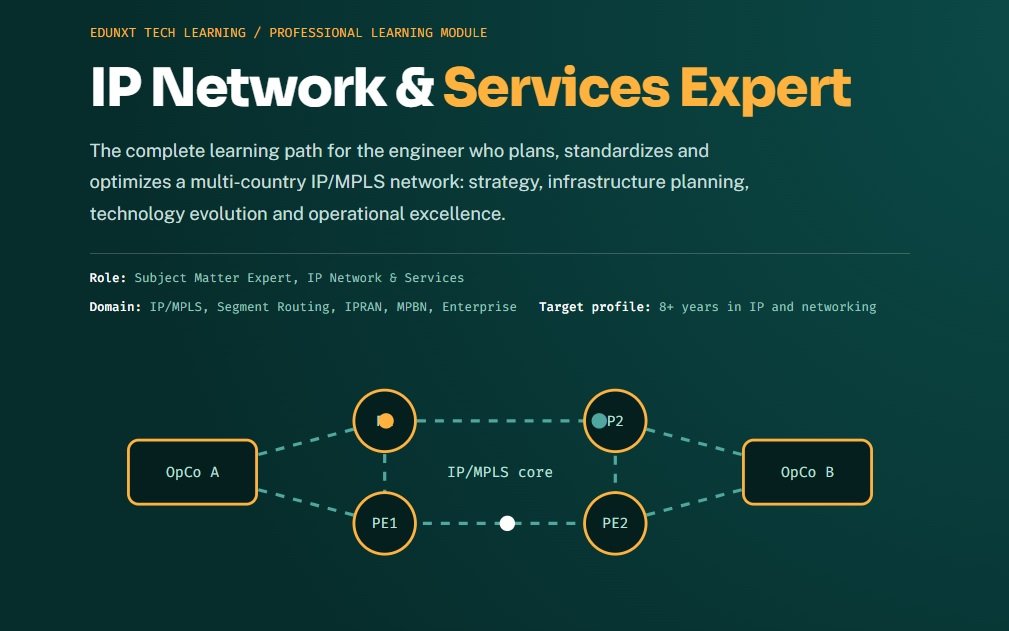
IP Network & Services Expert
The complete learning path for the engineer who plans, standardizes and optimizes a multi-country IP/MPLS network: strategy, infrastructure planning, technology evolution and operational excellence.
Module map
- 00The role at a glance and how to use this module
- 01Unit 1: Telecom IP architecture foundations
- 02Unit 2: MPLS, services and Segment Routing
- 03Unit 3: IPRAN and mobile backhaul
- 04Unit 4: Strategy for IP network and services
- 05Unit 5: Infrastructure planning, capacity and resilience
- 06Unit 6: Technology evolution and blueprint
- 07Unit 7: Standardization, optimization and KPIs
- 08Unit 8: Commercial, project and leadership skills
- 09Unit 9: Case studies, labs and 90-day plan
- 10FAQ and glossary
The Role at a Glance: Why This Expert Matters
Behind every call, video stream, mobile money transaction and enterprise VPN is an IP network that someone planned years earlier. The IP Network & Services Expert is the person who decides what that network should look like, how it should grow, which technologies it should adopt, and how its performance is measured. This module provides a comprehensive learning resource for an IP Network and Services subject matter expert into a structured professional curriculum.
This comprehensive learning module provides the framework for the purpose of the role as being a subject matter expert on IP network and services for strategic planning, technology evolution, standardization and optimization. The expert works with the operating companies (OpCos) in each country and with the head-office team to ensure end-to-end service delivery across internal and partner organizations, and to ensure that internal and external SLAs and KPIs are proactively managed and achieved. Notice what is absent from that sentence: there is no mention of configuring a single router. The role is senior precisely because its output is decisions, standards, plans and people who are better prepared, not individual commands.
That does not mean the expert can be less technical. It means technical depth is used as leverage. An expert who understands why a Segment Routing policy needs a maximum SID depth can write a tender that catches a vendor’s hardware limitation before the contract is signed. An expert who understands shared-risk link groups can look at a “dual-homed” diagram and ask the one question that exposes the shared duct. This module therefore pairs deep networking content with the planning, commercial and leadership skills for the job IP Network & Services Expert.
The four pillars of the role
This Learning Module organises the deliverables into four groups of activities. Each becomes a pillar of this module.
Decision rights: who decides what
This learning module includes a “decision level” section, but in the source it is only a template that explains the purpose of the section: describing which decisions the role holder takes, who is accountable, and where responsibility is primary, shared or merely contributory. For a role that spans several countries, clarifying decision rights is not bureaucracy; it prevents both paralysis and overreach. The table below proposes a realistic starting point that you should adapt to your own organisation.
| Decision | Expert’s level | Typically also involved |
|---|---|---|
| Target architecture and design standards | Primary: recommends and owns the standard | CTO or architecture board approves |
| Technical evaluation of vendors and products | Primary on technical scoring | Procurement and finance on commercial scoring |
| Capacity augmentation triggers and priorities | Shared with OpCo planning | OpCo CTO and finance for budget |
| Local configuration and change execution | Contributes guidance only | OpCo network operations are accountable |
| Capex envelope and business case approval | Contributes technical input | Finance, CTO and business owners |
| Processes, procedures and KPI definitions | Primary | OpCo operations adopt; quality function audits |
The competency map
The job description lists the skills critical to the role and the minimum background expected. The next table links every item to the unit where it is developed, so you can use it as a self-assessment checklist.
| Competency or requirement | Developed in |
|---|---|
| Strong in IP and MPLS networking | Units 1, 2, 3 |
| Segment Routing, IP services and implementation strategy in the telco domain | Units 2 and 6 |
| Multivendor IP products knowledge | Units 2 and 6 |
| Strategic planning for IP and MPLS services over access IPRAN and MPBN | Units 3, 4, 5 |
| Techno-commercial understanding of technology evolution and roadmaps | Units 4 and 6 |
| Commercial and project management | Unit 8 |
| Communication, problem solving, analytical ability, collaboration, boundaryless behaviour | Units 8 and 9 |
| Planning, optimization and O&M knowledge; performance management experience | Units 5 and 7 |
| Understanding of voice, data and infrastructure domains | Units 1 and 3 |
How to use this module
- Read for the decision, not just the definition. Every unit ends with the question an expert must be able to answer, such as “when do we order the upgrade?” or “which vendor and why?”
- Use the calculators. Units 5 contains two interactive tools, a capacity runway calculator and an availability calculator. Change the numbers until the behaviour is intuitive.
- Work the case studies and labs in Unit 9. They turn knowledge into artefacts: a model, a specification, a standard and a plan.
- Teach it back. The role requires on-the-job training of OpCo teams. If you can explain a unit to a colleague in ten minutes, you own it.
Telecom IP Architecture Foundations
The layers, node types and design principles of an operator IP network: access IPRAN, aggregation, IP/MPLS core, POPs, enterprise and data centre.
1.1 From a collection of routers to a layered network
A telecom operator’s IP infrastructure is not one network but several layers that evolved at different times for different purposes. The job description names them directly: MPBN, IP/MPLS infrastructure, POP routers, access IPRAN and the enterprise network. Planning, capacity management, resilience and KPI monitoring are all expected to cover each of them, so the first step is a clear mental map.
- Access IPRAN (IP radio access network) is the IP/MPLS-based backhaul that connects cell sites to the network. It is characterised by compact, cost-optimised routers at thousands of locations, ring or dual-homed topologies and the need to distribute precise timing. Unit 3 treats it in depth.
- Aggregation and metro routers concentrate many access rings, apply policy and quality-of-service, and hand traffic to the core. Capacity planning here is the most granular because there are many nodes.
- IP/MPLS core and MPBN. This module uses MPBN to mean the multi-service packet backbone that interconnects core nodes, data centres and regions. Some operators use the acronym for a mobile-specific packet backbone; the engineering principles are the same. The core is small in node count but large in blast radius: a failure here affects many services.
- POP routers are points of presence where the operator connects to the Internet, transit providers, peers, international carriers and partner organisations. They are where many external SLAs are won or lost.
- Enterprise network services, typically delivered as L3VPN or Ethernet services over the same infrastructure, carry contractual SLAs that are usually stricter than consumer mobile traffic.
1.2 The services that ride on the network
An expert thinks in services as well as nodes. The network exists to deliver mobile backhaul and core interconnect (the user plane and signalling of the radio and core networks), internet and transit, enterprise VPNs (L3VPN, L2VPN and EVPN), voice and IMS signalling, and wholesale and partner connectivity. Each service class has a different tolerance for delay, jitter, loss and outage time. Voice and signalling are sensitive to jitter and loss; bulk internet traffic tolerates delay but needs capacity; enterprise services are defined by their contract. Capturing these requirements, which the job description calls requirement capture through business engagement, begins with knowing what each service demands of the network.
1.3 Design principles that survive vendor changes
- Hierarchy and modularity. Separate access, aggregation and core roles, and use standard building blocks so that a design proven in one OpCo can be repeated in another.
- Underlay and overlay. The underlay (IGP plus MPLS or Segment Routing transport) provides reachability and fast restoration. Services such as VPNs are overlays that ride on top, so they can be added without redesigning the core.
- Redundancy by design. Every layer has a failure model: node, link, line card, power, software and path. Redundancy is verified, not assumed (Unit 5).
- Standardization. A small set of approved node types, software releases and configuration templates lowers operating cost and error rates (Unit 7).
- Observability. If a node, interface or path cannot be measured, it cannot be planned or optimised. Telemetry requirements belong in the design, not in an afterthought.
1.4 Routing and control plane in the core
Most operator cores run a link-state IGP (IS-IS or OSPF) to build topology and compute shortest paths between loopbacks, and BGP to carry customer and service routes. Large networks use route reflectors instead of a full iBGP mesh so that the number of sessions grows linearly rather than quadratically. Hierarchical IGP design (areas or levels) limits the scope of failures and the size of the link-state database; designs such as seamless MPLS extend label reachability across those boundaries with BGP labelled unicast. Segment Routing, covered in Unit 2, simplifies this by carrying segment information in the IGP itself.
Two details deserve an expert’s attention. First, IGP metrics are policy: they decide which path traffic prefers, so they should be set from a documented rule (for example, derived from link bandwidth and latency) and not edited ad hoc at 3 a.m. Second, convergence time is the sum of failure detection, propagation, computation and forwarding-table update. Fast detection with BFD, prefix-prioritisation and pre-computed backup paths shrink it, which is why they appear in every modern design standard.
1.5 Quality of service in one page
When a link is congested, quality of service decides who suffers. Operators normally classify traffic with DiffServ code points at the network edge, carry the class in the MPLS traffic-class bits, and map classes to queues. A typical scheme has network control and signalling in a strict-priority or guaranteed class, real-time voice and interactive services in a low-latency class, business-critical and enterprise data in assured classes, and best-effort internet in the remainder. The expert’s job is less to configure these than to standardise the class model across all OpCos, so that an enterprise SLA can be honoured end to end and so that capacity planning can be performed per class rather than on aggregate utilisation alone.
MPLS, Services and Segment Routing
The forwarding technologies that carry operator services, why the industry is moving to Segment Routing, and what an expert must check before adopting it.
2.1 MPLS in five minutes
Multiprotocol Label Switching forwards packets using short labels instead of full IP lookups. The ingress router (the PE, provider edge) classifies a packet once, pushes a label identifying the path, each transit router (P, provider) swaps the label and forwards, and the last or penultimate hop pops it. Because the decision is made at the edge, the core can be simple, fast and predictable, and traffic can be engineered along paths other than the IGP shortest path.
The services layer
- L3VPN. Each customer gets a VRF (virtual routing and forwarding instance) on the PE. A route distinguisher makes overlapping customer prefixes unique, and route targets control which VRFs import and export which routes. MP-BGP carries the routes between PEs. This is the basis of enterprise IP VPNs and many mobile core interconnects.
- L2VPN and EVPN. Point-to-point pseudowires and multipoint services carry Ethernet across the core. EVPN, using BGP for MAC and IP advertisement, has become the modern standard because it supports active-active multihoming and scales better than older VPLS designs.
- Internet and transit run as global routing table or in a dedicated VRF depending on operator policy.
2.2 Building the transport: LDP, RSVP-TE and Segment Routing
LDP distributes labels hop by hop and follows the IGP shortest path. It is simple and widely deployed but has no traffic engineering and needs its own synchronisation with the IGP to avoid blackholes. RSVP-TE signals explicit paths with bandwidth reservations and supports fast reroute, at the price of keeping state in every router along every tunnel, which becomes heavy as networks grow. Segment Routing (SR) takes a different approach: the IGP itself advertises segments, and the ingress router encodes the desired path as an ordered list of segments in the packet. The core keeps no per-path state.
Segment Routing concepts you must be fluent in
- Prefix (node) SID: a globally significant identifier for a router, derived from an index in the SR global block (SRGB). Every router uses it to reach that node along its shortest path.
- Adjacency SID: a locally significant segment that forces traffic over a specific link.
- Source routing: the ingress pushes a label stack, a segment list, describing the path. A stack with one node SID is simply the shortest path; adding adjacency or node SIDs steers traffic along a different path.
- SR-TE policies: the policy identified by headend, colour and endpoint holds one or more candidate paths with constraints such as lowest latency or avoid a given link group. On-demand next hop and automated steering let a service route marked with a colour be steered onto the matching policy automatically.
- TI-LFA (topology-independent loop-free alternate) pre-computes a backup path based on the post-convergence topology and installs it in advance, typically restoring traffic in the tens of milliseconds, without any signalling.
- Flexible algorithms allow several IGP topologies with different metrics (for example, low latency versus default) to coexist on the same physical network.
- SRv6 carries segments as IPv6 addresses in a segment routing header, enabling network programming and, with compressed forms, much shorter headers. SR-MPLS and SRv6 are both in use; the choice depends on hardware support, operations and strategy.
router isis CORE
 is-type level-2-only
 net 49.0001.0000.0000.0001.00
 address-family ipv4 unicast
  metric-style wide
  segment-routing mpls
 !
 interface Loopback0
  address-family ipv4 unicast
   prefix-sid index 11
 !
 interface HundredGigE0/0/0/1
  point-to-point
  address-family ipv4 unicast
   fast-reroute per-prefix
   fast-reroute per-prefix ti-lfa
! Syntax differs by vendor. The design intent (IGP-advertised SIDs,
! per-prefix TI-LFA on every core link) is what the expert standardises.
2.3 The expert’s adoption checklist
A technology is not adopted because it is fashionable. Before recommending SR-MPLS or SRv6 for a multi-vendor, multi-country network, an expert should have written answers to the following:
- What problem does it solve for us? Fewer protocols (retire LDP and RSVP-TE), less state, simpler traffic engineering, built-in fast reroute, readiness for slicing and latency-differentiated services.
- What do our platforms support? Hardware capability, maximum SID depth (how many labels a node can push and process), SRGB range consistency across vendors, and the maturity of the feature in the exact software release.
- How do we migrate without outages? LDP and SR can coexist; preference rules and a node-by-node plan (Unit 6) protect services during the transition.
- How will we operate it? Troubleshooting tools, OAM, telemetry and training for the OpCo engineers who will run it daily.
- What are the commercial implications? Licences, hardware refresh, vendor lock-in and total cost over the lifecycle.
IPRAN and Mobile Backhaul
How cell sites connect to the core: topologies, services, timing, fast failure detection and dimensioning.
3.1 The IPRAN model
An IPRAN replaces legacy TDM and ATM backhaul with an IP/MPLS network built from compact routers at the cell site. At the bottom sits the cell site gateway (CSG), a small ruggedised router with a handful of ports facing the base station and the ring. CSGs are connected in rings or in dual-homed hub-and-spoke patterns to aggregation site gateways, which in turn connect to the core PEs. Services such as the LTE S1 and X2 interfaces and the 5G NG and Xn interfaces run as L3VPN or EVPN across this infrastructure. The central design question is how many layers of IP intelligence to push toward the cell site. “L3 to the edge” designs terminate the VPN on the CSG and give the best convergence and scalability, but require more capable and more expensive devices at every site; this is a classic capex-versus-performance decision for the expert to quantify (Unit 4).
3.2 Timing and synchronisation
Radio networks are unforgiving about timing. Frequency synchronisation is required by essentially all mobile technologies, and time-division duplex LTE and 5G also need accurate phase synchronisation, with budgets on the order of a microsecond and a half end to end. Packet networks deliver this with two cooperating techniques: Synchronous Ethernet (SyncE) distributes frequency at the physical layer, while the Precision Time Protocol (IEEE 1588) distributes time and phase. The ITU-T telecom profiles, including the full-timing-support profile where every node participates in timing, allow the budget to be engineered node by node. The planning implication: timing is a design constraint, not a feature. Each node type must support the required clock quality, every hop adds error, and a path change (for example during protection switching) can change the delay asymmetry that timing depends on.
3.3 Fast failure detection and protection
Backhaul rings and dual-homing are only as good as their failure detection. Loss of light on an optical interface is detected quickly, but failures in intermediate equipment may be silent. BFD (bidirectional forwarding detection) fills the gap with lightweight, fast hello packets; typical designs use intervals of tens of milliseconds with a small multiplier, tied to the IGP, BGP and the protection mechanism so that all react together. Combined with local protection such as TI-LFA, a well-designed IPRAN can restore traffic well inside the time a mobile call would drop. The expert’s task is to standardise the timers across vendors, because mismatched BFD and IGP timers are a frequent source of flapping and unnecessary outages.
3.4 Dimensioning the backhaul
Backhaul dimensioning starts from the radio configuration at the site: the number of sectors and carriers, channel bandwidth, MIMO and the expected busy-hour throughput, plus headroom for peaks and for traffic of co-located technologies. Link speeds then follow from a rule such as “provision capacity for busy-hour peak plus a growth margin, and keep utilisation below the planning threshold”. A single site with one 4G carrier might be comfortable on a 1 Gbps interface, while a multi-sector 5G site may need 10 Gbps or more. Rings add a subtlety: the ring must carry the sum of all sites plus the failure case where traffic reverses direction, so ring capacity is planned against the worst single failure, not the normal state. Unit 5 builds this into a calculator.
| Choice | Benefit | Cost or risk |
|---|---|---|
| L3 to the cell site | Fast convergence, scalable, simple services | More expensive CSGs, more devices to manage |
| L2 access with L3 at aggregation | Cheaper nodes, simpler sites | Larger failure domains, slower convergence, loop risks |
| Rings | Fibre-efficient, deterministic protection | Capacity planned for failure case; a second fibre cut can isolate sites |
| Dual-homed to two aggregation nodes | Node failure protection | Needs diverse physical routes to deliver real resilience |
| Full timing support on every node | Meets phase budget, measurable | Hardware and software requirements restrict vendor choice |
Strategy for IP Network and Services
Engaging the business, capturing requirements, building a reliable network, and deploying it at the lowest sensible cost.
4.1 Proactive engagement with business teams
The first strategy activity in the job description is proactive engagement with business teams: advising on network features and functionality on IP, MPLS and Segment Routing, and supporting those teams in creating business plans. The word proactive matters. A reactive network team waits for a request such as “we need 200 enterprise VPN sites by June” and then discovers that the access capacity, the port inventory and the SLA tooling are not ready. A proactive expert meets product, enterprise sales, wholesale and radio teams regularly, explains what the network can do today and what it will be able to do next year, and shapes the product plan so that it matches the network roadmap.
In practice this means translating commercial language into network language, and back. The table shows the translation an expert performs in every conversation.
| Business request | Network implication | Questions the expert asks |
|---|---|---|
| “Launch 5G in three more cities” | Backhaul capacity, timing, aggregation ports, core scale | Number of sites, busy-hour throughput per site, fibre availability, target date |
| “Sell a 99.99% enterprise VPN” | Diverse access, protected PEs, SLA measurement | Which sites, what diversity, how will we measure and report the SLA |
| “Offer low-latency services for gaming or finance” | Latency-aware traffic engineering, flex-algo or SR policies | Latency target, geography, how it is measured and priced |
| “Add a partner interconnect” | POP capacity, security, SLA and demarcation | Traffic forecast, protocol, responsibilities, support model |
4.2 Requirement capture and long-term impact
Requirement capture is the discipline of turning a conversation into a document that can be designed against. A good requirement states the service, the volume and its growth, the geography, the performance and availability targets, the timeline and the commercial constraints. The second half of the job description item is just as important: evaluating the long-term impact on the IP network. A requirement that looks small, such as a new service class, may consume a scarce resource later: a queue, a label, a VRF scale limit, a timing port or an IGP adjacency. Every accepted requirement should come with a short impact note answering three questions: what does it consume, when does that resource run out, and what would the next step be?
4.3 A reliable, redundant network and a quality improvement plan
The job description asks the expert to establish “a highly reliable and redundant IP network” and “a robust quality improvement plan”. They are two halves of the same loop. Reliability is designed in (Unit 5). Quality improvement is the continuing process that finds what the design did not anticipate. A workable plan follows the plan-do-check-act cycle:
- Baseline. Agree the KPIs and measure them for every OpCo using the same definitions (Unit 7). Without a common baseline, comparisons are arguments rather than facts.
- Find the vital few. Use a Pareto analysis of incidents by root cause, by node type, by vendor and by region. Typically a small number of causes produce most of the customer impact.
- Root cause, not symptom. For every major incident ask “why” repeatedly until the answer is a process, a design or a configuration standard, not “an engineer made a mistake”.
- Fix at the standard level. If a fault could recur in another OpCo, fix the design standard, the template or the release policy, not just the one device.
- Verify and share. Track whether the KPI moved, and share lessons through the centre of excellence and the training programme.
4.4 Capex productivity and cost-efficient design
A long-term deployment strategy has to be affordable. “Capex productivity” asks how much service capacity and quality each unit of capital buys. Useful metrics are cost per delivered Gbps, cost per connected site, installed capacity utilisation, port and licence utilisation, and lifecycle cost (capex plus operating costs for power, space, support and spares). The main levers are standard designs, reuse of existing assets, right-sized platforms, competitive tendering, volume agreements across OpCos, deferring upgrades through optimisation, and the build-versus-lease decision for fibre and wavelengths.
Consider an illustrative example, with deliberately simple numbers. A core link between two sites carries a busy-hour peak of 14 Gbps today, growing 3% per month, and is planned to stay under 70% utilisation. Two upgrade options are on the table.
| Measure | Option A: add two 10G ports to the bundle (40G) | Option B: move to one 100G link |
|---|---|---|
| Capex (arbitrary units) | 20 | 45 |
| Planning ceiling at 70% | 28 Gbps | 70 Gbps |
| Months until ceiling is reached (3% monthly growth) | about 23 | about 54 |
| Capex per month of runway | about 0.85 | about 0.83 |
| Other considerations | Hashing imbalance across links, more ports used, repeat upgrade in two years | One change event, simpler, but needs new optics and compatible hardware |
The two options cost almost the same per month of runway, which is the lesson: the cheapest option on day one is not automatically the most productive, and the decision turns on operational complexity, number of change events and strategic fit. The calculator in Unit 5 lets you reproduce and vary these numbers.
Infrastructure Planning: Capacity, Resilience and Control
Dimensioning every node class, engineering real resilience, running a centre of excellence and keeping diagrams and software releases under control.
5.1 Capacity planning and dimensioning
The job description requires proper capacity planning and dimensioning for all IP infrastructure, MPBN, IP/MPLS, POP routers, access IPRAN and enterprise nodes, in line with agreed capacity management guidelines. Notice the last phrase. The expert’s first output is the guideline itself, an agreed rulebook, so that every OpCo plans in the same way. A solid guideline defines the following.
- What is measured. Busy-hour peak or a high percentile (such as the 95th) of five-minute samples, per interface, per class where possible, plus node resources: CPU, memory, forwarding-table and label-table occupancy, line-card slots, power and space.
- Planning thresholds. The utilisation at which an upgrade must be triggered, commonly in the region of 60 to 70% for links, and lower for links that must absorb a failure.
- Failure-case sizing (N-1). For two equal links sharing traffic, each should normally stay below about 50% so the survivor can carry everything after a failure. Rings must be dimensioned for the traffic that reverses direction after a single cut.
- Growth forecasting. A compound monthly growth rate, adjusted for known events such as a 5G launch, a new data centre or a large enterprise win.
- Lead times. Procurement, shipping, customs, site access and installation can take months in some regions. The upgrade must be ordered when the runway equals the lead time, not when the threshold is hit.
The core arithmetic is compound growth. If current peak utilisation is u, the planning threshold is t and monthly growth is g, then the months until the threshold is reached is ln(t/u) divided by ln(1+g). Subtracting the lead time gives the months remaining before the order must be placed. Try it.
Capacity runway calculator
Enter a link’s capacity and busy-hour peak. The chart projects utilisation for 36 months against the planning threshold.
Node-level dimensioning
Links are only half the story. A router can be exhausted by control-plane and table scale long before its ports are full: BGP routes, VRFs, labels or SIDs, ACL entries, BFD sessions and multicast state each have a limit. Dimension against the vendor’s tested scale numbers, not the datasheet maximum, and keep a headroom margin. Plan physical resources too: free slots, power and cooling, rack space and spare optics. The job description also asks for “an efficient usage of the IP infrastructure nodes and interfaces”, which is the flip side: stranded capacity, such as a 100G port at 5% utilisation or a node full of unused licences, is wasted capital that Unit 7 shows how to find.
5.2 Network resilience and availability
Resilience is expected “for all IP infrastructure network and nodes in line with agreed network availability KPIs”. Availability is the fraction of time a service works. For a component with mean time between failures (MTBF) and mean time to repair (MTTR), availability is MTBF divided by (MTBF + MTTR). The table converts familiar targets into downtime per year.
| Availability | Common name | Downtime per year |
|---|---|---|
| 99.9% | three nines | about 8.8 hours |
| 99.95% | three and a half nines | about 4.4 hours |
| 99.99% | four nines | about 53 minutes |
| 99.999% | five nines | about 5.3 minutes |
Elements in series multiply their availabilities, so every extra element in a path lowers the total. Elements in parallel multiply their unavailabilities: two independent 99.9% paths give 1 − (0.001 × 0.001) = 99.9999%. That is the textbook promise of redundancy, and it is almost always too optimistic, because the two paths are not independent.
This is the shared-risk link group (SRLG) problem, and reliability engineers model it with a common-cause or beta-factor idea: a fraction of the unavailability of each path is common to both. If U is a single path’s unavailability, s the common-mode share and n the number of paths, a simple illustration is Utotal ≈ s·U + ((1 − s)·U)n. The calculator below makes the effect visible.
Availability and shared-risk calculator
Set a single path’s availability, the number of parallel paths and the share of failures that are common (same duct, same power, same software bug).
With two 99.9% paths and no common mode, the result is about half a minute of downtime a year. Set the common-mode share to 10% and the result falls to roughly 53 minutes a year, about a hundred times worse, even though both paths still exist. The lesson for the expert: spend resilience money on diversity, and audit it.
Resilience practices to standardise
- Redundant control and power components, and in-service software upgrade where the platform supports it.
- Physically diverse fibre routes and power feeds for critical nodes, documented and audited, with SRLG data in the topology records.
- Fast detection and local protection (BFD, TI-LFA or equivalent), tested after every software change.
- Periodic failure testing (planned link, card and node failures in a controlled window) to prove that the design delivers what the diagram promises.
- Defined restoration targets, spares strategy and escalation paths, so that MTTR is managed, not hoped for.
5.3 Centre of excellence, network diagrams and release management
The job description asks the expert to provide a technical centre of excellence for IP infrastructure issues. A centre of excellence is not a heroic individual who answers every call. It is a small team and a set of mechanisms: an escalation tier for difficult problems; a searchable knowledge base of incidents and fixes; a design-review board that approves non-standard designs; and a routine of sharing lessons across OpCos.
It also asks the expert to report and maintain updated network diagrams and hardware and software release management. Diagrams go stale unless they are generated from data. Keep a single source of truth for topology, inventory and addressing, produce high-level and low-level diagrams from it, and version them. For release management, define a small number of approved (“golden”) releases per platform. Each candidate release passes a qualification pipeline: feature and bug review against your configuration, lab testing including failure scenarios and scale, a pilot on low-risk nodes, and a staged rollout with a rollback plan. Track end-of-sale and end-of-support dates for every hardware and software version so that obsolescence is planned, not discovered.
| Stage | Entry condition | Exit criteria |
|---|---|---|
| Candidate review | Vendor release or security fix announced | Bug scrub complete, features and CVEs assessed |
| Lab qualification | Candidate accepted | Functional, failure and scale tests passed, no regression |
| Pilot | Lab report signed | Low-risk nodes stable for the agreed period, KPIs unchanged |
| Staged rollout | Pilot approved | All OpCos upgraded in waves, rollback not triggered |
| Golden release | Rollout complete | Published as standard, old releases scheduled for retirement |
Technology Evolution and the Network Blueprint
Working with suppliers, writing white papers and tender specifications, and planning a long-term blueprint across many OpCos.
6.1 Continuous, sustained supplier engagement
The job description calls for continuous and sustained engagement with existing and potential suppliers to evaluate the best IP network roadmap for every OpCo. The words “continuous” and “potential” are deliberate. The time to learn a supplier’s roadmap is long before a tender. A disciplined engagement programme includes regular roadmap reviews, lab access and early trials, participation in vendor advisory forums, and structured comparison of how each supplier’s plans match your blueprint. Keep the conversation two-way: tell suppliers which features you need, in what order, and why, because roadmap items are prioritised by the customers who ask clearly.
Multivendor knowledge matters because every supplier implements the same standard with different defaults, command syntax, scale limits and bugs. The expert should know the leading operating systems at a working level, maintain a feature and interoperability matrix across the approved vendors, and prefer standards-based and model-driven interfaces (such as YANG models over NETCONF or gNMI) so that automation and operations do not need to be rewritten for each vendor.
6.2 White papers, specifications and tendering requirements
Three document types carry the expert’s influence.
- White paper. A decision document for senior management. It states the problem and its business impact, the options considered, the evaluation criteria, a recommendation with reasons, the risks and a migration outline. It is short enough to be read and detailed enough to be challenged.
- Technical specification. A precise statement of what the network element or solution must do: protocols and standards, scale and performance numbers, timing and protection behaviour, interfaces and optics, management and telemetry, security, environmental and power requirements.
- Tendering requirements. The commercial and procedural wrapper: mandatory versus desirable requirements, a compliance matrix, evaluation method, proof-of-concept and acceptance tests, delivery and local support obligations, software and hardware lifecycle commitments, price structure and warranty.
Evaluating bids: weights decide
A transparent evaluation matrix keeps the process fair and defensible. The example below is illustrative. Scores run from 1 to 5, and the weighted total is out of 100.
| Criterion | Weight | Vendor A | Vendor B | Vendor C |
|---|---|---|---|---|
| Technical compliance | 35 | 4 | 5 | 3 |
| Interoperability and PoC results | 15 | 3 | 4 | 3 |
| Commercial (lifecycle cost) | 30 | 3 | 2 | 5 |
| Roadmap and support | 10 | 4 | 5 | 3 |
| Delivery and local presence | 10 | 5 | 3 | 4 |
| Weighted total | 100 | 73 | 75 | 74 |
The three totals are within two points of each other. A result this close is not a decision; it is a prompt for sensitivity analysis. How does the ranking change if commercial weight rises from 30 to 40? Does any vendor fail a mandatory requirement? What do the PoC results say about the risks that scores cannot capture? An expert presents the sensitivity along with the ranking, so that the final choice is made knowingly.
6.3 The IP network blueprint
The blueprint is the long-term target architecture and the path to it. It answers: what should every OpCo’s network look like in five years, in what order do we get there, and what do we stop doing along the way? Because the OpCos start from different places, the blueprint defines a common target with country-specific migration plans. A typical migration sequence is shown below.
Several themes recur in operator blueprints: moving from LDP and RSVP-TE to Segment Routing, from older Layer 2 services to EVPN, from manual configuration to model-driven automation, and from IPv4-only to IPv6-ready designs. The expert should also follow the standards ecosystem so that the blueprint is not built on a private dialect. The IETF defines routing and MPLS protocols, ITU-T defines timing and transport profiles, 3GPP defines the mobile architecture that the transport network serves, and the MEF and Broadband Forum define service models. Reading the right working-group drafts early is part of the job.
Standardization, Optimization and KPIs
Measuring the network, using it efficiently, delivering reports, standardising processes, training OpCo teams and managing SLAs.
7.1 Proactive monitoring of KPIs
The job description asks the expert to perform proactive monitoring of key performance indicators across MPBN, IP/MPLS, POP routers, access IPRAN and the enterprise network. The emphasis is on being proactive: a KPI that is only reviewed after a customer complains has become a post-mortem. The design of the KPI framework is therefore a core deliverable. It works as a hierarchy that connects contractual promises to raw measurements.
| Domain | Example KPIs | Why it matters |
|---|---|---|
| Availability | Node, link and service availability; MTTR; incidents per 100 nodes | Direct link to SLAs and customer experience |
| Capacity | Busy-hour utilisation; share of links above threshold; months to threshold | Prevents congestion and triggers orders early |
| Quality | Latency, jitter and loss per class and per path | Voice, video and enterprise SLAs depend on it |
| Stability | BFD and IGP flaps, unexpected reloads, optical errors | Early warning of faults before they cause outages |
| Resources | CPU, memory, table scale, licence usage | Shows nodes approaching their limits |
| Change and process | Change success rate, emergency changes, release compliance | Measures operational discipline |
The data must come from sources fast and accurate enough for the question. Classic SNMP polling every five minutes averages away microbursts that cause real packet loss. Model-driven streaming telemetry (for example gNMI) delivers counters at intervals of seconds. Flow records (NetFlow or IPFIX) show who is using the capacity. Active probes (TWAMP or equivalent) measure latency, jitter and loss on actual paths. Optical power and error counters reveal degrading fibre and optics before failure. Feed these into a time-series store, build dashboards and threshold alerts on top, and let the same data produce your reports.
7.2 Efficient use of nodes and interfaces
Efficiency is the discipline of getting more service from the same assets. The expert hunts for four kinds of waste. Stranded capacity: ports, line cards and licences that were installed but are barely used. Imbalance: a link bundle where one member carries most of the traffic because of hashing, or a path that is congested while an alternative sits idle. Over-provisioning: links sized far beyond their forecast. Unplanned fragmentation: many small interfaces where a larger one would be simpler. The remedies include rebalancing with traffic engineering, redistributing traffic across equal-cost paths, re-using decommissioned equipment, right-sizing the next upgrade, and consolidating nodes. Every remedy should be measured: the KPI is utilisation of installed capacity, tracked by node class and OpCo.
7.3 Capacity and performance reports: daily, weekly, monthly
The job description is explicit that the expert sees to “the daily, weekly and monthly delivery of all capacity and performance reports.” Treat each cadence as a different product for a different audience.
| Cadence | Audience | Content |
|---|---|---|
| Daily | OpCo operations and planning | Exceptions only: links over threshold, new flaps, critical alarms, failed changes |
| Weekly | OpCo and regional network leads | Trends, top-N congested links and nodes, predicted breaches in the next quarter, actions due |
| Monthly | Head office and OpCo CTOs | KPI scorecard per OpCo, capacity forecast and orders required, incident review, progress on standards and the quality plan |
Two rules make reports valuable. Automate production, so that people spend their time on analysis, and end every report with decisions: what needs approval, which order must be placed, which risk is accepted. A report that does not trigger a decision is only a record.
7.4 Standardizing processes and procedures
The expert prepares and continuously evolves processes and procedures on IP network design and planning, technology and evolution, and life-cycle management. A life-cycle view organises them: plan, design, procure, deploy, operate, optimise and retire. For each phase, define the standard documents and who owns them.
- Design and planning: architecture and design standards, addressing and naming conventions, capacity management guideline, configuration templates, diversity rules.
- Technology and evolution: technology assessment template, white paper template, PoC and acceptance test plans, release qualification policy.
- Life-cycle management: asset and software inventory, end-of-life tracking and replacement planning, spares policy, decommissioning checklist.
- Operations interface: change and method-of-procedure templates, escalation matrix, post-incident review format.
Good standards are short, versioned, owned and reviewed on a schedule. Allow a documented exception process: standards that cannot flex are ignored, while exceptions that are not recorded erode them silently.
7.5 On-the-job training for OpCo teams
The last standardization item is “on the job training organization to OpCo teams for uplifting their skill set.” Skill transfer is how standards become practice. A simple, effective approach follows five steps. First, run a training needs analysis against a competency matrix with levels such as aware, practitioner and expert. Second, build a curriculum aligned to the blueprint (for example, Segment Routing and EVPN before they are deployed). Third, deliver mostly through practice, using a rough 70-20-10 balance of hands-on work, coaching and formal instruction. Fourth, use shadowing and joint execution of real changes. Fifth, measure the effect with KPIs such as change success rate and mean time to repair, and certify trainers within each OpCo so knowledge persists after you leave the room.
7.6 Managing internal and external SLAs
The purpose statement of the role asks that internal and external SLAs and KPIs are proactively managed and achieved. External SLAs are commitments to customers and partners, often with financial credits. Internal SLAs or operational level agreements govern commitments between teams, for example restoration times between the NOC and field teams. Underpinning contracts bind suppliers. The chain must be consistent: an external 4-hour restoration promise cannot rest on a supplier contract with a 24-hour response. Manage proactively with early-warning thresholds, for example alerting when 80% of a period’s allowed downtime has been consumed, and with a standing review of near-misses. Treat the allowed downtime as an error budget that guides how aggressively to schedule changes.
Commercial, Project and Leadership Skills
The behaviours and business skills that turn technical authority into results across countries and functions.
8.1 Techno-commercial thinking
The job description asks for micro-level understanding of technology evolution and roadmaps at a techno-commercial level, and for strength in commercial management. In practice, every recommendation needs a business case. The core tools are simple. Total cost of ownership adds capex, installation, power, space, support, licences, spares and the cost of operating complexity over the equipment’s life. Net present value discounts future cash flows: NPV is the sum over each year of net cash flow divided by (1 + r) raised to the year number, where r is the discount rate. Payback period shows how soon an investment recovers its cost. Sensitivity analysis asks what happens if traffic growth, equipment prices or currency rates move against you, which matters in multi-currency, multi-country operations.
Negotiation is part of the commercial skill. Strong levers include aggregated volume across OpCos, multi-year commitments in exchange for price and roadmap guarantees, software licence flexibility, spares and support terms, and credible alternatives. The expert’s technical specification is the foundation of that leverage: a vendor that cannot meet a clear, testable requirement cannot argue price against one that can.
8.2 Project management for network programmes
Network programmes fail more often from planning and coordination than from technology. Use a stage-gate structure with clear entry and exit criteria, a work breakdown structure, a critical path that includes procurement and logistics lead times, a RAID log (risks, assumptions, issues, dependencies), formal change control and regular steering reviews. For multi-OpCo rollouts, run the first deployment as a pathfinder that produces templates, lessons and a proven method of procedure, then scale with waves. Define rollback and success criteria before the first change, and do not move to the next wave until the previous wave’s KPIs are stable.
8.3 Influence without authority
The expert usually has no direct line authority over OpCo engineers, procurement or finance. Results come through influence. Build a stakeholder map that lists each party’s interests, concerns and decision power, then plan engagement accordingly. Make it easy for others to say yes: bring options, data and a recommended path. Credit local teams for good ideas and carry them into the standards, which is the most reliable way to earn adoption.
8.4 Communication that gets decisions
Written and verbal communication skills are named in the job description and are decisive in this role. Use the answer-first structure: begin with the recommendation and the decision required, follow with the three strongest reasons, then give supporting detail. Adjust depth for the audience: a CTO wants risk, cost and timing; an OpCo engineer wants configuration, impact and steps. Prepare a one-page summary for every proposal and a technical annex for those who want to verify.
8.5 From competencies to observable behaviours
| Behaviour in the job description | What it looks like in practice |
|---|---|
| Can-do attitude and problem solving | Brings options and a recommendation, not only the problem; unblocks others |
| Quick thinking and analytical ability | Uses data to size an issue in minutes; states assumptions explicitly |
| Boundaryless behaviour | Works across OpCos, functions and suppliers without waiting for formal hand-offs |
| Collaborative team player | Shares credit, documents and teaches; builds standards from local best practice |
| Ability to innovate and deliver value at multiple levels | Links a technical improvement to a measurable business result, from node to country to group |
The role also expects at least two years of management experience in performance, optimisation, planning or operations. If you are growing toward that, practise team leadership explicitly: delegate with clear outcomes, set KPIs for your team, coach through real tasks, and hold regular reviews that develop people as well as check numbers.
Case Studies, Labs and Your 90-Day Plan
Apply the module: three realistic cases, six practical labs, an assessment rubric and a plan for your first three months in the role.
9.1 Case study 1: the late core upgrade
Situation. A 100 Gbps core link between two country hubs shows a busy-hour peak of 62 Gbps. Traffic has grown about 2.5% a month. The guideline threshold is 70%, and the lead time for a new wavelength and optics is nine months.
Analysis. The planning ceiling is 70 Gbps. Months to ceiling equals ln(70/62) divided by ln(1.025), about 4.9 months. With a nine-month lead time, the order was due roughly four months ago. The upgrade is late, and congestion is likely before any new capacity can arrive.
Decision. Run a two-track response: reduce risk now and fix the process. Immediately, rebalance traffic with traffic engineering onto an alternative path with headroom, apply stricter quality-of-service for protected classes, and look for a short-term leased capacity option. In parallel, expedite the order and agree an executive escalation. Afterwards, change the guideline so that alerts fire at runway equals lead time, not at the threshold.
Lesson. The failure was not technical. The data existed but nobody owned the question “when must we order?”
9.2 Case study 2: migrating from LDP and RSVP-TE to SR-MPLS
Situation. A multi-vendor core uses LDP for general transport and RSVP-TE tunnels for a handful of premium services. Operations complain about tunnel state, long troubleshooting times and inconsistent behaviour between vendors.
Approach. The expert runs a pathfinder in a single OpCo. In the lab, a hidden issue appears: the SRGB defaults differ between two vendors, and one platform cannot push as many labels as the premium policies need. The team standardises one SRGB range for the whole group, rewrites the premium policies to use fewer segments and binding SIDs, and adds a maximum-SID-depth requirement to the next tender. The migration proceeds node by node with LDP and SR coexisting, TI-LFA enabled and tested, and RSVP-TE tunnels retired only after the equivalent SR-TE policies carry production traffic for an agreed period.
Lesson. A proof-of-concept and a precise specification prevent expensive surprises. Standardise before scaling.
9.3 Case study 3: the shared duct
Situation. A fibre cut isolates 140 cell sites in a region even though each ring was designed with dual-homing to two aggregation nodes. Post-incident review shows that both homing fibres share a 6 km duct near a river crossing.
Analysis. The logical design was correct, but physical diversity was assumed rather than verified. The availability model used independent paths; the real common-mode share was substantial, so the achieved availability was far below the design target (compare the calculator in Unit 5).
Decision. The expert establishes an SRLG audit across all OpCos, records duct and route data in the source of truth, adds a diversity KPI (share of critical sites with verified diverse paths), prioritises remediation by customers affected, and adds a diversity verification clause to fibre leasing and build contracts.
Lesson. Redundancy that is not physically diverse is a diagram, not a protection.
9.4 Six practical labs
Use virtual routers or a containerised lab environment from your preferred vendors, plus a spreadsheet or notebook for the planning exercises. Each lab ends with an artefact you can keep in your portfolio.
Build an L3VPN and inspect the labels
Configure IGP, LDP or SR transport, MP-BGP VPNv4 between two PEs, and two customer VRFs with overlapping prefixes. Capture the label stack on the wire and verify with forwarding-table commands.
Artefact: topology, configurations and a one-page explanation of the two-label stack.
SR-MPLS with TI-LFA and a failure test
Enable SR with prefix SIDs on a ring-and-spur topology, enable TI-LFA, and run continuous traffic while you cut each link in turn. Record the restoration time per failure.
Artefact: measurement table and a recommendation on BFD and protection timers.
Capacity model from twelve months of data
Take a year of monthly busy-hour peaks for twenty links, fit a growth rate, compute months to threshold and the latest order date for each link using realistic lead times, and rank the links by urgency.
Artefact: spreadsheet model and a one-page monthly capacity report.
White paper and tender specification
Write a two-page white paper recommending an IPRAN cell-site router platform, then draft the technical section of a tender with ten testable requirements and an evaluation matrix with weights and a sensitivity check.
Artefact: white paper, specification extract and compliance matrix.
Availability and SRLG audit
For a sample regional topology with route and duct data, identify shared-risk groups, calculate the availability of each protected service with and without common-mode failures, and propose the three highest-value diversity fixes.
Artefact: SRLG register and prioritised remediation list.
KPI dashboard, weekly report and teach-back
Design a KPI dashboard from the catalogue in Table 9, write a weekly report template that ends in decisions, then deliver a fifteen-minute training session on one topic to a colleague and collect feedback.
Artefact: dashboard design, report template and training feedback summary.
9.5 Assessment rubric
| Dimension | Weight | Evidence of mastery |
|---|---|---|
| Technical depth | 30% | Correct reasoning on MPLS, SR, IPRAN, timing, protection; lab results |
| Planning and analysis | 25% | Capacity and availability models; sensitivity checks; clear assumptions |
| Standards and documents | 20% | White paper and specification quality; testable requirements |
| Commercial and project judgement | 15% | Business case, vendor evaluation, risk and stage-gate thinking |
| Communication and leadership | 10% | Answer-first writing; teach-back quality; stakeholder handling |
9.6 Your first 90 days in the role
| Period | Focus | Outputs |
|---|---|---|
| Days 1 to 30: listen and baseline | Meet each OpCo and business team, collect diagrams, inventory, KPIs and guidelines, identify the top five risks | Current-state summary, risk register, KPI baseline |
| Days 31 to 60: standardise and quick wins | Agree common KPI definitions and a capacity guideline, fix the most urgent capacity and diversity gaps, start the weekly report | Capacity guideline v1, report templates, first remediation plan |
| Days 61 to 90: roadmap and governance | Draft the blueprint and the first white paper, set up the design-review board, launch a training plan | Blueprint v0.1, review board charter, training calendar |
9.7 Education, experience and certification path
This module provides a comprehensive learning resource for an IP Network and Services Engineer in communication, electronics or a related field, sound knowledge of IP network planning, optimisation and operations and maintenance, at least eight years in IP and networking, and at least two years of management experience in performance, optimisation, planning or operations, together with an understanding of voice, data and infrastructure domains. Professional certifications are not a substitute for experience, but they structure learning. Useful categories include vendor service-provider routing certifications at professional and expert levels, project management certification, and service-management frameworks. Choose certifications for the platforms in your estate and pair each with a lab or project that you can show.Frequently Asked Questions
What does an IP Network and Services Expert do?
The expert acts as the subject matter expert for strategic planning, technology evolution, standardization and optimization of an operator’s IP network. The role works with operating companies and head office to deliver end-to-end services and to achieve SLAs and KPIs.
What is IPRAN?
IPRAN is an IP and MPLS based radio access backhaul network. Cell site gateways connect base stations, through aggregation routers, to the core network.
Why are operators migrating from LDP and RSVP-TE to Segment Routing?
Segment Routing removes per-hop signalling state, uses the IGP to distribute segments, and adds built-in fast reroute and flexible traffic engineering, leaving fewer protocols to operate.
How do you decide when to upgrade a network link?
Use busy-hour utilisation, a growth rate and a planning threshold such as 70%, then subtract the procurement and deployment lead time, so the upgrade is ordered before the threshold is reached.
Why does redundancy not always deliver the expected availability?
Redundant paths often share a risk such as a duct, power feed or software defect. This common-cause failure can dominate unavailability, so diversity must be engineered and verified.
What should a white paper and tender specification include?
A white paper states the problem, options, criteria, recommendation and migration plan. A tender specification defines mandatory and desirable requirements, a compliance matrix, testing and acceptance criteria, and support and lifecycle terms.
Glossary
| Term | Meaning |
|---|---|
| OpCo | Operating company: the local operator business in a country |
| MPBN | Multi-service packet backbone network (definitions vary by operator) |
| IPRAN | IP radio access network used for mobile backhaul |
| POP | Point of presence where the network meets the Internet and partners |
| PE / P | Provider edge and provider (transit) routers in an MPLS network |
| SR / SRv6 | Segment Routing, using MPLS labels or IPv6 addresses as segments |
| TI-LFA | Topology-independent loop-free alternate: pre-computed fast reroute |
| SRLG | Shared-risk link group: links that fail together |
| SLA / OLA | Service level agreement (external) and operational level agreement (internal) |
| MTTR | Mean time to repair |
| RFI / RFP | Request for information and request for proposal, stages of a tender |
| PoC | Proof of concept: a controlled trial of a technology or product |
About this learning module
This module provides a comprehensive learning resource for an IP Network and Services subject matter expert into a structured professional curriculum. It is independent educational material and is not affiliated with or endorsed by any employer, vendor or standards body mentioned. Worked numbers are illustrative; always validate designs and plans against your own data, platforms and policies.
Published by EDUNXT TECH LEARNING
EDUNXT TECH LEARNING produces professional, research-driven content on AI & ML, software engineering, system design, and technical education for founders and engineering teams worldwide. This guide is part of an ongoing series that translates core engineering concepts into practical, actionable frameworks for a global audience.
© 2026 EDUNXT TECH LEARNING. Educational use. All diagrams are original.