
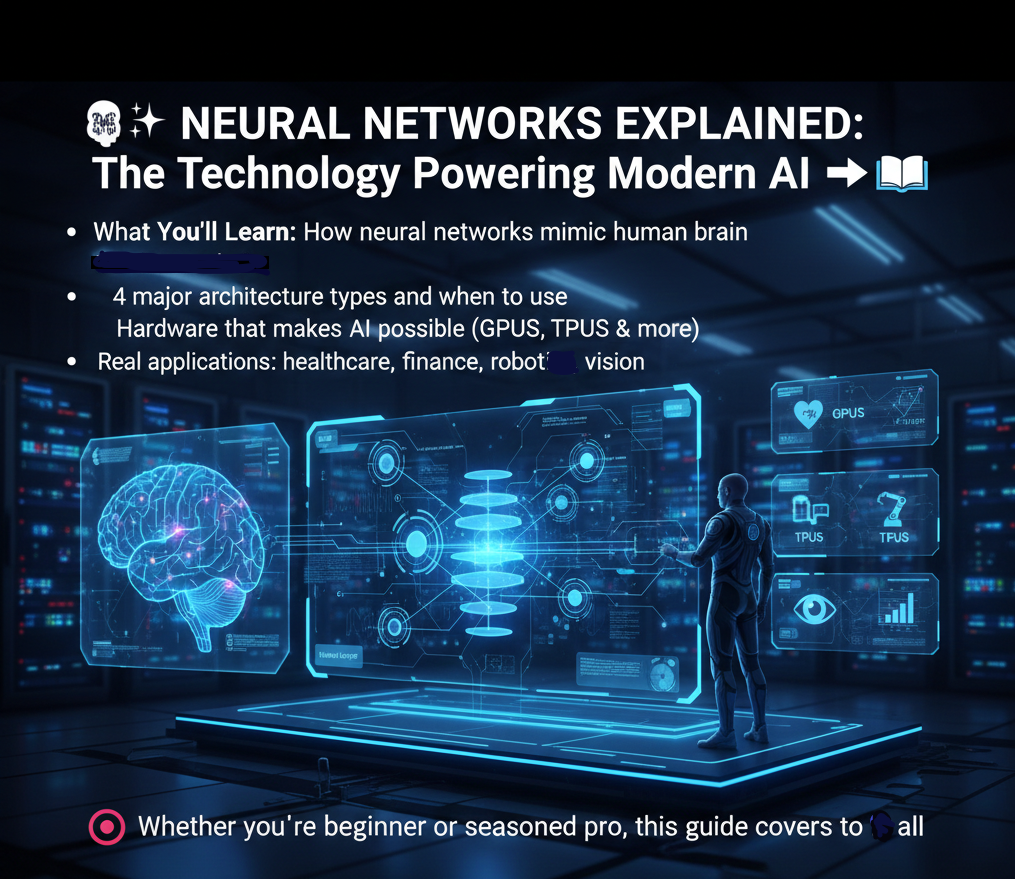

NEURAL NETWORKS
Fundamentals, Architecture & Applications in the AI Era
Introduction to Neural Networks
Neural networks represent the cornerstone of modern artificial intelligence, mimicking the intricate structure and function of the human brain to process complex data patterns and enable machines to learn from experience.
Biological Inspiration
Neural networks draw their fundamental design from the biological neural systems found in the human brain. Just as biological neurons communicate through synapses to process information, artificial neural networks use interconnected nodes that transmit signals through weighted connections. This biomimetic approach enables machines to process information in a manner that mirrors human cognitive functions, allowing for pattern recognition, learning, and decision-making capabilities that were previously thought to be uniquely human.
- Mimics structure of biological neurons and synapses
- Processes information through interconnected nodes
- Enables adaptive learning from experience
- Supports parallel distributed processing
Learning Paradigm
The power of neural networks lies in their ability to learn from data through iterative training processes. Unlike traditional programming where rules are explicitly coded, neural networks discover patterns and relationships autonomously. Through exposure to training data, these networks adjust their internal parameters to minimize prediction errors, gradually improving their performance. This learning capability makes them invaluable for tasks where explicit rule formulation is difficult or impossible, such as understanding natural language nuances or recognizing objects in complex visual scenes.
- Learns patterns from training data automatically
- Improves performance through iterative optimization
- Adapts to new data and changing environments
- Generalizes knowledge to unseen examples
Modern Applications
Today’s neural networks power transformative technologies across virtually every industry. From enabling autonomous vehicles to navigate complex traffic scenarios, to powering virtual assistants that understand and respond to human speech, to diagnosing diseases from medical imagery with superhuman accuracy, neural networks have become indispensable. They drive recommendation systems that personalize our digital experiences, enhance cybersecurity through anomaly detection, optimize supply chains, and even contribute to scientific discoveries in fields ranging from particle physics to genomics.
- Computer vision and image recognition systems
- Natural language processing and translation
- Autonomous systems and robotics
- Healthcare diagnostics and drug discovery
- Financial modeling and fraud detection
Basic Neural Network Structure
Historical Evolution
The journey of neural networks spans over seven decades, marked by periods of explosive innovation and challenging winters, ultimately culminating in today’s deep learning revolution.
1940s – Conceptual Birth
Warren McCulloch and Walter Pitts introduced the first mathematical model of artificial neurons, laying the theoretical foundation for all future neural network development.
1958 – The Perceptron
Frank Rosenblatt developed the Perceptron, the first implementation of an artificial neural network capable of learning from examples, sparking the first wave of AI optimism.
1980s – Backpropagation
The rediscovery and popularization of the backpropagation algorithm enabled training of multi-layer networks, overcoming previous limitations and revitalizing the field.
2006 – Deep Learning Era
Geoffrey Hinton’s breakthrough in training deep networks initiated the modern deep learning revolution, enabled by increased computational power and massive datasets.
2012 – ImageNet Moment
AlexNet’s dramatic victory in the ImageNet competition demonstrated the superiority of deep learning for computer vision, catalyzing widespread industry adoption.
2017-Present – Transformer Age
Introduction of transformer architectures and attention mechanisms revolutionized NLP and beyond, enabling models like GPT and BERT that exhibit unprecedented language understanding.
Fundamental Key Concepts
Understanding the core principles that govern neural network operation is essential for effective design, implementation, and optimization of AI systems.
Neural Network Concepts Mind Map
NETWORK
CONCEPTS
Learning Paradigms
Supervised, Unsupervised, Reinforcement
Activation Functions
ReLU, Sigmoid, Tanh, Softmax
Optimization
Gradient Descent, Adam, SGD
Regularization
Dropout, L1/L2, Batch Norm
Loss Functions
MSE, Cross-Entropy, Custom
Backpropagation
Chain Rule, Gradient Flow
Learning Paradigms
Supervised Learning: The most common training approach where the network learns from labeled data, mapping inputs to known outputs. Applications include image classification where each image is tagged with its content, speech recognition systems trained on transcribed audio, and medical diagnosis systems that learn from expert-labeled patient data. The network iteratively adjusts its parameters to minimize the difference between its predictions and the true labels, eventually generalizing to make accurate predictions on new, unseen data.
Unsupervised Learning: Networks discover hidden patterns and structures in unlabeled data without explicit guidance. Clustering algorithms group similar data points, dimensionality reduction techniques like autoencoders compress data while preserving important features, and anomaly detection systems identify unusual patterns. These methods are crucial when labeled data is scarce or expensive to obtain, and for exploratory data analysis where the underlying structure is unknown.
Reinforcement Learning: Agents learn optimal behavior through trial and error, receiving rewards for desirable actions and penalties for mistakes. This paradigm powers game-playing AI that masters complex strategies, robotic systems that learn manipulation tasks, and autonomous vehicles that navigate dynamic environments. The network learns a policy that maximizes cumulative reward over time, balancing exploration of new strategies with exploitation of known successful approaches.
Activation Functions
ReLU (Rectified Linear Unit): The most widely used activation function in modern deep networks, defined as f(x) = max(0, x). ReLU’s simplicity enables fast computation while its non-linearity allows networks to learn complex patterns. It addresses the vanishing gradient problem that plagued earlier activation functions, though it can suffer from “dying ReLU” where neurons permanently output zero. Variants like Leaky ReLU and Parametric ReLU address this limitation.
Sigmoid Function: Maps inputs to a range between 0 and 1, historically popular for binary classification and as the activation function in early neural networks. While intuitive for representing probabilities, sigmoid suffers from vanishing gradients for extreme input values, making deep network training difficult. It remains useful in specific contexts, particularly in the output layer for binary classification problems and in certain recurrent network architectures.
Tanh (Hyperbolic Tangent): Similar to sigmoid but maps inputs to the range [-1, 1], providing zero-centered outputs that can improve training dynamics. Tanh is often preferred over sigmoid in hidden layers as its symmetric output range can lead to faster convergence. However, it still experiences vanishing gradients for large input magnitudes, limiting its use in very deep networks.
Softmax: Converts a vector of real numbers into a probability distribution, essential for multi-class classification tasks. Each output represents the probability of a particular class, with all outputs summing to one. Softmax is typically used in the final layer of classification networks and is paired with cross-entropy loss for training.
Loss Functions & Optimization
Loss Functions: Quantify the discrepancy between network predictions and true values, providing a scalar metric to minimize during training. Mean Squared Error (MSE) is standard for regression tasks, measuring the average squared difference between predictions and targets. Cross-Entropy Loss is preferred for classification, penalizing incorrect class predictions more heavily. Custom loss functions can incorporate domain-specific knowledge, such as emphasizing certain types of errors or incorporating multiple objectives.
Gradient Descent: The fundamental optimization algorithm that iteratively adjusts network parameters in the direction that reduces loss most steeply. Stochastic Gradient Descent (SGD) uses random mini-batches of data for efficiency, while batch gradient descent uses the entire dataset per update. The learning rate hyperparameter controls step size, requiring careful tuning to balance convergence speed and stability.
Advanced Optimizers: Modern variants like Adam (Adaptive Moment Estimation) combine momentum and adaptive learning rates, automatically adjusting step sizes for each parameter based on historical gradients. RMSprop addresses issues with AdaGrad for non-stationary problems. These sophisticated optimizers often achieve faster and more stable convergence than vanilla gradient descent, particularly for complex, high-dimensional problems.
Overfitting & Regularization
Overfitting Problem: Occurs when networks memorize training data rather than learning generalizable patterns, resulting in excellent training performance but poor test accuracy. This is particularly problematic with limited training data or excessively complex models. Signs include a growing gap between training and validation loss, and high sensitivity to minor input variations. Addressing overfitting is crucial for deploying reliable AI systems.
Dropout Regularization: Randomly deactivates a fraction of neurons during training, forcing the network to learn redundant representations that don’t rely on any single neuron. This prevents co-adaptation of features and acts as an ensemble method, effectively training multiple sub-networks. Dropout rates typically range from 0.2 to 0.5 and are disabled during inference to leverage the full network capacity.
L1/L2 Regularization: Add penalty terms to the loss function based on weight magnitudes. L2 regularization (weight decay) penalizes large weights quadratically, encouraging smooth, distributed representations. L1 regularization penalizes absolute weight values, promoting sparsity by driving many weights to exactly zero, which can be useful for feature selection and model interpretation.
Batch Normalization: Normalizes layer inputs to have zero mean and unit variance, stabilizing training and allowing higher learning rates. It reduces internal covariate shift, accelerates convergence, and provides a regularization effect. Batch normalization has become a standard component in modern architectures, particularly for computer vision tasks.
Early Stopping: Monitors validation performance during training and halts when improvement plateaus, preventing the network from continuing to overfit training data. This simple yet effective technique requires maintaining a validation set separate from training and test data.
Core Network Components
Neural networks comprise several fundamental building blocks that work in concert to process information and enable learning capabilities.
Neurons (Nodes)
Neurons serve as the fundamental computational units of neural networks, analogous to biological neurons in the brain. Each neuron receives multiple inputs, typically from neurons in the previous layer, and produces a single output that may feed into multiple subsequent neurons. The neuron’s operation involves three key steps: aggregation of weighted inputs, addition of a bias term, and application of an activation function.
The mathematical operation of a neuron can be expressed as: output = activation(Σ(weights × inputs) + bias). This simple formula, when replicated across thousands or millions of neurons, enables the network to approximate arbitrarily complex functions. The weights determine how strongly each input influences the neuron’s output, while the bias allows the activation function to be shifted, providing additional modeling flexibility.
During training, neurons learn to recognize specific features or patterns in the data. In early layers, neurons might detect simple features like edges in images or phonemes in audio. Deeper layers combine these basic features to recognize increasingly complex patterns, such as object parts, entire objects, or semantic concepts. This hierarchical feature learning is a key strength of deep neural networks.
Network Layers
Input Layer: The entry point for data into the network, with each neuron representing a feature or data dimension. For image data, this might include a neuron for each pixel; for tabular data, one neuron per column. The input layer performs no computation, simply passing data forward. Its size is determined by the nature and dimensionality of the input data.
Hidden Layers: The computational heart of neural networks, where complex transformations and feature extraction occur. Each hidden layer learns to represent the data at different levels of abstraction. The number and size of hidden layers dramatically affect the network’s capacity to learn complex patterns. Modern deep networks may contain dozens or even hundreds of hidden layers, each specializing in particular aspects of the learning task.
Output Layer: Produces the network’s final predictions, with architecture dependent on the task type. Classification tasks use one neuron per class with softmax activation for probability outputs. Regression tasks typically use linear activation to output continuous values. Binary classification often uses a single neuron with sigmoid activation. The output layer’s design directly reflects the problem being solved.
The depth (number of layers) versus width (neurons per layer) represents a fundamental architectural choice. Deeper networks can learn more complex hierarchical features but are harder to train. Wider networks increase capacity within each layer but may require more data to avoid overfitting. Modern architectures often balance both dimensions based on empirical performance.
Weights and Biases
Weights: The network’s learned parameters that encode knowledge extracted from training data. Each connection between neurons has an associated weight that modulates signal strength. Positive weights amplify signals, negative weights inhibit them, and weights near zero effectively disconnect neurons. The collection of all weights defines the network’s behavior and represents the learned model.
Weight initialization significantly impacts training dynamics. Random initialization breaks symmetry, ensuring neurons learn different features. Sophisticated initialization schemes like Xavier (Glorot) or He initialization account for layer sizes and activation functions, promoting stable gradient flow. Poor initialization can lead to vanishing or exploding gradients, hindering or preventing learning entirely.
Biases: Additional learned parameters, one per neuron, that shift activation functions horizontally. Biases allow neurons to activate even with zero input, providing crucial flexibility in pattern recognition. Without biases, a neuron can only learn patterns that pass through the origin. The bias term enables the network to fit data with arbitrary offsets and translations.
During training, weights and biases are iteratively adjusted through backpropagation and gradient descent. The optimization process seeks to minimize the loss function by computing gradients with respect to each parameter and updating them proportionally. The learning rate hyperparameter controls update magnitude, with too-large values causing instability and too-small values leading to extremely slow convergence.
Connections (Synapses)
Connections define the network’s topology, determining how information flows from inputs to outputs. In fully-connected (dense) layers, every neuron connects to every neuron in adjacent layers, allowing maximum information flow but requiring substantial computational resources and memory. A layer with N input neurons and M output neurons requires N × M weight parameters.
Sparse connectivity patterns reduce computational costs and can improve generalization by introducing architectural priors. Convolutional layers use local connectivity, with each neuron connecting only to a small spatial region of the input, exploiting the spatial structure of image data. Recurrent connections create loops, enabling networks to maintain state and process sequential data by feeding outputs back as inputs.
The strength and pattern of connections encode the network’s learned representations. Strong positive connections between neurons indicate features that commonly co-occur and should be jointly considered. Negative connections represent inhibitory relationships where one feature’s presence suppresses another. The network’s architecture – its connection pattern – serves as an inductive bias that shapes what patterns it can efficiently learn.
Skip connections, popularized by ResNet, create shortcuts that bypass one or more layers, enabling training of extremely deep networks by facilitating gradient flow. Attention mechanisms create dynamic, data-dependent connections, allowing networks to focus on relevant information while ignoring irrelevant details. These advanced connection patterns have been instrumental in recent deep learning breakthroughs.
Neural Network Architectures
Different architectural designs optimize neural networks for specific data types and tasks, each with unique strengths and applications.
Feedforward Networks
Architecture: Information flows unidirectionally from input through hidden layers to output, with no loops or feedback connections. Each layer transforms its input and passes the result forward. This simplicity makes feedforward networks easy to understand, implement, and train, serving as the foundation for more complex architectures.
Applications: Excel at tasks with fixed-size inputs and outputs where temporal or spatial relationships are not critical. Widely used for tabular data classification, function approximation, and as building blocks within larger systems. Multi-layer perceptrons (MLPs), the most common feedforward networks, can approximate any continuous function given sufficient neurons.
Strengths: Straightforward training via backpropagation, well-understood theoretical properties, and broad applicability. Computationally efficient and parallelizable. Suitable for scenarios where input features are independent or their relationships can be captured through learned transformations.
Limitations: Cannot handle variable-length sequences or temporal dependencies. Require fixed-size inputs, necessitating preprocessing for variable-sized data. Lack spatial or temporal inductive biases, requiring more data to learn patterns that specialized architectures encode directly.
Recurrent Neural Networks
Architecture: Incorporate recurrent connections that create cycles, allowing information to persist across time steps. The network maintains an internal state that is updated at each time step based on new input and previous state. This memory mechanism enables processing of sequential data of arbitrary length.
Variants: Long Short-Term Memory (LSTM) networks address the vanishing gradient problem in standard RNNs using gating mechanisms that control information flow, enabling learning of long-term dependencies. Gated Recurrent Units (GRUs) provide similar capabilities with a simpler architecture. Bidirectional RNNs process sequences in both forward and backward directions, capturing context from both past and future.
Applications: Natural language processing tasks including language modeling, machine translation, and text generation. Speech recognition and synthesis, video analysis, time series forecasting, and any domain where temporal context is crucial. RNNs excel when current outputs depend on historical inputs.
Strengths: Handle variable-length sequences naturally, maintain temporal context, and can learn complex temporal patterns. Suitable for tasks requiring memory of past inputs. Share parameters across time steps, enabling generalization to sequences longer than those seen during training.
Limitations: Sequential processing limits parallelization, resulting in slower training compared to feedforward or convolutional networks. Despite improvements from LSTMs and GRUs, very long-term dependencies remain challenging. Training can be unstable due to vanishing or exploding gradients.
Convolutional Neural Networks
Architecture: Utilize convolutional layers that apply learned filters to local regions of the input, exploiting spatial structure. Filters slide across the input, computing dot products to detect specific features. Pooling layers reduce spatial dimensions while preserving important information. This architecture incorporates inductive biases suited to grid-like data.
Hierarchical Learning: Early layers detect low-level features like edges and textures. Middle layers combine these into parts and patterns. Deep layers recognize high-level concepts and complete objects. This hierarchical feature learning mirrors visual processing in the brain’s visual cortex.
Applications: Dominant architecture for computer vision tasks including image classification, object detection, semantic segmentation, and facial recognition. Also effective for other grid-like data such as audio spectrograms, genomic sequences, and game boards. Transfer learning from large-scale image datasets enables strong performance even with limited task-specific data.
Strengths: Parameter sharing through convolutional filters dramatically reduces parameters compared to fully-connected networks, improving generalization and computational efficiency. Translation invariance enables recognizing features regardless of position. Local connectivity captures spatial relationships effectively.
Key Architectures: LeNet pioneered modern CNNs for digit recognition. AlexNet demonstrated deep learning’s power on ImageNet. VGG introduced very deep networks with small filters. ResNet’s skip connections enabled training of networks with hundreds of layers. EfficientNet optimizes depth, width, and resolution scaling for maximum efficiency.
Transformer Networks
Architecture: Revolutionized sequence modeling by replacing recurrence with attention mechanisms that compute weighted combinations of all input elements. Self-attention allows each position to attend to all other positions, capturing long-range dependencies without the sequential bottleneck of RNNs. Multi-head attention enables learning of different types of relationships in parallel.
Mechanism: Attention computes queries, keys, and values from inputs, then determines attention weights based on query-key compatibility. The weighted sum of values forms the output. Positional encodings inject sequence order information. Feed-forward networks process each position independently. Layer normalization and residual connections stabilize training.
Applications: Transformers dominate natural language processing, powering models like BERT for understanding and GPT for generation. Vision Transformers (ViT) challenge CNN supremacy in computer vision. Speech recognition, protein folding prediction, and multi-modal tasks benefit from transformer architectures. Their flexibility and performance have made transformers the default choice for many AI applications.
Strengths: Parallel processing of entire sequences enables efficient training on modern hardware. Attention mechanisms provide interpretability by revealing which inputs influence outputs. Scale effectively to massive datasets and model sizes. Can handle extremely long-range dependencies. Transfer learning through pre-training on massive datasets followed by fine-tuning on specific tasks has proven remarkably effective.
Considerations: Quadratic complexity with sequence length limits application to very long sequences, though techniques like sparse attention and linear attention address this. Require substantial computational resources and data for training from scratch. Lack of inherent positional awareness necessitates explicit positional encodings.
Architecture Selection Principles
Data Structure
Choose architectures that match your data’s structure: CNNs for spatial data, RNNs or Transformers for sequences, feedforward for tabular data. Leveraging appropriate inductive biases dramatically improves sample efficiency and performance.
Task Requirements
Classification, regression, generation, and reinforcement learning have different architectural needs. Consider output type, loss function compatibility, and whether the task benefits from attention mechanisms or recurrence.
Computational Budget
Balance model complexity with available computational resources. Transformers offer excellent performance but demand substantial compute. Mobile and edge applications may require lightweight architectures like MobileNets or pruned models.
Data Availability
Large, complex architectures require extensive training data. With limited data, consider transfer learning, data augmentation, or simpler architectures with strong regularization to avoid overfitting.
Interpretability Needs
Some applications require understanding model decisions. Attention mechanisms provide interpretability. Simpler architectures are easier to analyze. Consider explainability requirements when selecting architectures for critical applications.
Hybrid Approaches
Modern systems often combine multiple architecture types. CNN feature extractors feeding into transformers, or RNN decoders with attention mechanisms, leverage complementary strengths for superior performance.
Hardware Architecture & Infrastructure
Neural network training and deployment require specialized hardware optimized for the massive parallel computations inherent in deep learning.
🖥️ Central Processing Units (CPUs)
Architecture: General-purpose processors designed for sequential instruction execution with emphasis on low latency and versatile computation. Modern CPUs feature multiple cores (typically 4-64) with sophisticated cache hierarchies, branch prediction, and out-of-order execution. They excel at complex control flow and single-threaded performance but lack the massive parallelism needed for efficient neural network training.
Use Cases: Suitable for initial development, small-scale models, and inference where latency is critical. Researchers often prototype on CPUs before scaling to GPUs. CPU inference remains popular for production systems with modest computational demands due to cost-effectiveness and ease of deployment. Modern CPUs with AVX-512 instructions can achieve reasonable performance for optimized models.
🎮 Graphics Processing Units (GPUs)
Architecture: Massively parallel processors originally designed for graphics rendering, now the workhorse of deep learning. Modern GPUs contain thousands of small, efficient cores organized into streaming multiprocessors. They excel at the matrix operations and data parallelism central to neural network computations. Dedicated Tensor Cores in recent NVIDIA GPUs accelerate mixed-precision matrix multiplications by up to 10x.
Market Leaders: NVIDIA dominates with their CUDA ecosystem, offering GPUs from consumer GTX/RTX lines to datacenter A100 and H100 cards. AMD competes with ROCm and Radeon Instinct series. Software frameworks like PyTorch and TensorFlow have excellent GPU support, enabling straightforward acceleration of neural network code.
Performance: GPUs provide 10-100x speedup over CPUs for neural network training, with larger models seeing greater benefits. Multi-GPU setups using NVIDIA’s NVLink or AMD’s Infinity Fabric enable training of models too large for a single GPU. Cloud providers offer GPU instances by the hour, democratizing access to powerful hardware.
⚡ Tensor Processing Units (TPUs)
Architecture: Google’s custom Application-Specific Integrated Circuits (ASICs) designed specifically for neural network workloads. TPUs optimize the matrix multiplication and activation function operations that dominate deep learning computations. The systolic array architecture enables extremely high throughput for tensor operations with exceptional power efficiency.
Advantages: Superior performance-per-watt compared to GPUs, particularly for inference workloads. TPU Pods connect hundreds of TPUs for training massive models. Tight integration with TensorFlow and JAX provides excellent performance. Google Cloud TPU offerings enable cost-effective access without hardware purchase.
Applications: Power Google’s own AI services including Search, Translate, and Gmail. External researchers and companies use Cloud TPUs for training state-of-the-art models. Particularly effective for transformer architectures and large language models where TPU optimizations shine.
🧠 Neuromorphic Hardware
Architecture: Emerging hardware that more closely mimics biological neural networks using spiking neural networks and event-driven computation. Unlike traditional architectures that separate memory and computation, neuromorphic chips integrate them, reducing data movement overhead. Examples include IBM’s TrueNorth (1 million neurons, 256 million synapses) and Intel’s Loihi (130,000 neurons).
Promise: Extreme energy efficiency enables AI in power-constrained environments like sensors, drones, and IoT devices. Asynchronous, event-driven operation provides ultra-low latency responses. Potential for new learning algorithms that leverage neuromorphic hardware’s unique capabilities.
Challenges: Limited software ecosystem and programming models compared to mature GPU toolchains. Requires rethinking algorithms to leverage spiking neural networks effectively. Currently in research and early commercial adoption phases, though progress is accelerating as edge AI demands grow.
Hardware Infrastructure Considerations
Distributed Training
Modern deep learning often requires multiple GPUs or TPUs working in concert. Data parallelism distributes mini-batches across devices. Model parallelism splits large models across multiple devices. Hybrid approaches combine both strategies for optimal scaling.
Cloud vs. On-Premise
Cloud platforms (AWS, Google Cloud, Azure) offer flexible, scalable access to cutting-edge hardware without capital investment. On-premise hardware provides better economics for sustained, heavy usage but requires infrastructure management expertise.
Mixed Precision Training
Using 16-bit floating-point (FP16) instead of 32-bit (FP32) reduces memory usage and accelerates training on modern GPUs with Tensor Cores, often without sacrificing model accuracy. Automatic mixed precision in frameworks like PyTorch makes this transparent.
Memory Optimization
GPU memory is often the limiting factor for model size. Gradient checkpointing trades computation for memory by recomputing activations. Model parallelism and offloading techniques enable training models larger than single-GPU memory.
Specialized Accelerators
Beyond GPUs and TPUs, specialized accelerators like Graphcore IPUs, Cerebras Wafer-Scale Engine, and SambaNova systems offer alternative approaches to AI acceleration. Each has unique architectural innovations targeting specific use cases.
Future Directions
Photonic computing, quantum machine learning, and in-memory computing represent future directions for AI hardware. While still largely research areas, these technologies promise orders of magnitude improvements in speed and efficiency.
Evolution of Neural Networks
The development of neural networks has been marked by periods of intense innovation, challenging setbacks, and breakthrough moments that shaped the field.
McCulloch-Pitts Neuron
Warren McCulloch and Walter Pitts published “A Logical Calculus of Ideas Immanent in Nervous Activity,” introducing the first mathematical model of an artificial neuron. This foundational work demonstrated that networks of simple threshold logic units could compute any arithmetic or logical function, establishing the theoretical basis for neural computation and inspiring decades of future research.
Perceptron Algorithm
Frank Rosenblatt developed the Perceptron, the first learning algorithm for neural networks. Implemented in hardware as the Mark I Perceptron machine, it could learn to classify simple patterns through weight adjustment. This breakthrough sparked the first wave of AI enthusiasm and significant research funding, demonstrating that machines could indeed learn from experience.
First AI Winter
Marvin Minsky and Seymour Papert published “Perceptrons,” mathematically proving that single-layer perceptrons cannot learn certain functions like XOR. This limitation, combined with computational constraints and overpromising, led to the first “AI Winter” where funding and interest in neural networks dramatically declined for nearly two decades.
Backpropagation Revival
Rumelhart, Hinton, and Williams popularized the backpropagation algorithm for training multi-layer networks, addressing the limitations of single-layer perceptrons. This enabled learning of complex non-linear functions and sparked renewed interest in neural networks. The method’s mathematical elegance and practical effectiveness established it as the standard training algorithm.
LeNet and CNNs
Yann LeCun developed LeNet-5 for handwritten digit recognition, demonstrating the power of convolutional neural networks for computer vision. Successfully deployed by banks for check reading, it proved that neural networks could solve real-world problems at scale. The architecture introduced key concepts like local connectivity, weight sharing, and pooling that remain fundamental to modern CNNs.
Deep Learning Breakthrough
Geoffrey Hinton introduced techniques for training deep belief networks, enabling successful training of networks with many layers. This breakthrough, combined with growing computational power and data availability, initiated the modern deep learning revolution. Hinton’s work demonstrated that very deep networks could learn hierarchical features automatically from raw data.
AlexNet Revolution
Alex Krizhevsky’s AlexNet achieved a stunning 15.3% error rate in ImageNet, dramatically outperforming traditional computer vision methods (26.2% error). Trained on GPUs with novel techniques like ReLU activation and dropout, AlexNet proved deep learning’s superiority for image recognition and catalyzed widespread industry adoption of neural networks.
ResNet and Very Deep Networks
Microsoft Research introduced ResNet with 152 layers, surpassing human-level performance on ImageNet. Skip connections solved the degradation problem in very deep networks, enabling training of models with hundreds or thousands of layers. This architectural innovation demonstrated that depth, when properly managed, provides substantial benefits.
Transformer Architecture
Google researchers introduced the Transformer in “Attention Is All You Need,” revolutionizing sequence modeling by replacing recurrence with self-attention mechanisms. This enabled parallel processing of sequences and better handling of long-range dependencies. Transformers became the foundation for breakthrough models in NLP and beyond.
Large Language Models Era
BERT, GPT-2, and GPT-3 demonstrated the power of pre-training massive transformer models on enormous text corpora. These models exhibited impressive few-shot learning abilities and general language understanding. The paradigm of pre-training followed by fine-tuning became dominant across NLP tasks, achieving state-of-the-art results with relatively little task-specific data.
Foundation Models & Multimodality
Emergence of foundation models like GPT-4, Claude, and DALL-E that demonstrate capabilities across multiple modalities and tasks. These models exhibit emergent abilities at scale, including reasoning, code generation, and creative tasks. The field increasingly focuses on alignment, safety, and responsible deployment of increasingly powerful AI systems.
Applications in AI & ML
Neural networks drive transformative applications across diverse industries, revolutionizing how we interact with technology and solve complex problems.
Computer Vision
Image Classification: Networks identify objects in images with superhuman accuracy. Applications range from medical imaging diagnosing diseases from X-rays and MRIs, to quality control in manufacturing detecting defects, to content moderation filtering inappropriate images on social platforms.
Object Detection: Real-time identification and localization of multiple objects enables autonomous vehicles to navigate safely, retail analytics to track customer behavior, and surveillance systems to monitor security. YOLO and Faster R-CNN architectures achieve remarkable speed and accuracy.
Facial Recognition: Powers smartphone unlocking, airport security, and payment authentication. Privacy considerations have led to regulatory scrutiny, emphasizing the need for responsible deployment and bias mitigation in facial recognition systems.
Image Segmentation: Pixel-level classification enables precise medical image analysis for surgical planning, satellite imagery interpretation for environmental monitoring, and augmented reality applications that separate foreground from background.
Natural Language Processing
Language Understanding: BERT and similar models power search engines, question-answering systems, and sentiment analysis tools. They understand context, handle ambiguity, and capture semantic relationships between words and phrases, enabling more intelligent text processing.
Machine Translation: Neural machine translation systems provide real-time translation across hundreds of language pairs. Google Translate, DeepL, and similar services break down language barriers for global communication, commerce, and information access.
Text Generation: Large language models produce coherent, contextually appropriate text for content creation, code generation, and conversational AI. Applications include writing assistance, automated reporting, chatbots, and creative writing tools.
Speech Recognition: Converts spoken language to text with high accuracy, enabling voice assistants like Siri and Alexa, automated transcription services, and accessibility tools for hearing-impaired individuals. End-to-end neural approaches have largely replaced traditional pipeline systems.
Healthcare & Medicine
Medical Imaging: Neural networks assist radiologists in detecting tumors, fractures, and anomalies from medical scans. They achieve diagnostic accuracy comparable to human experts while processing images faster, enabling earlier detection and treatment of diseases like cancer.
Drug Discovery: Deep learning accelerates drug development by predicting molecular properties, identifying drug candidates, and optimizing chemical structures. This reduces the time and cost of bringing new medications to market, potentially saving lives through faster therapeutic development.
Genomics: Analyzing genetic sequences to predict disease risk, understand gene function, and enable personalized medicine. Neural networks identify patterns in massive genomic datasets that would be impossible for humans to detect manually.
Clinical Decision Support: AI systems assist doctors in diagnosis, treatment planning, and predicting patient outcomes. They aggregate vast medical literature and patient data to provide evidence-based recommendations, though human expertise remains essential for final decisions.
Finance & Trading
Fraud Detection: Real-time analysis of transaction patterns identifies suspicious activity with high accuracy and low false positive rates. Neural networks adapt to evolving fraud tactics, protecting consumers and financial institutions from billions in losses annually.
Algorithmic Trading: High-frequency trading systems use neural networks to predict market movements, optimize portfolios, and execute trades. Deep reinforcement learning enables adaptive strategies that respond to changing market conditions.
Credit Scoring: Alternative data sources and neural networks enable more accurate and inclusive credit risk assessment. This expands financial access while managing risk, though fairness and transparency concerns require careful attention.
Market Analysis: Sentiment analysis of news, social media, and financial reports provides insights into market trends. Neural networks process vast amounts of unstructured data to identify investment opportunities and risks.
Robotics & Automation
Autonomous Vehicles: Self-driving cars use neural networks for perception (detecting pedestrians, vehicles, lanes), prediction (anticipating other agents’ behavior), and planning (determining safe trajectories). Companies like Waymo and Tesla are pushing toward fully autonomous transportation.
Industrial Robots: Manufacturing robots employ vision systems for precise assembly, quality inspection, and material handling. Neural networks enable robots to handle variability and adapt to new tasks without extensive reprogramming.
Warehouse Automation: Companies like Amazon use neural networks for inventory management, path planning for mobile robots, and package sorting. This increases efficiency and reduces costs in logistics operations.
Drones: Autonomous navigation, object avoidance, and task execution in agriculture (crop monitoring), delivery, surveillance, and search-and-rescue operations rely on neural networks for real-time decision-making in dynamic environments.
Gaming & Entertainment
Game AI: AlphaGo’s defeat of world champion Go players demonstrated superhuman performance in strategic games. Neural networks power NPC behavior, procedural content generation, and game balancing, creating more engaging player experiences.
Content Recommendation: Netflix, YouTube, and Spotify use neural networks to personalize content suggestions, matching users with movies, videos, and music they’re likely to enjoy. This drives engagement and user satisfaction.
Content Creation: Generative models produce artwork, music, and video content. DALL-E and Midjourney create images from text descriptions, while tools like Runway enable AI-assisted video editing and generation.
Animation & VFX: Neural networks accelerate animation production through motion capture enhancement, style transfer, and automated in-betweening. Deepfake technology, while controversial, demonstrates the power of neural networks for realistic face swapping and synthesis.
Climate & Environment
Weather Forecasting: Neural networks improve prediction accuracy for weather patterns, severe storms, and climate modeling. They process massive datasets from satellites, sensors, and simulations to provide actionable forecasts for agriculture, disaster preparedness, and resource management.
Energy Optimization: Smart grids use neural networks to predict energy demand, optimize renewable energy integration, and reduce waste. Building management systems adjust heating, cooling, and lighting for maximum efficiency while maintaining comfort.
Environmental Monitoring: Satellite imagery analysis tracks deforestation, urbanization, and ecosystem health. Neural networks identify illegal logging, monitor wildlife populations, and assess environmental damage, supporting conservation efforts.
Agriculture: Precision farming uses computer vision to monitor crop health, identify diseases, and optimize irrigation and fertilization. This increases yields while reducing environmental impact through more efficient resource use.
Cybersecurity
Threat Detection: Neural networks identify malware, phishing attempts, and network intrusions by learning patterns of malicious behavior. They adapt to new threats faster than signature-based approaches, providing robust defense against evolving cyber attacks.
Anomaly Detection: Monitoring network traffic and user behavior to identify unusual patterns that may indicate security breaches. Unsupervised learning approaches detect novel attacks without prior examples.
Authentication: Behavioral biometrics using neural networks analyze typing patterns, mouse movements, and other behaviors for continuous authentication, adding security layers beyond passwords.
Vulnerability Assessment: Automated code analysis identifies security vulnerabilities in software. Neural networks help prioritize patches and predict exploitation likelihood, enabling more effective security resource allocation.
Impact & Future Directions
Democratization of AI
Pre-trained models, cloud platforms, and user-friendly frameworks make advanced AI capabilities accessible to researchers, startups, and enterprises worldwide, accelerating innovation across all sectors.
Ethical Considerations
As neural networks influence critical decisions, addressing bias, ensuring fairness, protecting privacy, and maintaining transparency become paramount. Responsible AI development requires ongoing attention to societal impact.
Multimodal Intelligence
Future systems will seamlessly integrate vision, language, audio, and other modalities, enabling more natural human-AI interaction and solving problems requiring diverse types of understanding.
Edge AI
Deploying neural networks on devices from smartphones to IoT sensors enables real-time, privacy-preserving AI without cloud dependency. Model compression and efficient architectures make this increasingly practical.
Continual Learning
Developing systems that learn continuously from new data without forgetting previous knowledge remains a key challenge. Progress here will enable more adaptive, long-lived AI systems.
Human-AI Collaboration
Rather than replacing humans, the most successful applications augment human capabilities. Designing effective human-AI interfaces and workflows maximizes the strengths of both.
The Neural Network Revolution
Key Takeaways
Foundation of Modern AI
Neural networks have evolved from theoretical curiosities to the foundation of modern artificial intelligence. Their ability to learn complex patterns from data has enabled breakthrough applications across virtually every industry, transforming how we work, communicate, and solve problems.
Architectural Diversity
Different architectures serve different purposes: feedforward networks for structured data, CNNs for vision, RNNs for sequences, and transformers for both NLP and increasingly diverse applications. Understanding when to apply each architecture is crucial for effective AI development.
Hardware Evolution
Specialized hardware from GPUs to TPUs to emerging neuromorphic chips enables training and deploying increasingly large and sophisticated models. The co-evolution of algorithms and hardware drives continued progress in AI capabilities.
Continued Innovation
The field rapidly evolves with new architectures, training techniques, and applications emerging continuously. Staying current requires ongoing learning and experimentation. The next breakthrough could come from anywhere.
Practical Deployment
Success requires more than just training accurate models. Deployment considerations including latency, cost, privacy, fairness, and maintainability determine whether AI systems deliver real-world value. Engineering excellence matters as much as algorithmic innovation.
Responsible Development
As AI systems increasingly impact society, developers must consider ethical implications, potential biases, environmental costs, and societal effects. Building beneficial AI requires technical excellence combined with ethical awareness and stakeholder engagement.
The Future is Neural
Neural networks represent humanity’s attempt to capture intelligence in silicon, to create machines that learn and adapt as we do. From their humble beginnings as mathematical abstractions to today’s transformer models exhibiting emergent capabilities, neural networks have come extraordinarily far. Yet this is merely the beginning. As we develop more efficient architectures, more powerful hardware, and better training methods, neural networks will unlock capabilities we can scarcely imagine today. The challenge for us as researchers, engineers, and technologists is to harness this power responsibly, ensuring that AI benefits all of humanity while navigating the technical and ethical challenges ahead. The neural network revolution is not a destination but a journey, and we are privileged to be part of it.