
Think and Grow Rich
Introduction: A Timeless Classic
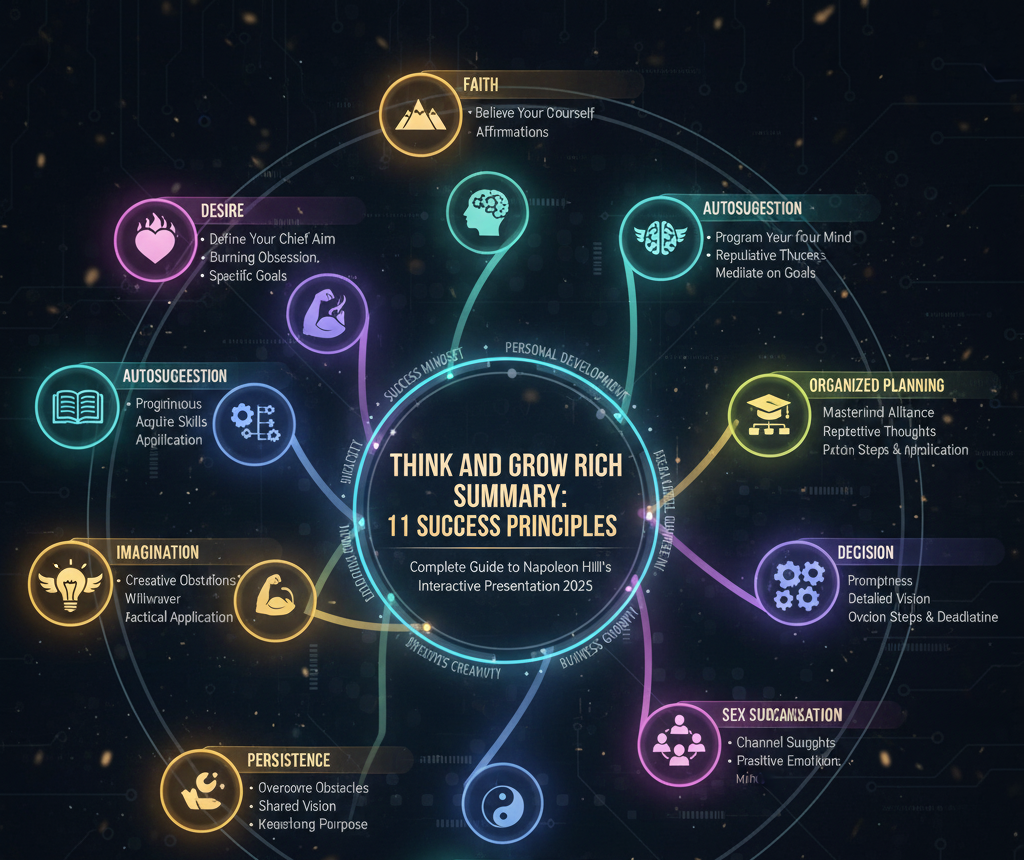
Success Formula
🔥 Desire
The burning obsession that drives all achievement and success
👁️ Visualization
Mental imagery that keeps you focused on your goals
💪 Persistence
Unwavering determination in the face of obstacles
🤝 Mastermind
Collaboration with like-minded individuals for mutual success
⚡ Action
Taking massive, consistent steps toward your objectives
✨ Faith
Unwavering belief in yourself and your vision
The Five Fundamental Concepts
1. The Importance of Desire: The Starting Point of All Achievement
Desire is not merely wanting something; it is an intense, burning obsession that consumes your thoughts and drives your actions. According to Napoleon Hill, this is the foundational element from which all achievement springs. Without powerful desire, no goal can be accomplished because there is insufficient motivation to overcome the inevitable obstacles that arise on the path to success.
Hill emphasizes that your desire must be so strong that it becomes an all-consuming force in your life. This level of intensity transforms a casual wish into a definite purpose. When desire reaches this threshold, it activates your subconscious mind, marshals your creative faculties, and mobilizes all your resources toward achieving your objective. The difference between those who achieve greatness and those who merely dream about it lies in the intensity and clarity of their desire.
Creating this burning desire requires you to define exactly what you want with crystal clarity. Vague wishes produce vague results. You must specify precisely what you desire, determine what you are willing to sacrifice to obtain it, establish a definite date by which you intend to possess it, and create a concrete plan for achieving it. This process transforms abstract wishes into tangible objectives.
2. The Power of Visualization: Seeing Success Before It Happens
Visualization is the practice of creating vivid mental images of your desired outcomes as if they have already been achieved. This powerful technique works because your subconscious mind cannot distinguish between a real experience and one that is vividly imagined. By consistently visualizing your goals, you program your mind to recognize and seize opportunities that align with your vision.
The practice of visualization serves multiple critical functions in your success journey. First, it keeps your goals at the forefront of your conscious awareness, ensuring you remain focused on what truly matters. Second, it activates the creative powers of your subconscious mind, which works continuously to find ways to make your visualized reality come true. Third, it generates emotional energy and motivation that propels you through difficult times when external circumstances might otherwise cause you to abandon your goals.
To practice effective visualization, Hill recommends creating detailed mental movies where you see yourself already in possession of your goal. Engage all your senses in this mental imagery. See the details, hear the sounds, feel the emotions, and experience the sensations of having achieved your objective. The more vivid and emotionally charged your visualizations, the more powerful their impact on your subconscious mind and subsequent actions.
3. The Importance of Persistence: The Sustained Effort Required
Persistence is perhaps the most critical factor that separates those who achieve lasting success from those who fall short of their potential. Hill discovered through his research that nearly every successful person encountered numerous failures, setbacks, and obstacles before achieving their goals. What distinguished them was their refusal to accept defeat as permanent and their unwavering commitment to continue forward regardless of circumstances.
Persistence is not merely stubbornness or blind determination. It is intelligent, focused effort sustained over time despite challenges, criticism, and temporary defeats. Hill emphasizes that most people give up just before they would have achieved success. They quit when faced with their first, second, or third major obstacle, not realizing that breakthrough often comes immediately after the darkest moment of struggle.
Developing persistence requires cultivating a definiteness of purpose, a burning desire to achieve your goal, accurate knowledge and a concrete plan, a positive mental attitude, and a mastermind alliance for support and encouragement. Hill teaches that persistence is a state of mind that can be cultivated through disciplined practice. When you face setbacks, view them not as failures but as temporary defeats that provide valuable lessons. Each obstacle overcome builds your persistence muscle stronger.
4. The Power of the Mastermind: Collective Intelligence
The mastermind principle represents one of Hill’s most revolutionary concepts. A mastermind group consists of two or more people who work together in perfect harmony toward a common objective. When minds are coordinated in a spirit of cooperation, they create a third, invisible force that Hill describes as the “Master Mind.” This collective intelligence exceeds the sum of the individual minds involved.
The benefits of a mastermind alliance are manifold. First, it provides access to the combined experience, knowledge, education, and influence of all members. Second, it offers moral support and encouragement during challenging times. Third, it creates accountability that helps each member maintain focus and follow through on commitments. Fourth, it generates creative synergy where the interaction of different perspectives produces ideas that no single member could have generated alone.
Creating an effective mastermind requires careful selection of members who are positive, growth-oriented, and genuinely committed to mutual success. The group should meet regularly with a structured agenda, maintain confidentiality, and operate with complete honesty and trust. Each member must be willing to both contribute their expertise and be receptive to input from others. When properly constituted and maintained, a mastermind group becomes one of the most powerful tools available for accelerating achievement.
5. The Importance of Taking Action: Translating Plans into Reality
Action is the crucial bridge between dreams and reality. Hill emphasizes that all the desire, visualization, faith, specialized knowledge, and planning in the world mean nothing without decisive action. Many people fail not because they lack good ideas or sufficient knowledge, but because they never translate their plans into concrete action steps.
Taking action requires courage because it exposes you to the possibility of failure, criticism, and disappointment. However, Hill teaches that procrastination is one of the most common causes of failure. Those who achieve great success develop the habit of making decisions quickly and following through on them persistently. They understand that imperfect action is infinitely superior to perfect inaction.
Effective action is characterized by several qualities. It must be massive in scale, meaning you take multiple steps daily toward your goal rather than occasional half-hearted efforts. It must be consistent, creating momentum through regular effort rather than sporadic bursts of activity. It must be intelligent, guided by a well-thought-out plan and adjusted based on feedback and results. And it must be persistent, continuing despite obstacles until success is achieved.
Six Additional Success Principles
Beyond the five fundamental concepts, Napoleon Hill identified several other critical principles that contribute to achievement and prosperity. These additional principles work synergistically with the core concepts to create a comprehensive success philosophy.
1. Faith
Faith is the visualization and belief in the attainment of desire. Hill teaches that faith is a state of mind that can be developed through affirmation and repeated instructions to the subconscious mind. You must have absolute faith in yourself, unwavering confidence in your abilities, and trust that the universe will support your worthy endeavors. Faith neutralizes the destructive emotion of fear and enables you to persist when external evidence might suggest giving up. By cultivating faith through positive self-talk and mental conditioning, you create an unshakeable foundation for achievement.
2. Autosuggestion
Autosuggestion is the practice of deliberately influencing your subconscious mind through repeated affirmations and self-directed suggestions. Hill discovered that your subconscious mind acts upon any thought or instruction repeated with emotional conviction. By consciously feeding your mind positive affirmations about your goals and capabilities, you gradually reprogram limiting beliefs and create new, empowering thought patterns. The key is repetition combined with emotion. Simply repeating words mechanically has little effect. You must state your affirmations with feeling, visualizing the desired outcome and experiencing the emotions associated with achievement.
3. Specialized Knowledge
General knowledge, while valuable, has limited utility in achieving specific success. Hill emphasizes that specialized knowledge in a particular field is essential for creating value and commanding higher compensation. However, you do not need to personally possess all the knowledge required for your success. What matters is knowing where to obtain needed information and having relationships with people who possess the expertise you lack. Continuous learning and skill development in your chosen field, combined with the ability to organize and direct specialized knowledge toward a definite purpose, creates the foundation for professional excellence and financial reward.
4. Imagination
Imagination is the workshop where all plans are created and all desires are shaped into concrete form. Hill distinguishes between synthetic imagination, which rearranges existing ideas into new combinations, and creative imagination, which creates something entirely new. Every fortune begins with an idea, and imagination is the faculty that generates those ideas. By actively exercising your imagination through brainstorming, creative visualization, and exploring possibilities, you tap into unlimited creative potential. The most successful people are those who can imagine solutions to problems, envision products or services that don’t yet exist, and mentally construct the future they desire.
5. Decision-Making
The ability to make decisions quickly and definitively is a hallmark of successful leaders. Hill’s research revealed that successful people have the habit of reaching decisions promptly and changing them slowly, if at all. In contrast, unsuccessful people make decisions slowly and change them frequently. Indecision is a common cause of failure because it creates doubt, which becomes fear, which leads to procrastination and ultimately to missed opportunities. Cultivating decisiveness requires trusting your judgment, gathering sufficient information to make informed choices, and then committing fully to your decision. Even if a decision proves incorrect, you can adjust course, having learned valuable lessons.
6. Organized Planning
Success requires transforming desire into organized, actionable plans through intelligent effort. Hill teaches that you must create definite, practical plans and continuously refine them based on results. Your plans should specify exactly what you intend to accomplish, identify the steps required to achieve it, determine who will be responsible for each step, and establish timelines for completion. When a plan fails, immediately replace it with a new one. Temporary defeat should never be accepted as permanent failure. The most successful people create multiple backup plans and persistently adjust their approach until they find a strategy that works.
The Step-by-Step Success Process
Napoleon Hill’s philosophy can be synthesized into a systematic process that anyone can follow. This process represents the distilled wisdom from decades of research and thousands of success stories.
Define Your Desire
Clarify exactly what you want with complete specificity and write it down
Develop Faith
Build unwavering belief that you can and will achieve your goal
Use Autosuggestion
Program your subconscious through repeated affirmations with emotion
Acquire Knowledge
Gain specialized expertise in your chosen field of endeavor
Create Plans
Develop organized, detailed action plans with clear steps and timelines
Take Action
Execute your plans with persistence until you achieve success
Practical Application: From Theory to Reality
The Holistic Nature of Success
Think and Grow Rich is far more than a manual for financial achievement. While the principles certainly apply to wealth creation, Hill’s philosophy encompasses every dimension of human success. The same principles that generate financial prosperity also produce excellence in relationships, health, personal growth, and spiritual development. Hill understood that authentic success requires balance and harmony across all areas of life.
When you apply these principles to your career, you develop the specialized knowledge, persistence, and decisive action that lead to professional advancement. When applied to relationships, these same principles help you visualize ideal partnerships, maintain faith during challenging periods, and take consistent action to nurture connections. In health and fitness, desire combined with organized planning and persistence produces remarkable physical transformation. The principles are universal because they address fundamental aspects of how the human mind works and how achievement occurs.
Action Steps for Immediate Implementation
- Write Your Definite Major Purpose: Take time today to define your primary goal with complete clarity. Write a detailed statement describing exactly what you want, why you want it, when you will achieve it, what you will give in return, and the specific plan for obtaining it. Read this statement aloud twice daily, morning and evening, with emotional conviction.
- Create Your Personal Affirmations: Develop five to ten powerful affirmations that support your goals and reflect the person you are becoming. State these in present tense as if already true. For example, “I am confident, capable, and creating extraordinary value in my work.” Repeat these affirmations throughout your day, especially during your visualization practice.
- Practice Daily Visualization: Set aside fifteen minutes each morning and evening for focused visualization. Find a quiet place, close your eyes, and create vivid mental images of yourself having already achieved your goal. Engage all your senses and genuinely feel the emotions of accomplishment. This practice programs your subconscious mind for success.
- Form or Join a Mastermind Group: Identify three to five people who share your commitment to growth and success. These should be positive individuals who will offer honest feedback, encouragement, and accountability. Establish regular meeting times and create a structure for your gatherings that ensures everyone benefits from the collective wisdom.
- Develop Your Specialized Knowledge: Identify the specific skills and knowledge required to excel in your chosen field. Create a learning plan that includes books to read, courses to take, mentors to seek out, and experiences to pursue. Commit to continuous improvement by dedicating at least one hour daily to expanding your expertise.
- Make Decisive Choices: Practice making decisions quickly and confidently. When faced with choices, gather essential information, trust your judgment, make your decision, and commit fully to it. Avoid the paralysis of analysis and the trap of endless deliberation. Remember that even an imperfect decision executed with commitment usually produces better results than indefinite indecision.
- Take Massive Action Daily: Break your major goal into specific action steps you can take today. Then take at least three concrete actions daily that move you toward your objective. These actions need not be large, but they must be consistent. The cumulative effect of small daily actions compounds into extraordinary results over time.
- Cultivate Persistence: When you encounter obstacles or setbacks, refuse to accept them as permanent defeat. Instead, view them as temporary challenges that provide valuable feedback. Adjust your approach as needed, but never abandon your goal. Develop the mental toughness to persist when others quit, because breakthrough often comes immediately after the moment when most people give up.
- Monitor and Measure Progress: Establish clear metrics for tracking your advancement toward your goals. Review your progress weekly and monthly. Celebrate wins, analyze setbacks, and adjust your plans based on results. This feedback loop ensures you remain on course and maintain motivation through visible evidence of progress.
- Maintain a Success Journal: Keep a daily journal where you record your goals, affirmations, visualizations, actions taken, lessons learned, and gratitude for progress made. This practice reinforces your commitment, clarifies your thinking, and creates a record of your journey that you can review for inspiration and insight.
Overcoming Common Obstacles
- Fear and Self-Doubt: These are perhaps the most common obstacles to success. Hill teaches that fear exists only in the mind and can be eliminated through faith and positive mental conditioning. Combat fear by focusing on your desire, reinforcing your faith through affirmations, and taking immediate action despite feeling afraid. Action is the antidote to fear.
- Lack of Persistence: Many people start enthusiastically but lose motivation when faced with challenges. Overcome this by connecting deeply to your “why” – the compelling reasons behind your goals. Surround yourself with positive influences through your mastermind group and inspirational materials. Break large goals into smaller milestones so you experience frequent wins that maintain momentum.
- Negative Environment: Your environment significantly influences your thoughts and beliefs. If you’re surrounded by negative people who discourage your ambitions, you must take deliberate steps to protect your mindset. This might mean limiting contact with certain individuals, seeking out positive role models, consuming uplifting content, and spending time in environments that support your growth.
- Unclear Goals: Vague wishes produce vague results. If you find yourself making little progress, the problem may be insufficient clarity about what you truly want. Take time to define your goals with precise detail. The more specific and clear your vision, the more powerfully your subconscious mind can work toward making it reality.
- Analysis Paralysis: Some people become so focused on planning and preparing that they never take action. While organized planning is important, perfectionism can become procrastination. Remember that you can refine your plans as you go. It’s better to start with an imperfect plan and adjust based on results than to endlessly prepare without ever beginning.
Mental Foundation
Faith, Belief, Positive Mental Attitude, Autosuggestion
Clear Direction
Definite Purpose, Specific Goals, Written Plans
Knowledge Base
Specialized Knowledge, Continuous Learning, Expertise
Creative Power
Imagination, Innovation, Problem-Solving
Support System
Mastermind Alliance, Mentors, Positive Environment
Execution
Decisive Action, Persistence, Daily Discipline
Emotional Drive
Burning Desire, Passion, Motivation
Mental Conditioning
Visualization, Affirmations, Subconscious Programming
The Enduring Impact and Timeless Relevance
- Foundation for Modern Success Literature: Think and Grow Rich essentially created the personal development genre as we know it today. Virtually every success book published since has been influenced by Hill’s work. Concepts like goal-setting, visualization, affirmations, mastermind groups, and positive thinking that are now commonplace in self-help literature all trace their popular origins to this groundbreaking book.
- Bridge Between Practical and Metaphysical: Hill’s genius was his ability to integrate practical business principles with metaphysical concepts in a way that remained accessible and actionable. He discusses the subconscious mind, infinite intelligence, and the power of thought while also providing concrete strategies for planning, decision-making, and relationship-building. This holistic approach acknowledges both the material and non-material dimensions of success.
- Universal Applicability: The principles in Think and Grow Rich apply regardless of your starting point, background, education, or circumstances. Hill interviewed people from diverse backgrounds and discovered that the same fundamental principles produced success across different industries, time periods, and socioeconomic conditions. This universality makes the book relevant to anyone, anywhere, at any stage of their journey.
- Emphasis on Personal Responsibility: A central theme throughout the book is that you are the architect of your own destiny. Hill rejects victim mentality and external blame, instead empowering readers to recognize that their thoughts, beliefs, and actions determine their outcomes. This message of personal responsibility resonates powerfully in any era because it places control where it truly belongs: within each individual.
- Integration of Success Principles: Rather than presenting isolated tips or tricks, Hill shows how various success principles work synergistically. Desire fuels persistence. Faith enables action despite fear. Visualization programs the subconscious mind. Specialized knowledge creates value. The mastermind multiplies individual capabilities. When these elements combine, they create exponential rather than merely additive results.
Conclusion: Your Journey to Success Begins Now
Think and Grow Rich provides more than information; it offers transformation. The principles Napoleon Hill discovered through decades of research and thousands of interviews represent timeless truths about human achievement. These principles have produced extraordinary results for millions of people across nearly a century because they align with fundamental laws of psychology, motivation, and success.
The most important realization is this: success is not a matter of luck, circumstance, or privileged background. Success is the natural result of understanding and applying specific principles with consistency and faith. You possess within you right now all the potential necessary to achieve remarkable things. Your thoughts have creative power. Your beliefs shape your reality. Your actions determine your destiny.
The question is not whether these principles work – millions of success stories prove they do. The question is whether you will apply them in your own life. Will you define your burning desire with clarity and commit to it with obsession? Will you visualize your goals daily with emotion and conviction? Will you persist through obstacles when others quit? Will you surround yourself with a supportive mastermind alliance? Will you take massive, consistent action toward your objectives?
Your answers to these questions will determine your results. Think and Grow Rich is not just a book to be read but a philosophy to be lived. Each principle requires practice, application, and refinement. Start where you are, use what you have, do what you can. Take the first step today by defining your definite major purpose. Then take another step tomorrow, and another the day after that.
Remember that every great achievement began as a thought in someone’s mind. Every fortune was first conceived in imagination before manifesting in reality. You have the same mental faculties, the same creative power, and the same potential for success as anyone who has ever lived. The only difference between where you are now and where you want to be is the consistent application of proven success principles.
Your journey to extraordinary success begins the moment you decide it does. That moment is now.
Week 1
Define your definite major purpose and write your goal statement
Week 2
Create affirmations and begin daily visualization practice
Week 3
Identify mastermind members and schedule first meeting
Week 4
Develop organized action plan with specific steps and timelines
Ongoing
Take daily action, track progress, persist through obstacles
Monthly
Review results, celebrate progress, adjust plans as needed